

Starting a cannabis delivery service really comes down to three key considerations: whether delivery is legal where you operate, whether your service area is dense enough to make delivery profitable, and whether your margins can absorb the added licensing, vehicle, insurance, and payroll costs.
A cannabis delivery business can extend your dispensary's reach without the expense of a second storefront, but it's never a free add-on; every delivery order carries new compliance obligations, a driver on payroll, and a vehicle that has to earn its keep.
Key Takeaways
- Costs vary by model. Adding cannabis delivery to an existing dispensary operation can run between $50,000 and $250,000, while a delivery-only business can cost significantly less – between $25,000 and $100,000 – depending on the specific delivery model and the state in which you’re operating.
- Delivery legality and license type vary by state. Some states allow cannabis delivery under an existing retail license, some require a separate delivery or courier permit, and some restrict it to medical patients only or don't allow it at all.
- Location economics matter more than demand. Consider population density, delivery radius rules, and local government opt-outs.
- Drivers must typically be employees, not contractors. Many legal markets that permit cannabis delivery prohibit gig-style, app-based courier models and require drivers to be W-2 employees of the licensed retailer.
- Your technology stack should fit your order volume, not an arbitrary feature list. Retailers who chase a delivery feature they don't have often end up losing point-of-sale (POS) capabilities they do need.
Should You Start a Cannabis Delivery Service?
Starting a cannabis delivery service makes sense for retailers in states that permit it, in service areas dense enough to support the route economics, and with the margin room to absorb licensing, vehicle, insurance, and payroll costs. Operators in low-density areas or already-thin markets should usually wait.
Determining whether delivery is right for your cannabis retail business comes down to three main questions:
- Is cannabis delivery legal in your market, and which license path applies?
- Does your location have enough delivery density to make routes pay for themselves?
- Can you staff it the way regulators require?
Before committing to a full cannabis delivery business, many operators start smaller. In-store pickup and, where permitted, curbside pickup typically run under your existing retail license and don’t require a separate state delivery license, vehicle fleet, or dedicated delivery-driver payroll, making them a lower-cost way to test demand for off-premises fulfillment. Delivery is a bigger commitment: it becomes its own cost center with its own compliance obligations, and one that's harder to unwind once you've hired drivers and bought vehicles.
What Does It Cost to Start a Cannabis Delivery Service?
Costs for cannabis delivery startups range widely, from as low as $50,000 for a storefront-attached program using existing staff and a single vehicle to $500,000-plus for a delivery-only operation with its own facility and fleet. To determine your potential costs, consider the actual line items:
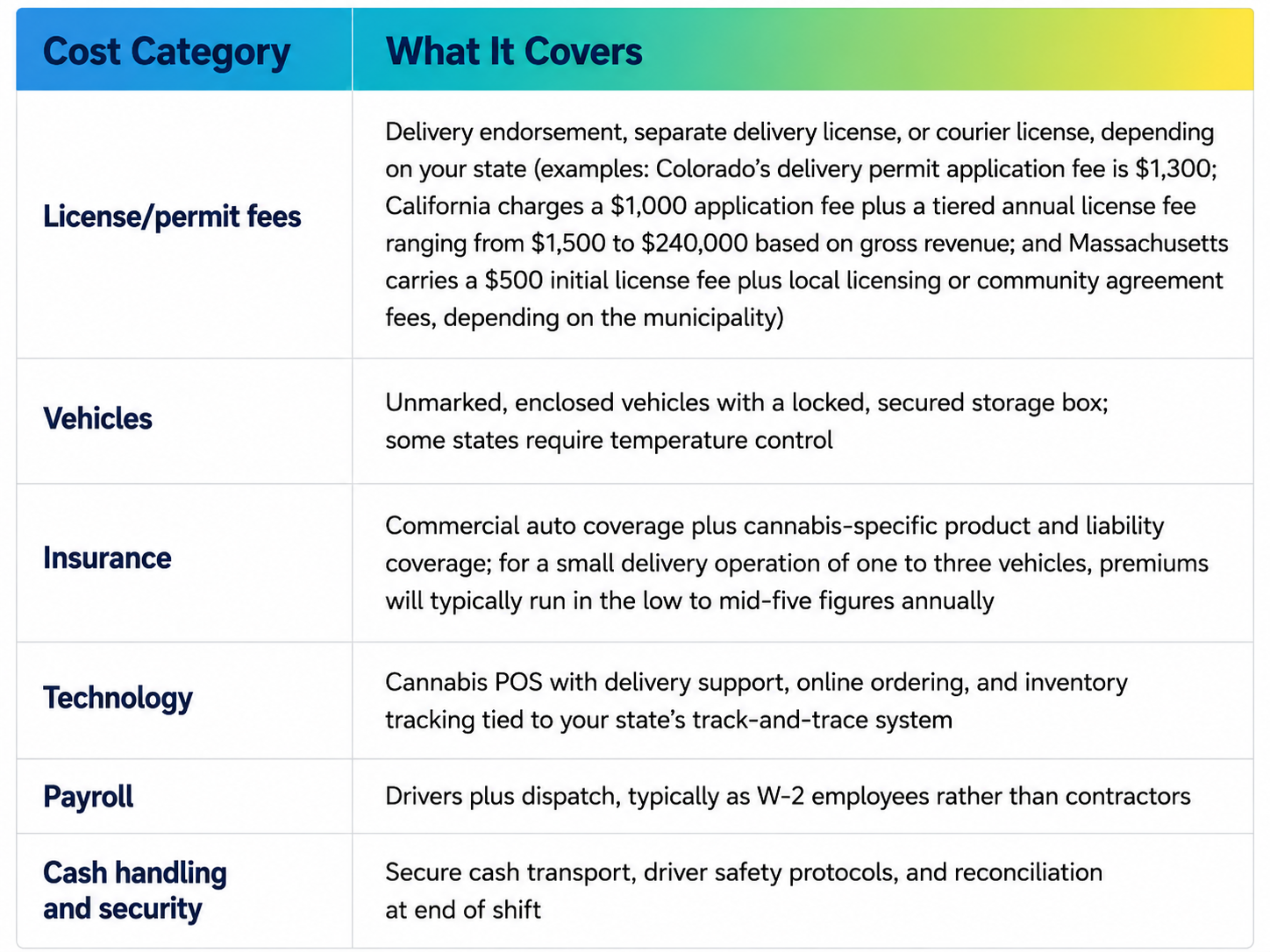
Many states that permit cannabis delivery cap the total retail value of product a single vehicle can carry at one time. California, for instance, now limits each licensed retailer’s delivery vehicle to $10,000 in cannabis goods at current retail prices, up from $5,000 under earlier rules. If you’re operating in California, you’ll want to confirm the latest figure with the Department of Cannabis Control before planning routes. That cap directly determines how many stops a driver can make before restocking and how many vehicles you need to support a given delivery volume, so it belongs in your cost model alongside licensing and payroll.
For a full breakdown of what it costs to open a cannabis retail store, separate from the delivery add-on costs above, see the true cost of opening a cannabis dispensary.
Location: Where Cannabis Delivery Works and Where It Does Not
State law decides whether you can start a cannabis delivery business; local density decides whether you should.
In the U.S., delivery is typically authorized in one of three ways: 1) as an activity under a standard retail license (for example, California’s Type 10 storefront retailer may deliver, and Type 9 non-storefront licenses are delivery only), 2) with dedicated delivery licenses or endorsements like Massachusetts’ Marijuana Courier and Delivery Operator licenses, and 3) only for medical patients in states that authorize medical but not adult-use delivery. You’ll want to confirm your state's licensing framework before budgeting further; this is covered in depth in our guide to the rules for starting a cannabis delivery business.
Even where state law allows delivery, local governments can restrict cannabis businesses’ physical location and, in some jurisdictions, delivery operations themselves. Municipalities in several states have used opt-out authority or zoning powers to bar retailers, narrow delivery zones, or add extra local permits, so a state license doesn’t guarantee you can operate everywhere in that state.
Additionally, legal approval doesn’t guarantee the numbers work. Population density within your permitted delivery radius, average drive times between stops, and competition from existing delivery services and the unregulated market all determine whether a route pencils out. A delivery-only, non-storefront model can lower your entry cost since you skip retail build-out, but it also gives up walk-in revenue and depends entirely on paid acquisition and online discovery to generate orders. That trade-off makes sense in some markets and not others, so model both before choosing a license type. More on how the major delivery models compare operationally is available in our guide to the cannabis delivery models landscape.
In Canada, delivery is regulated provincially rather than federally, and the rules differ by province. Ontario, British Columbia, and Alberta each set their own requirements for private-retailer delivery. Retailers evaluating delivery in any of these provinces should start with the province-specific guidance: Ontario, British Columbia, and Alberta.
Staffing a Cannabis Delivery Service
In many states, cannabis delivery drivers must be direct employees of the licensed retailer rather than gig-economy contractors. California codified this explicitly: state regulation bars delivery services from using independent contractors, and drivers must be at least 21 with a valid license. That requirement changes your payroll model substantially compared to a typical last-mile delivery business, since you're budgeting for W-2 wages and payroll tax rather than a per-delivery contractor rate.
Margins on cannabis delivery vary by state, license type, and route density, and three factors drive most of that variation:
- Your state's carry limit caps how much revenue a single vehicle can generate per route, regardless of demand.
- Employee payroll costs more than a contractor model would, since most legal markets require W-2 drivers rather than the gig-style courier arrangements common in other delivery businesses.
- Route density, the number of deliveries a driver completes per hour, is the lever operators actually control day to day.
Beyond drivers, a delivery program typically adds a dispatcher or delivery coordinator to manage routing once you're running more than one vehicle, staff to reconcile inventory and manifests for each route, and doorstep ID verification training, including refusal protocols for intoxicated or underage customers.
Delivery demand tends to skew toward evenings, weekends, and holidays, so scheduling usually needs a mix of full-time and part-time drivers rather than one fixed shift pattern. Cash-carrying drivers also introduce turnover and security considerations that in-store budtenders don't face. Robust dispensary scheduling software can help you model delivery staffing against your existing schedule.
Compliance and Technology: What a Cannabis Delivery Operation Needs
If you’re wanting to launch cannabis delivery at your store, understand that every state that permits cannabis delivery requires some combination of a real-time inventory ledger, transport manifests, doorstep ID verification, and compliant receipts tied back to your seed-to-sale system. That's the baseline cost of doing business, not optional overhead.
It's worth separating this into two layers, since they're often handled by different tools. The first layer is the point of sale: capturing the online order, deducting inventory in real time, and keeping your compliance ledger current as product leaves the building. The second layer is what happens inside the vehicle: dispatch, live routing, and fleet-level tracking once a driver is on the road. Cova handles the first layer natively as part of the eCommerce and inventory management workflow, keeping delivery orders on the same real-time ledger as everything else you sell. For the second layer, U.S. retailers typically pair Cova with a dedicated delivery-logistics partner like Carrot for dispatch and live vehicle tracking at scale. In Canada, lower-volume delivery programs can often run on Cova's built-in delivery workflow alone, while higher-volume retailers are usually better served pairing Cova with a partner like Breadstack, built for that scale of dispatch. For the deeper technical breakdown, see how to choose the best cannabis delivery software and mastering delivery driver logs and route compliance.
The Go/No-Go Cannabis Delivery Business Checklist
Considering a cannabis delivery business? Take a look at this checklist; if you answer yes to all six, you may be ready to move into execution planning.
- Is delivery legal in your state and local municipality?
- Have you identified the correct license path (existing retail license, separate delivery permit, or courier license)?
- Does a line-item startup budget, built from your own license, vehicle, insurance, and payroll costs, fit your available capital?
- Does your service-area density support route economics once you factor in your state's carry limit?
- Can you model payroll for compliant, employee-status drivers, including overtime and turnover?
- Have you priced the technology stack against your actual order volume, rather than switching POS platforms for a delivery feature you may not need? That trade-off can mean sacrificing compliance or reporting depth you already rely on, especially if your license doesn't allow delivery yet or your order volume doesn't justify the added cost.
At the end of the day, the primary decision factor is whether offering cannabis delivery will increase your bottom line. To determine this, you can do a simple margin vs. variable cost calculation. For example, the average cannabis retailer sees roughly 100 transactions a day. If delivery makes up 5% of your business and the average order size is $60, you’re looking at $9,000 in delivery revenue per month (5 x 60 x 30). If your gross margin is 40%, you can expect about $3,600 in gross profit after the cost of goods sold. From there, you’ll need to subtract the ongoing costs of running the deliveries: payroll, insurance, vehicle maintenance and fuel, tech, and any other overhead.
You also need to consider the implications of IRS Section 280E, which prohibits cannabis operators from deducting normal operating expenses for federal income tax purposes. As of July 2026, 280E still applies to adult-use cannabis operations; however, medical operators can now seek tax relief since certain cannabis activities have been moved to Schedule 3.
If you’re ready to move forward with planning, the execution details, licensing steps, software setup, and launch sequence are covered in our full guide to starting cannabis eCommerce delivery and how to launch a cannabis dispensary delivery service.
Cova's POS and eCommerce platform keeps delivery orders on the same real-time inventory and compliance ledger as your in-store sales, so you're not managing two systems to stay compliant. Book a demo to see how Cova supports delivery-ready retailers in both the U.S. and Canada.