

After nearly a decade of litigation, the U.S. Tax Court delivered its final verdict in 2018 – Harborside, a medical dispensary, would have to pay $11 million in back taxes for improperly claiming business deductions between 2007 and 2012. The court ruled that because Harborside’s primary activity was dealing in cannabis, a Schedule I substance, Section 280E of the tax code disallowed nearly every deduction, leaving them with only the literal Cost of Goods Sold (COGS) to offset their income.
The fact that a single cannabis tax decision nearly bankrupted one of the nation's most successful dispensaries is a good reminder that dispensary owners must take cannabis tax laws very seriously.
This guide provides a complete overview of the complex tax landscape, focused on dispensary operators – breaking down why cannabis taxation remains structurally different from traditional retail, how Section 280E impacts your bottom line, and the tax planning you need to do to keep records audit-ready.
Disclaimer: This page is meant to educate readers and spread awareness only – it has been fact-checked and is current as of January 27, 2026. It is not intended to be, nor should be considered legal advice. Given the evolving nature of cannabis tax, legal advice of any nature should be sought from legal counsel.
- Key Takeaways
- How Cannabis Tax Laws Differ From Other Retail Businesses
- Federal vs State Cannabis Taxes Explained
- What Is IRS Section 280E and Why It Matters
- How Business Structure Affects Cannabis Tax Liability
- States Allowing Cannabis Business Expense Deductions
- Cannabis Excise Tax vs Sales Tax: How Cannabis Taxes Vary by State
- Cannabis Tax Planning Tips for Dispensary Owners
- Common Cannabis Tax Mistakes New Dispensaries Make
- How To Prepare for a Cannabis Dispensary Tax Audit
- Frequently Asked Questions (FAQs)
- What Dispensary Owners Should Do Next
Key Takeaways
- Cannabis dispensaries are subject to overlapping federal and state tax regimes, with federal rules often driving the highest risk and liability.
- IRC §280E disallows most ordinary business deductions at the federal level, leaving Cost of Goods Sold (COGS) as the primary way to reduce taxable income.
- Cannabis business tax treatment varies widely, some states decouple from 280E and allow standard deductions, while others layer excise, wholesale, and sales taxes on top.
- Cannabis business owners can avoid costly IRS investigations through early planning, accurate inventory and COGS tracking, and audit-ready recordkeeping supported by purpose-built systems.
How Cannabis Tax Laws Differ From Other Retail Businesses
Most retail businesses are taxed on what they actually earn after operating costs. Cannabis dispensaries operate under a fundamentally different tax framework. Even when fully licensed and compliant at the state level, cannabis businesses are treated differently for tax purposes than virtually every other retail industry in the U.S.
In practice, cannabis’ illegality at the federal level results in three key tax implications for dispensary owners:
- Taxation on Gross Profit, Not Net Income: Cannabis businesses are taxed closer to gross profit rather than true net income. This means that many of the routine expenses that define retail operations (staffing, facilities, marketing, and day-to-day overhead) do not reduce federal taxable income in the same way they do for non-cannabis retailers.
- Taxation Without Profitability: Because tax liability for a dispensary does not account for expenses, a dispensary can still operate at a net loss and still owe substantial taxes.
- Cannabis Tax Stamping: Beyond the specific rates and unique tax code, many states/jurisdictions require cannabis businesses to have physical tax-paid stamps applied to product packaging.
- Layered State Obligations: State legality provides no shield from federal obligations. Operators must simultaneously manage state-level taxes, such as Michigan’s new 24% wholesale tax which took effect on January 1, 2026, on top of existing excise and sales taxes.
Editor’s Note: In December 2025, the Trump administration directed the Attorney General to fast-track the rescheduling of marijuana to Schedule III with an executive order. However, most policy analysts suggest that relief will only apply prospectively, meaning 2026 the 280E “penalty” would still apply to dispensaries and thus tax planning should be done accordingly.
Federal vs State Cannabis Taxes Explained
Like most retail businesses, cannabis dispensaries pay both federal and state taxes, even though cannabis is illegal at the federal level. State legalization does not exempt a business from IRS taxation. State taxes stack on top of federal taxes with states imposing their own income taxes, general sales taxes, and often, a cannabis sales tax.
As a general rule of thumb, federal tax is primarily about personal/business income while state cannabis taxes are about revenue at the point of sale. As a result, state compliance does not typically reduce or offset federal exposure.
In other words, the answer to “how do dispensaries pay federal taxes?” is: they pay on gross profit, with 280E cost of goods sold being the only allowed buffer.
What Is IRS Section 280E and Why It Matters
Every U.S. business – cannabis or not – faces federal income tax, state-level income tax, sales, and excise taxes where applicable. Cannabis is unique because how taxable income is calculated at the federal level is distorted by IRC §280E.
Section 280E of the IRS’ code prohibits businesses associated with trafficking Schedule I or II substances from deducting normal business expenses from their taxable income. Since cannabis is still listed as a Schedule I substance at the federal level, this means that legitimate, state-approved, legally-licensed cannabis businesses are subject to 280E.
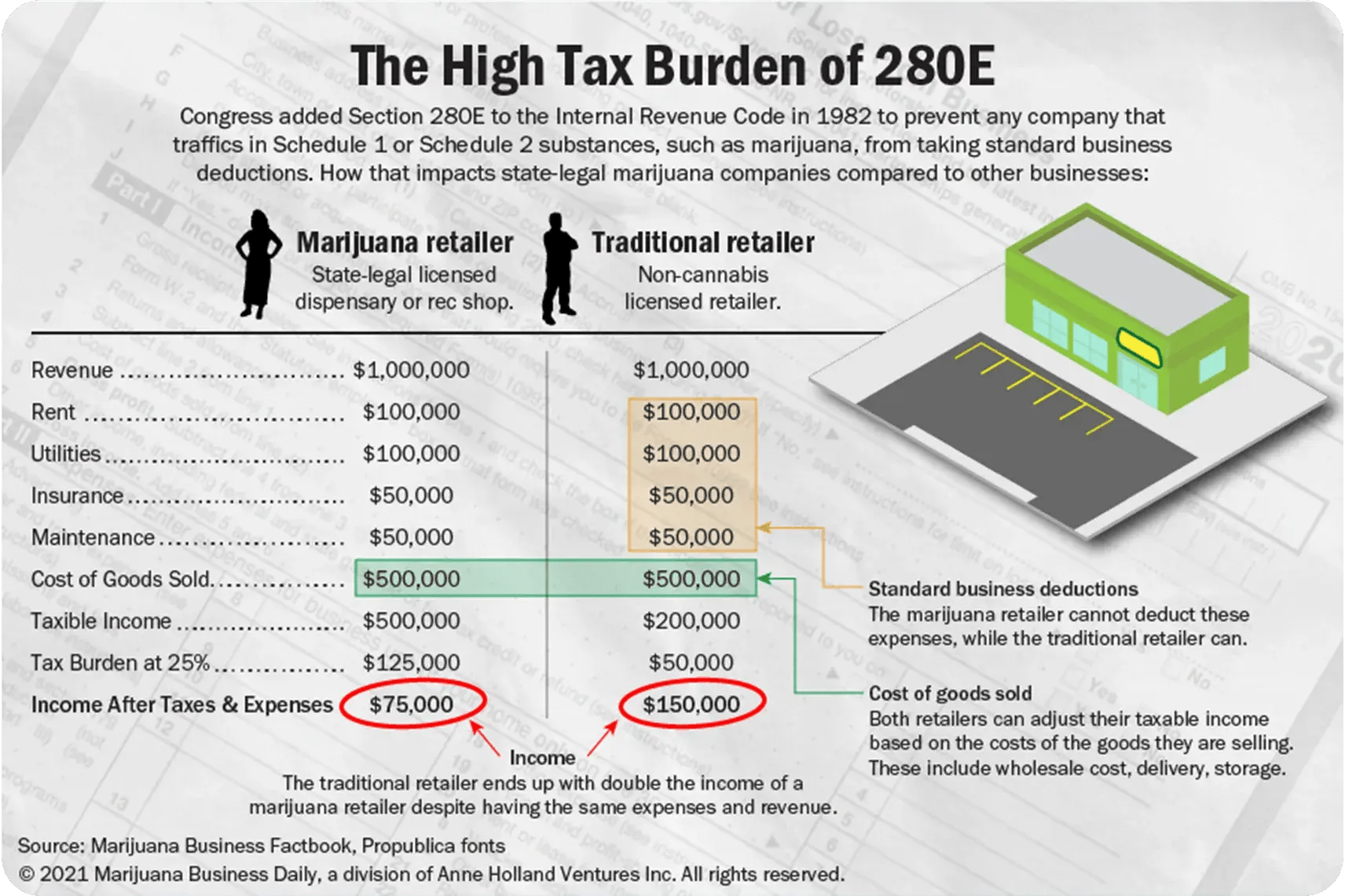
IRS Section 280E Explained for Cannabis Companies | Source
Stay on top of your tax situation by using this 280E tax compliance checklist for cannabis businesses to ensure you are not improperly deducting the following non-allowable expenses:
- Employee payroll (wages for retail and administrative staff) & benefits (health insurance, 401k, etc.)
- Rent for retail storefronts or office space
- Utilities (electricity, water, heating for the dispensary)
- Marketing and advertising (social media, billboards, local ads)
- Facility repairs and general maintenance
- General administrative overhead
- Professional services (non-inventory related legal or consulting fees)
- Standard business credits (e.g., R&D or Work Opportunity Tax Credits)
- Bonus or accelerated depreciation (only straight-line depreciation in COGS is typically allowed)
- Travel, meals, entertainment, and education expenses
How Business Structure Affects Cannabis Tax Liability
How and where taxes are paid also depends on the dispensary’s entity structure. Some taxes are paid at the business level, some at the owner level, and in certain cases both. While a full comparison of entity types is beyond the scope of this article, here is a brief breakdown of the basic tax framework:
Sole proprietorships and general partnerships are both only taxed at the owner level. They are not suitable for dispensary operations because they lack personal liability protections – exposing owners to regulatory violations, lawsuits, and debts.
Pass-through entities such as LLCs, partnerships, and S corporations generally do not pay federal income tax themselves – instead, profits are allocated to owners and reported on their personal tax returns.
C corporations operate differently – the corporation itself pays federal income tax on its profits, and owners are taxed separately only if profits are distributed to them.
Regardless of entity type, all dispensaries still face the 280E issue and must plan their taxes accordingly.
States Allowing Cannabis Business Expense Deductions
The good news is that many states recognize the burden that federal tax poses on their legal markets and have thus “decoupled” their state tax codes from this federal rule. Starting with Colorado in 2014, there are now 24 states and jurisdictions that allow cannabis dispensaries and businesses to deduct business expenses at the state level.
States and Jurisdictions Decoupled from Federal Tax Code (as of Jan 2026)
- Arkansas
- California
- Colorado
- Connecticut
- Delaware
- Hawaii
- Illinois
- Louisiana
- Maine
- Maryland
- Massachusetts
- Michigan
- Minnesota
- Mississippi
- Missouri
- Montana
- New Jersey
- New Mexico
- New York
- Oregon
- Pennsylvania
- Vermont
- Virginia
- Washington D.C.
Editor’s Note: Some states, like Pennsylvania, primarily apply these deductions to corporate or medical cannabis income specifically. Check local statutes for entity-specific nuances.
Cannabis Excise Tax vs Sales Tax: How Cannabis Taxes Vary by State
Almost all consumer goods have a sales tax, usually between 4% and 9%. However, a cannabis excise tax is unique to the sale of cannabis products. Comparing cannabis excise tax vs sales tax, the difference is significant with the former as high as 37% (in Washington). Often called a “sin tax”, the excise tax is justified as a means to offset negative effects of cannabis – used for causes ranging from school construction in Colorado to social equity and "economic repair" programs in states like New York and Illinois, which aim to support communities historically impacted by drug enforcement.
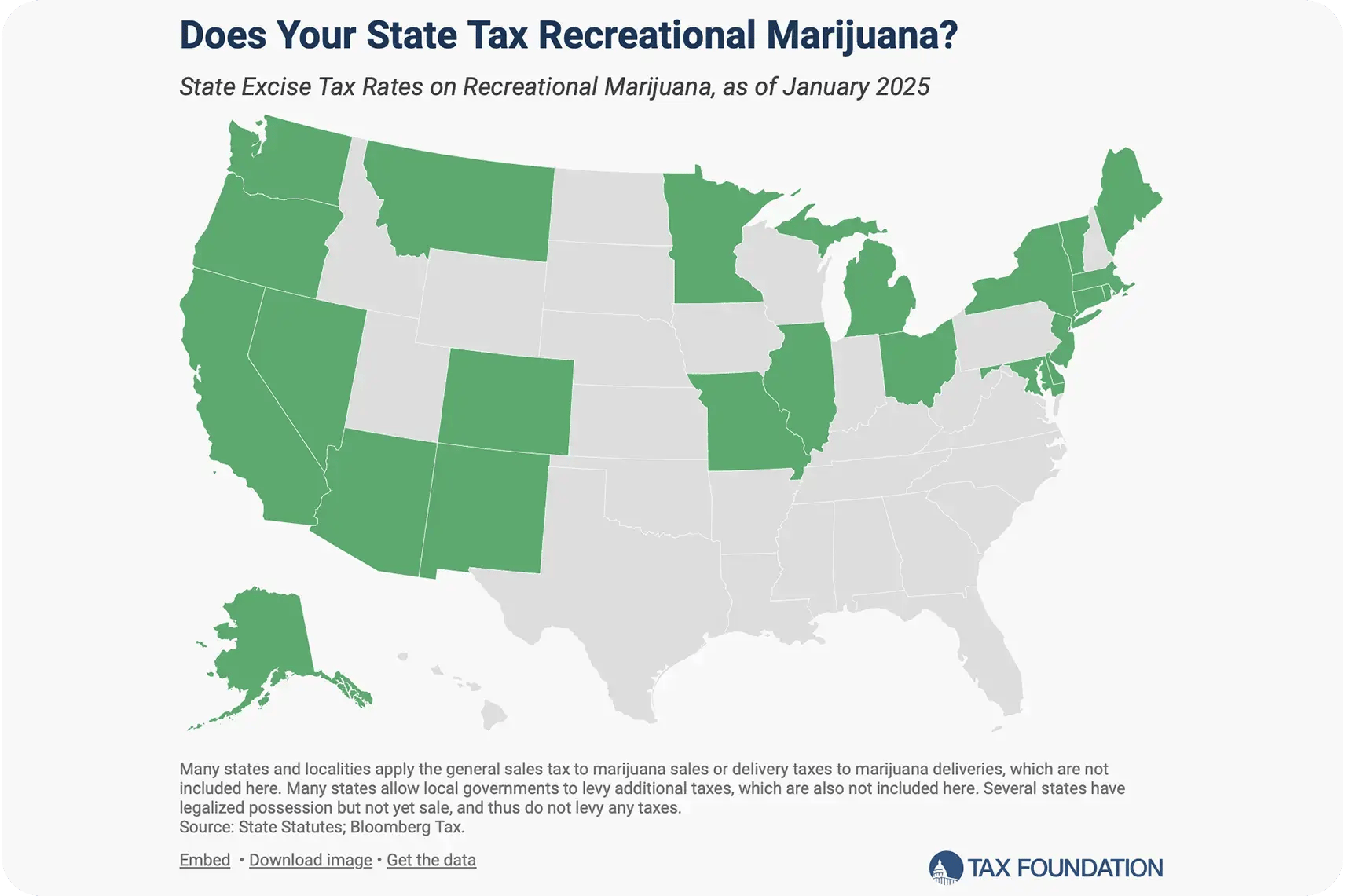
Most states levy cannabis excise tax as a percentage of price but some states like Connecticut and Alaska also have a weight/potency-based tax type. As of January 2026, 24 states in the US have a cannabis excise tax.
Cannabis Tax Rates by State
Cannabis Tax Planning Tips for Dispensary Owners
Tax liability for a dispensary is not dictated by end-of-year profit and thus planning must begin early and in earnest. In fact, the tax season for cannabis businesses should never really end. Each quarter, you need to make estimated tax payments and the only way you’ll be able to do that with any accuracy is if your bookkeeping is up to par all year long.
- Establish separate business entities: In some cases, dispensary owners can form legally distinct businesses that provide services unrelated to the sale or distribution of cannabis, such as education, IP licensing, or management services. That said, these entities must have independent operations, separate books, arm’s-length agreements, and clear economic substance.
- Implement specialized cannabis ERPs: Generic bookkeeping tools often fail to track COGS, inventory, and tax exposure with the precision cannabis requires. For example, Canix is an ERP software solution specifically designed for cannabis cost accounting and it can seamlessly integrate with your cannabis POS. Speaking of…
- Rely on POS systems: A good retail cannabis point of sale system will record the required taxes collected at each purchase, incorporating tax accounting into your employee’s normal workflow. Modern POS systems like Cova have a variety of quality of life features such as custom tax rules, tax-inclusive pricing, and custom workflows that can help relieve some of the manual burden for budtenders.
- Maintain digital record-keeping: Utilize technology to instantly scan and store every receipt, invoice, and expense throughout the year to avoid the "pristine" bookkeeping failures common in manual audits – creating a defensible transaction trail and covering the worst case scenarios.
Common Cannabis Tax Mistakes New Dispensaries Make
Even with a solid plan, navigating the unique tax challenges cannabis businesses face is difficult, and the cost of mistakes is very high. Common tax filing mistakes for cannabis startups can result in massive penalties or even bankruptcy.
It’s much cheaper and easier to learn from other dispensaries’ mistakes, mistakes like:
- Not hiring a specialized cannabis CPA: Avoid the “DIY” tax trap of filing own taxes or by hiring a generalist CPA. Cannabis taxation, especially Section 280E, requires industry-specific expertise. A CPA without cannabis experience may improperly claim standard business deductions, creating serious audit and penalty risk.
- Not making estimated tax payments: Many operators wait until the end of the fiscal year to address their liability. This can compound discrepancies resulting in minor offenses snowballing into massive underpayment penalties.
- Not understanding state taxes: Operators in “decoupled” states often assume all standard deductions are allowed. In reality, state-level deductions come with strict limitations that vary by entity type and activity. Never take deductions without confirming eligibility with a CPA familiar with that state’s cannabis tax code.
- Not maintaining meticulous labor logs: Closely track employee hours and specific tasks, particularly when staff split time between the retail shop and a secondary entity that does not involve direct cannabis operations.
- Not organizing expenses: Never wait for "tax season" to organize expenses. Scan, categorize, and digitally store every receipt and invoice as you operate to avoid the record-keeping failures that invite audit scrutiny.
How To Prepare for a Cannabis Dispensary Tax Audit
To prepare for a cannabis dispensary tax audit, start by treating documentation as a daily operational task rather than a year-end exercise. Dispensaries face a higher frequency of tax audits than traditional retailers due to Section 280E complexities and heavy cash handling. Operators who record every transaction, inventory movement, and COGS allocation in real time rather than reconstructing records after a notice arrives put themselves in the strongest position.
Additionally, IRS auditors operate under established and published guidelines. By following this tax audit checklist for new cannabis dispensary owners, operators can stay one step ahead and have a strong position during an audit.
- Record and retain all financial records, including cash logs and transaction data, for at least ten years (or for the lifetime of your business) to ensure every general ledger entry is verifiable.
- Use GAAP-compliant accounting methods, including accrual accounting and accurate inventory costing tied directly to COGS.
- Apply only straight-line depreciation in COGS and exclude bonus depreciation or accelerated methods.
- Prioritize the timely payment of federal employment taxes to avoid 100% personal liability penalties imposed on responsible business officers.
- Work with experienced cannabis accountants to document tax positions, conduct 280E/COGS studies, and fix compliance gaps early.
- Respond immediately to any IRS audit notice and authorize qualified professionals to manage communications and document production.
- If audit results are not in your favor, pursue appeals through the IRS Independent Office of Appeals before considering costly Tax Court litigation.
Frequently Asked Questions (FAQs)
How do dispensaries pay federal taxes?
Dispensaries file federal tax returns using the same process as any other business and standard forms like Form 1120 or 1065. The main difference is that they face a significantly higher effective tax rate due to Section 280E which prohibits dispensaries from deducting ordinary business expenses.
Does Section 280E apply if cannabis is legal in my state?
Yes, because federal tax law is independent of state law. Even if your state has fully legalized and regulated cannabis, the IRS continues to enforce Section 280E at the federal level as long as cannabis remains a Schedule I or II controlled substance.
What expenses can a cannabis business deduct under 280E?
Under Section 280E, the only allowable deduction is the Cost of Goods Sold (COGS), which includes the direct costs of buying or producing inventory. Common operating expenses such as rent, marketing, utilities, and administrative payroll are strictly non-deductible for federal tax purposes.
Why do state cannabis tax structures vary?
States exercise their own sovereign authority to regulate and tax commerce within their borders, leading to differences in tax structures across state lines. Some states tax cannabis based on its weight/potency, while others use a percentage of the retail price, reflecting different local priorities like social equity funding or public health initiatives.
Can a cannabis dispensary get federal tax credits or deductions?
Generally, no. Most federal business credits (such as the R&D credit or Work Opportunity Tax Credit) and standard deductions are disallowed by Section 280E. However, some states like California, New York, and Massachusetts, among others, have "decoupled" their tax codes from federal law, allowing these businesses to claim certain credits or deductions on their state tax returns.
Will IRS or tax audits treat cannabis businesses differently?
Cannabis businesses do experience a higher frequency of audits and more intense scrutiny because of the complexities surrounding Section 280E and the heavy reliance on cash in the industry.
What happens if cannabis is rescheduled federally?
If cannabis is moved to Schedule III (a process currently in the works as of early 2026), Section 280E would no longer apply. This would mean dispensaries can deduct normal business expenses like any other company, though the exact timing and potential retroactivity of this change is only speculation at the moment.
If cannabis is moved to Schedule III (a process currently in the works as of early 2026), Section 280E would no longer apply. This would mean dispensaries can deduct normal business expenses like any other company, though the exact timing and potential retroactivity of this change is only speculation at the moment.
Are there states that allow more deductions despite 280E?
Yes, 24 states have passed laws to "decouple" from Section 280E. In these states, cannabis businesses can deduct ordinary business expenses on their state income tax returns, even while they remain prohibited from doing so on their federal returns.
What Dispensary Owners Should Do Next
Unique federal vs state tax laws for cannabis, Section 280E, IRS scrutiny & audits – all of those things combined can make running a cannabis business look like an uphill battle but there’s another side too.
Rescheduling on the horizon, a growing number of lawmakers realize the importance of marijuana as a product, and the industry has proved its worth and resilience – generating $25 billion in adult-use tax revenue since legalization began.
For dispensary owners, that means now is the time to position your cannabis business for a future where federal reform, banking access, and normalized tax treatment could unlock new growth. If you’re an existing cannabis business or one about to start, you have every reason to up your retail game – starting with providing a seamless and reliable shopping experience.
With over two decades of experience working with countless cannabis dispensary owners across North America, Cova dispensary POS systems offer secure, fast, and compliant payment processing for cannabis businesses.
Schedule your COVA Software Dispensary POS Demo today. Our team of experts will help you understand the capabilities of our award-winning POS system and how it can meet (and exceed) your business’s unique needs.