

Choosing the best dispensary POS system – and the technology, support, and innovation that come with it – locks you into an ecosystem for years. Switching can be expensive enough that most operators treat the decision as a five-year commitment.
Over the past decade, the cannabis POS market has consolidated around five platforms – BLAZE, Cova, Dutchie, Flowhub and Treez – each with its own set of pros and cons. Some systems prioritize reliability and customer support while others field an expansive lineup of supporting products.
This guide provides a complete and objective comparison of the best cannabis POS systems – where each vendor leads, where it falls short, and where it won’t say.
Transparency Disclaimer: Cova publishes this comparison and is one of the five systems evaluated here but each vendor was evaluated on the same criteria – compliance and reporting, reliability and speed, ecommerce, payments, ease of use and support, pricing transparency and markets served. This guide is based on publicly available information as of October 2026.
What Are the Best Cannabis POS Systems in 2026?
Five systems account for the bulk of licensed dispensary POS installations in North America: BLAZE, Cova, Dutchie, Flowhub and Treez. Every single cannabis POS has its USPs and differentiators but none leads in every area, so the best POS system for a dispensary depends on its state and how it sells.
Some are full retail stacks while some grew out of online ordering or payments. One entered the POS market in 2022; others have processed dispensary transactions for a decade. What they share is multi-state reach and cannabis-specific compliance (something generic POS systems can’t claim).
By judging these vendors on seven key retail areas (including reliability, markets, ecommerce, payments, and support), we’ve highlighted what each vendor prioritizes for their users and the trade-offs they may have to make.
How Were These Dispensary POS Systems Compared?
We evaluated how top-rated dispensary POS systems perform across seven key areas, using publicly available data from each vendor's own website, its G2 product page, and recent coverage from reputable third-party sources like Cannabiz Media’s Point-of-Sale Software in the Cannabis Industry report. This comparison is current as of October 2026.
The seven comparison points and how we judged each dispensary software:
- Compliance and reporting: 2-way Metrc and BioTrack integration, ID verification, purchase-limit enforcement, and built-in sales, inventory and compliance reports
- Reliability and speed: the most reliable track record based on uptime, offline mode and peak-day performance, particularly on high-volume days like 4/20, plus checkout speed and reported glitches, bugs and slowdowns
- Ecommerce: native online ordering, integration with websites, online menus, and delivery and pickup
- Payments: integrated processing, accepted methods, rates, and additional features like gift cards
- Ease of use and support: how quickly a new store can be set up and new staff trained, response times, availability, and human vs AI support
- Pricing transparency: whether the vendor publishes a starting price on its website
- Markets served: ease of cross-border operations, support for states, provinces, and license types
Readers who need weighted scoring and demo checklists should start with the guide on how to evaluate a dispensary POS. For state-level traceability requirements, see Metrc integration.
Cannabis Dispensary POS Comparison: How Do the Top Five Systems Stack Up?
Compliance features like Metrc integration, ID scanning, purchase limits, and basic inventory tracking are mandated by most states and are thus standard across most top-rated cannabis POS systems.
Differences start to show up in pricing transparency, geographic reach, and how each vendor delivers ecommerce, payments and support. No system leads on every row, so the cannabis POS with the best features for your store is the one that leads on the rows you need.
The table is current as of October 2026. Apart from these differences, all five systems offer:
- Metrc integration for state traceability reporting
- ecommerce capabilities (native or add-on)
- a branded payment processing service
- loyalty and marketing tools
- cannabis-specific compliance automation, including ID verification and purchase-limit enforcement.
Cova is the only vendor of the five to publish a starting price on its website, while the rest quote pricing on request. Full plan details are on Cova's published pricing page. Flowhub and Treez have far fewer G2 reviews than competitors.
What Are the Pros and Cons of the Top Dispensary POS Systems?
BLAZE, Cova, Dutchie, Flowhub and Treez are North America’s top dispensary POS systems by market share. Each can run a compliant dispensary but no single POS leads in every category. Each vendor has made trade-offs – in pricing, payments, reliability, and where they operate.
The following breakdown looks at each platform – what it does well, where it falls short, and what it costs.
Editor’s Note: The strengths and trade-offs below come from each vendor’s published documentation, G2, and third-party coverage in October 2026.
BLAZE
BLAZE describes itself as an AI-powered cannabis retail platform, offering a full retail stack under one brand. Its current product line-up includes a Retail POS, BLAZEPAY, and an ecommerce suite (which includes delivery, online menus, and a website builder).
The company built its product range through a mix of internal development and acquisitions: Greenline in May 2022 for the Canadian market and Tymber in January 2023 for ecommerce. BLAZE claims 15 days to launch on average, and its website states 88-second support ticket response times and 99% customer satisfaction.
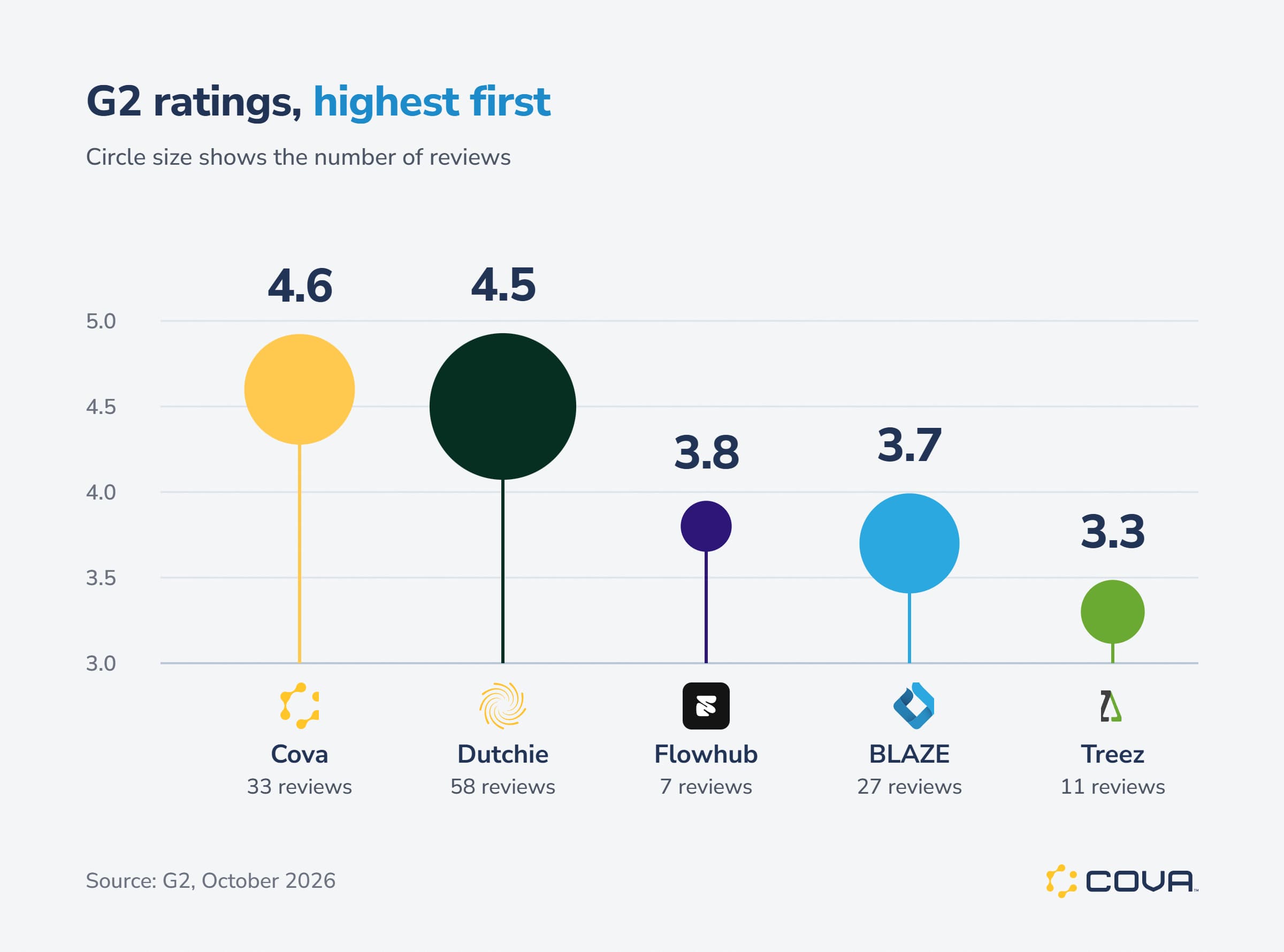
The all-in-one model is its main selling point but it also means being fully dependent on one vendor for every layer of the operation. BLAZE does not publish pricing, and its G2 rating is 3.7 from 27 reviews.
Best for: Operators who want POS, online ordering, delivery dispatch, a driver app and a website builder from a single AI-powered platform, without relying on third-party tools for core retail operations.
Strengths:
- Full product suite from POS through delivery – no third-party platforms required for core ecommerce and logistics
- Metrc and BioTrack integration for medical and adult-use
- Hardware agnostic: iPad or Windows
Watch-outs:
- No published pricing
- 3.7 G2 rating from 27 reviews (October 2026)
Pricing: Quote on request.
Cova
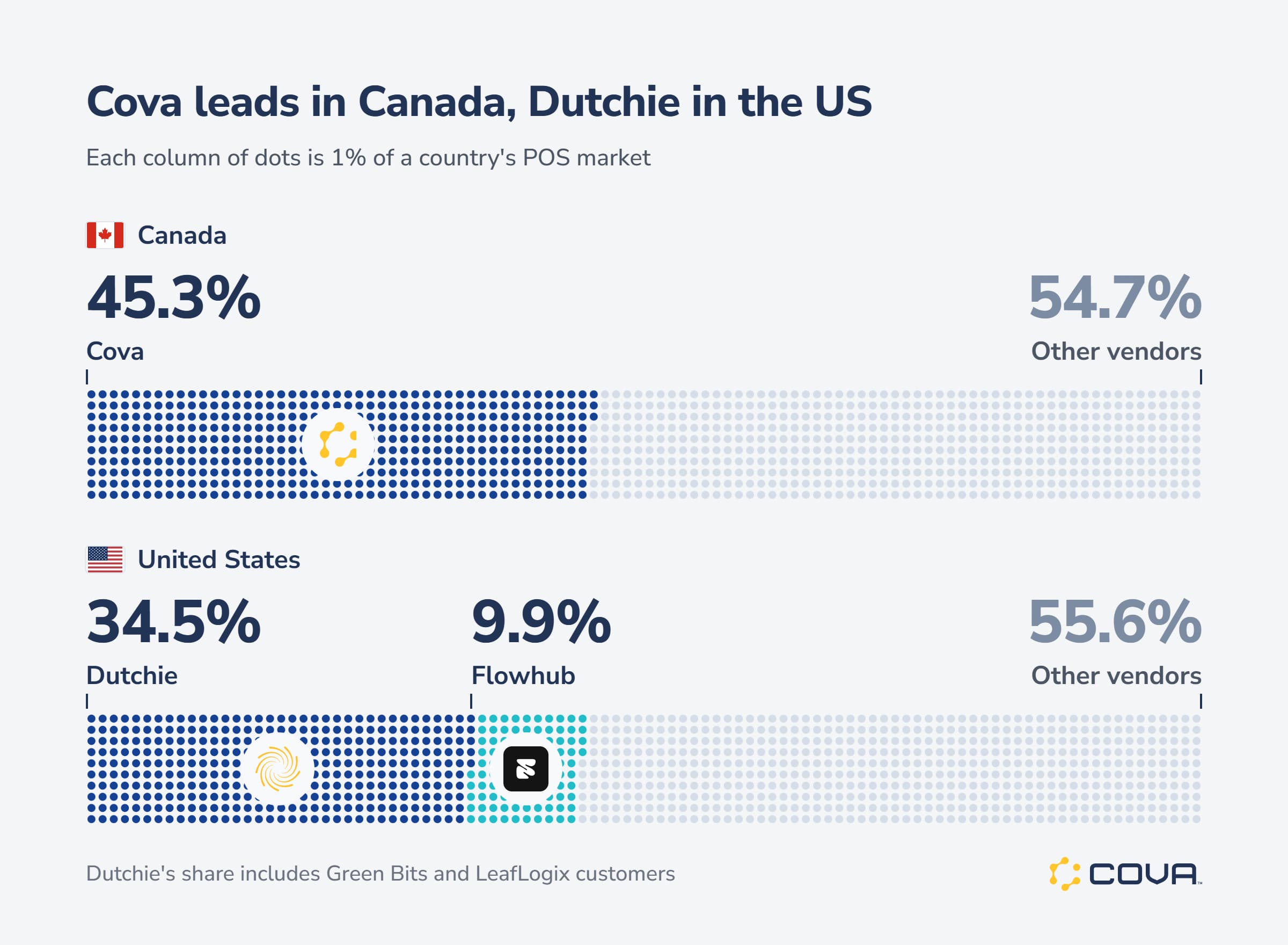
Cova’s cannabis POS system stands apart from many top-rated POS systems by prioritizing reliability and support. It holds the largest share (45.3%) of the cannabis POS market in Canada and the POS is designed around supporting market expansion and growing dispensaries to multiple stores, serving:
- single-location stores and enterprise retailers managing 200+ locations across multiple brands
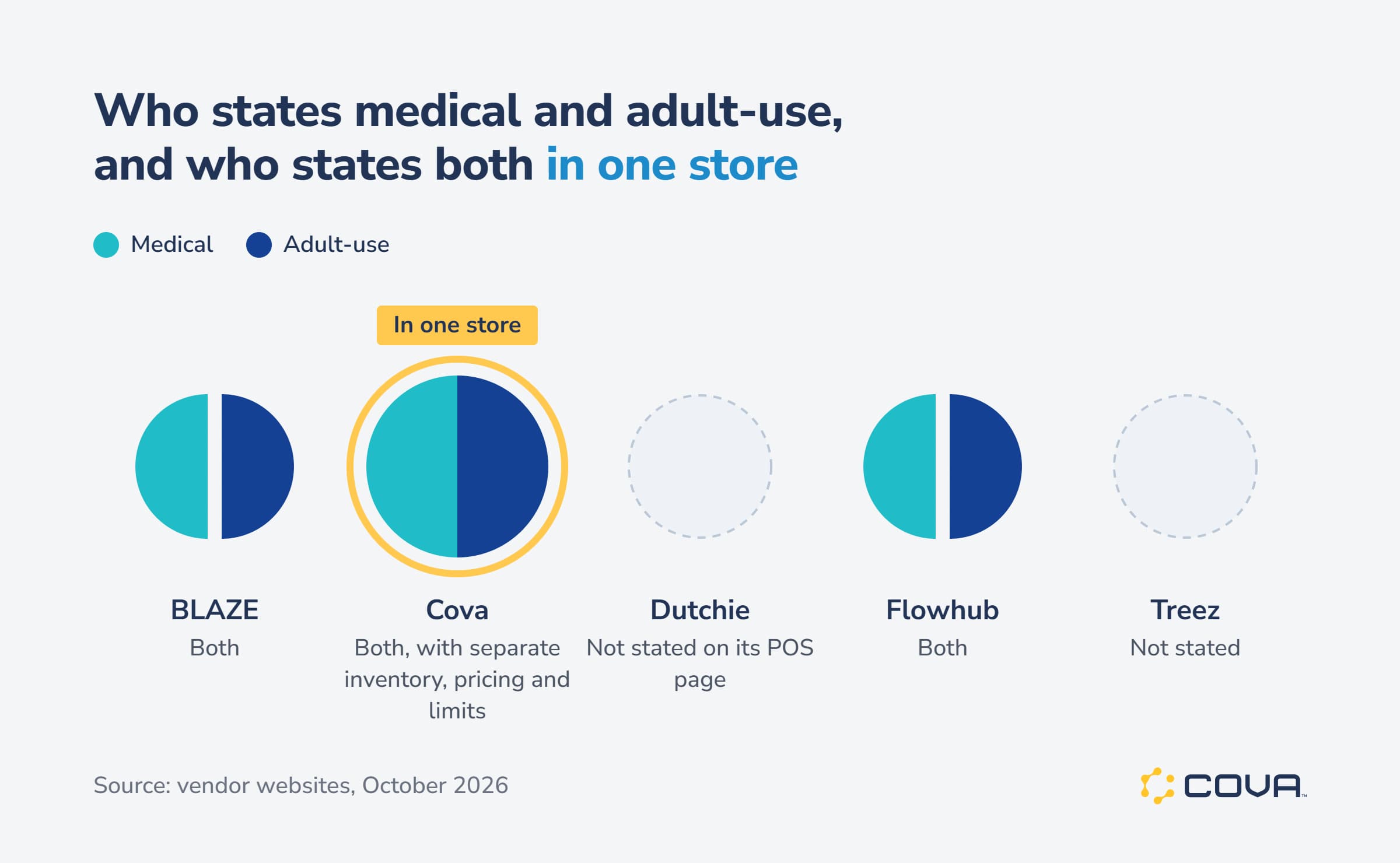
- retailers in dual-license states, with separate inventory, pricing and purchase limits in the same store
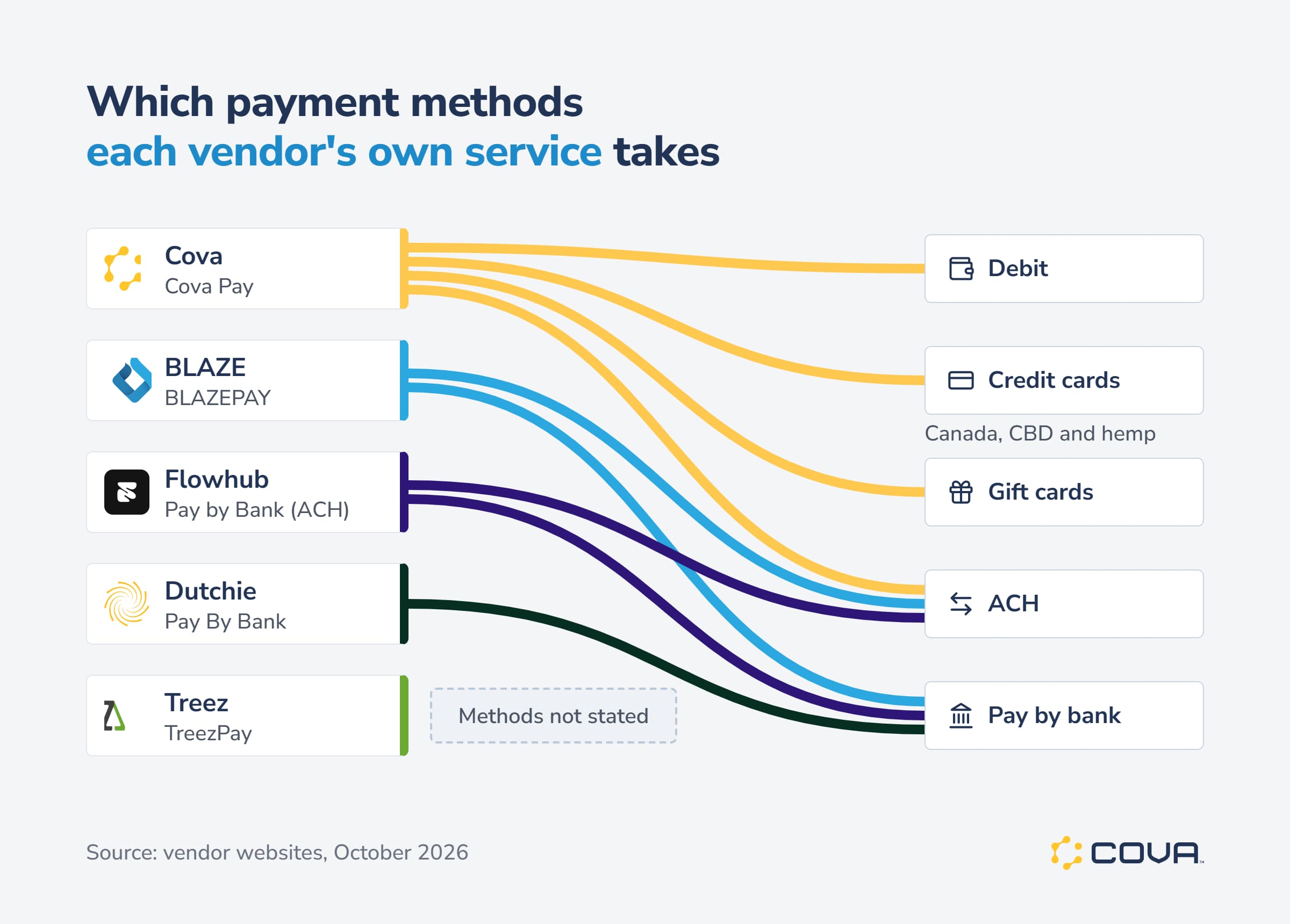
For enterprise retailers, Cova completes an annual SOC 2 compliance audit with A-LIGN. It’s also transparent – being the only one of the five with published pricing. Cova pricing starts at $349 a month with Cova Pay, which handles:
- debit and ACH in the US
- credit cards in Canada
- credit card processing for CBD and hemp retailers
- branded gift cards built into the POS
Cova's open API connects to ERP systems and enterprise tools, and for AI integration, it offers an MCP connector that lets retailers plug their own AI assistants into their POS data, so the assistants can analyze that data and make changes in Cova on request.
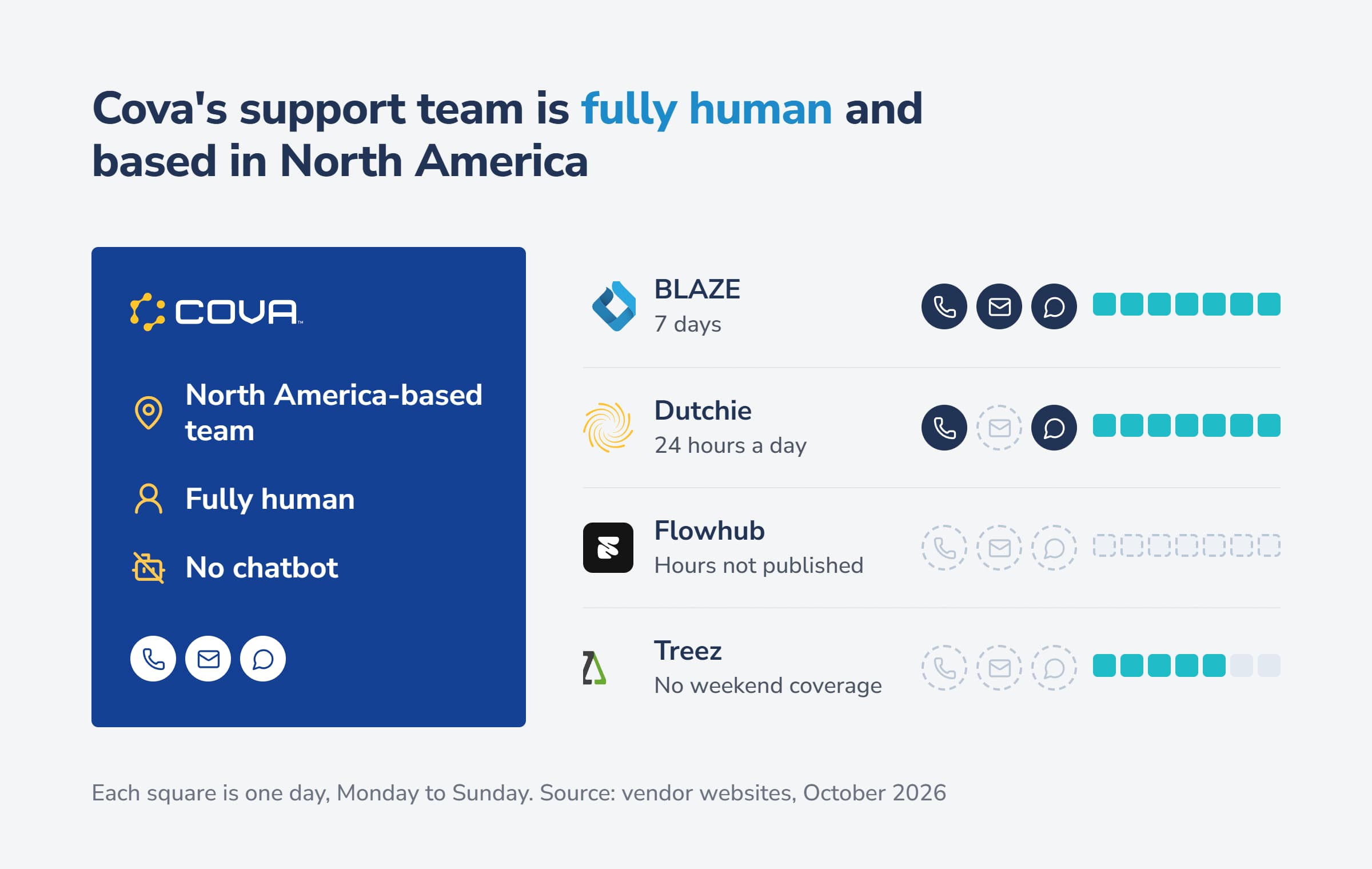
The one place Cova doesn’t use AI is its own customer support. Cova’s fully human, North America-based customer support team is available seven days a week by phone, email and chat at no extra charge.
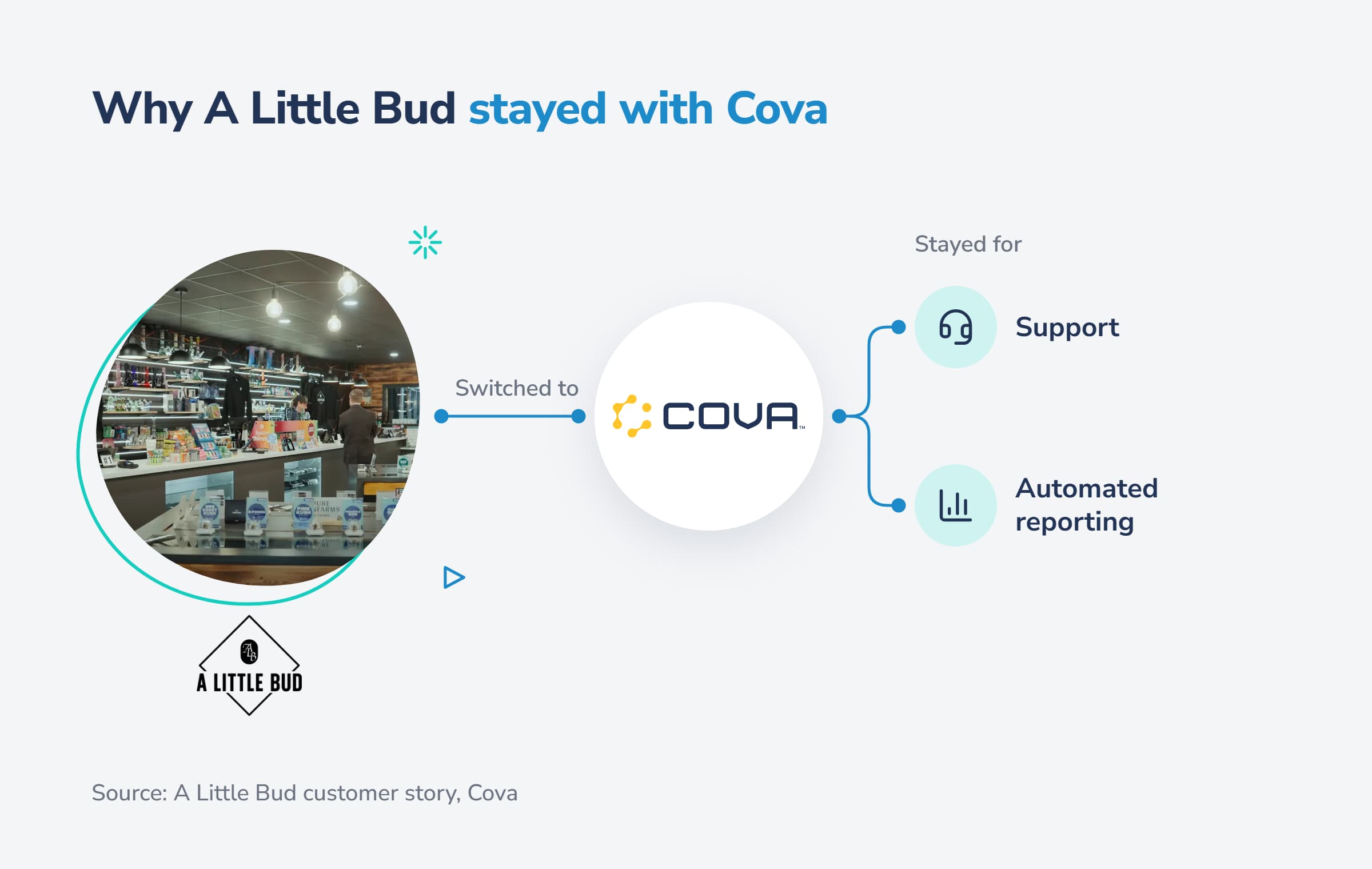
For a closer look at how one retailer made the switch, see the A Little Bud customer story.
Best for: Growing single-store and multi-location dispensaries – including hemp and CBD retailers – that want a POS new stores and new staff can learn quickly, built-in reporting, peak-day reliability, fully human customer support, transparent pricing and an AI connector that can analyze store data and make changes on request.
Strengths:
- 100% uptime on 4/20 for nine consecutive years, and an offline mode that keeps it working through internet outages
- Compliance automated for staff and the back office – ID scanning, purchase limits and legal sale hours are enforced at checkout, and sales and inventory adjustments are sent to Metrc or BioTrack automatically, across medical and adult-use in the same store
- Built-in reporting with real-time and custom reports, mobile dashboards, scheduled reports, and filters by company, region, store or employee
- Phone, email and chat support seven days a week at no extra charge – phone waits under 30 seconds, 80% first-call resolution
- Built-in loyalty tools for smaller operations; partner integrations with Springbig, Alpine IQ and Carrot for larger retailers
Watch-outs:
- Serves 2,200+ dispensaries across single-location and enterprise retailers in 23 US states and 6 Canadian provinces – does not cover every US market
- Cova eCommerce is a paid add-on, starting from $149/month (bundle pricing available) – advanced delivery runs through partner platforms
Pricing: From $349/month with Cova Pay. See the states and provinces Cova serves.
Dutchie
Dutchie is the newest POS on this list, having started as an online ordering platform in 2017 and only shipping a full POS in 2022. 6,500+ dispensaries use some component of their platform in 40+ markets across North America. Dutchie’s POS page does not describe how dual-license inventory and limits are handled in the same store.
Peak-day reliability has been a weak point: on 4/20 2023, Dutchie's ecommerce platform went down after cascading failures, and the company offered affected retailers a payment for estimated lost profits.
On 4/20 2024, Dutchie reported that fewer than 20% of customers experienced serious issues. No 4/20 incident for 2025 or 2026 appears in news coverage.
Best for: Ecommerce-led and multi-state operators who need the largest stated dispensary footprint in North America, with AI-powered tools at the register and a branded mobile app alongside the core POS.
Strengths:
- Dispensaries in 40+ markets
- E-Commerce Pro (August 2025) adds a deeper online ordering layer on top of the existing platform
- Metrc and BioTrack integration with multi-location management tools
Watch-outs:
- No published pricing
- 4/20 outage history: cascading failures in 2023, partial issues for under 20% of customers in 2024. No reported incidents for 2025 or 2026
- Dutchie’s platform is built around its own product suite. Some retailers have found that third-party integrations outside Dutchie’s ecosystem are more limited compared to vendors with published open APIs
- Dutchie reduced its workforce in 2022, reported by MJBizDaily. Workforce reductions at a POS vendor can affect the product roadmap and support capacity.
Pricing: Quote on request.
Flowhub
Flowhub describes itself as an agentic commerce platform built from the ground up. The platform serves 1,000+ dispensaries across 30+ US states although its POS page does not describe dual-license handling in the same detail as some competitors.
Flowhub claims migrations as quickly as 9 days, and none of the Flowhub competitors compared here states a faster go-live. It also states 99.99% uptime and that its workflows run 3x faster than alternatives, with checkout averaging 20 seconds.
The platform offers native Ecommerce (launched July 2025), a Marketing Suite with a loyalty program and wallet passes, and the View mobile analytics app. Flowhub also lists 100+ integrations and launched an MCP Connector for AI assistants on 1 July 2026.
Best for: Operators who want fast onboarding, native ecommerce and a built-in marketing suite with loyalty and wallet passes.
Strengths:
- Onboarding in under two weeks on average
- Built-in Marketing Suite with a loyalty program and wallet passes
- Native Ecommerce since July 2025 with Metrc and BioTrack integration
Watch-outs:
- No published pricing; support hours not stated
- 4/20 2021 outage attributed to a third-party authentication provider
- 3.8 G2 rating from 7 reviews (October 2026) – limited review volume
Pricing: Quote on request.
Treez
Treez takes a different approach to pricing – one plan that includes everything: unlimited registers, unlimited employees, API access, analytics, and support. Treez Ecommerce (launched April 2024) runs on the retailer's own website – keeping traffic and SEO in-house rather than routing orders through a third-party domain. TreezPay handles payments, and Treez Loyalty (launched August 2025) added a digital wallet.
As of October 2026, Treez operates in only 15 US states with no word on support for medical-use cannabis or dual-license stores.
The all-inclusive model is meant to simplify the cost structure for enterprise retailers and Treez is unique in assigning a customer success manager to each POS client. But it only offers customer support Monday to Friday from 7 am to 6 pm Pacific with no weekend or after-hours coverage.
Best for: Enterprise retailers in Treez's 15 states who want a single all-inclusive plan with unlimited registers and employees, a dedicated customer success manager and ecommerce on their own domain.
Strengths:
- One plan with unlimited registers and employees – no per-register fees
- Ecommerce on the retailer's own website, keeping traffic and SEO in-house
- Dedicated customer success manager for each POS client
Watch-outs:
- 3.3 G2 rating from 11 reviews (October 2026)
- Available in 15 US states only (Arizona, California, Colorado, Illinois, Maine, Massachusetts, Michigan, Minnesota, Mississippi, Missouri, Nevada, New Jersey, New York, Texas, Maryland)
- Support Monday to Friday, 7 am – 6 pm Pacific – no weekend or after-hours coverage
- BioTrack not named on Treez's pages; confirm compatibility if your state uses BioTrack
Pricing: Quote on request (one all-inclusive plan).
How Do Cova vs Dutchie, Dutchie vs Flowhub and Treez vs Dutchie Compare?
When shortlisting POS systems, you’ll inevitably pit these pairs against each other. The differences between Cova vs Dutchie, Dutchie vs Flowhub, and Treez vs Dutchie come down to pricing transparency, scale, ecommerce depth and peak-day record.
The following comparisons put these systems head-to-head. For Cova and Flowhub, see the Cova vs Flowhub comparison.
Cova vs Dutchie
This comparison comes down to pricing transparency, focus on support and reliability, and markets served. Cova publishes a starting price ($349/month) while Dutchie quotes on request. Cova serves 2,200+ dispensaries in 23 US states and 6 Canadian provinces while Dutchie claims support for 40+ markets but does not specify which ones.
Cova is the largest POS provider in Canada (45.3% market share) while Dutchie leads in the US (34.5% including Green Bits and LeafLogix customers which it acquired in 2021). Cova prioritizes customer support and reliability with nine consecutive years of 100% uptime on 4/20, fully human support with no chatbot, and phone waits under 30 seconds while Dutchie offers phone and live chat support 24 hours a day without a stated phone wait time.
Both are closely rated on G2: Cova’s 4.6 rating (33 reviews) versus Dutchie’s 4.5 (58 reviews).
Overall, Cova fits operators who value pricing transparency, a Canadian presence and peak-day reliability. Dutchie fits multi-state operators who prioritize ecommerce scale and geographic breadth.
Dutchie vs Flowhub
Dutchie serves 6,500+ dispensaries and holds 34.5% of US POS market share whereas Flowhub serves 1,000+ and holds 9.9%. Both quote pricing on request and both offer Pay By Bank. But Flowhub promises much faster migrations – in as few as nine days.
Where they diverge is philosophy: Flowhub built everything internally, while Dutchie grew through acquisitions (Green Bits, LeafLogix).
On G2, Dutchie leads at 4.5 from 58 reviews against Flowhub’s 3.8 from 7, though Flowhub’s low review count limits that comparison.
Overall, Dutchie fits operators who need the widest coverage and a mature ecommerce stack. Flowhub fits operators who want fast onboarding, native ecommerce and a built-in marketing suite.
Treez vs Dutchie
The difference in market reach is even bigger here with Dutchie covering 40+ markets while Treez only operates in 15 US states. But within that footprint, Treez offers something Dutchie doesn’t – a single all-inclusive plan with unlimited registers and employees.
Treez publishes its hours (Monday–Friday, 7 am–6 pm Pacific) and assigns a dedicated customer success manager for every POS client. Dutchie offers phone and live chat support 24 hours a day.
On G2, Dutchie leads at 4.5 from 58 reviews to Treez’s 3.3 from 11.
Overall, Treez fits enterprise retailers within its 15-state footprint who want predictable pricing, a named account manager and no per-register fees. Dutchie fits operators who need broader geographic coverage or a deeper ecommerce layer.
Other Cannabis POS Systems to Consider in 2026
The five systems above account for the majority of dispensary POS installations, but three other platforms appear on operator shortlists and serve specific segments of the market.
Sweed
Sweed is an all-in-one dispensary platform covering POS, inventory, ecommerce, delivery, loyalty, marketing and analytics. Payments are integrated directly into the POS, with no external terminals needed. In August 2025, Sweed launched an AI-powered customer-facing display for checkout that adds upsell recommendations at the register.
Sweed also offers a public API for custom storefronts and a loyalty program that works across locations. Sweed does not publish pricing. On G2, it holds a 4.6 rating from 29 reviews (October 2026).
Meadow
Meadow is another POS system that combines ecommerce, delivery, inventory, and loyalty in one platform. The POS runs on iPads with recommended peripherals. Payments are processed through integrated debit and Stronghold pay-by-bank (ACH), which requires no hardware and works for delivery and online orders.
Meadow claims 99.99% uptime since 2014 and 100% uptime on every 4/20 – a peak-day record comparable to Cova's. Meadow serves dispensaries in California, New York, New Jersey, Michigan, Massachusetts, Washington DC, and Minnesota. Pricing is flat monthly but not published. On G2, Meadow holds a 4.9 rating from 90 reviews.
IndicaOnline
IndicaOnline is a cloud-based dispensary POS that operates in 30 US states and 6 Canadian provinces. Its features include patient and physician verification, inventory tracking, and delivery management. IndicaOnline’s ecommerce runs through its own online ordering platform, Sweede, with sweedePay for bank-to-bank payments.
IndicaOnline is one of the few cannabis POS vendors to publish pricing online, starting at $240 per month, billed annually. The vendor claims 24/7 support and has a 4.0 rating on G2 from 15 reviews.
Which POS Fits Your Type of Dispensary?
Most POS vendors prioritize different areas, features, and markets. The right POS system for your specific dispensary will thus depend on your personal needs and requirements. Use the following table as a cheat sheet for what to compare first, based on your type of dispensary.
New dispensaries should also review dispensary POS hardware options. Multi-location operators comparing inventory transfers and stock management can start with inventory management.
Why Do Dispensaries Need a Cannabis-Specific POS?
Every state with legal cannabis sales mandates compliance checks at the register – age and ID verification, purchase-limit enforcement, traceability reporting, and much more. A general retail POS does not handle them, putting your license at risk.
Also Read: Why Square Falls Short For Dispensaries For A Comparison Against General Platforms
Before choosing a system, confirm it covers:
- Age and ID verification with an audit-ready record of each scan
- Automatic purchase limits per customer, transaction and day
- Separate rules for medical and adult-use where the state requires it
- Metrc or BioTrack reporting built into the transaction flow
- Compliant labels and receipts
- Audit-ready records retrievable by date, customer or product
- Market-specific workflows for the dispensary's state
Also Read: Breakdown of Dispensary Compliance Tools
Do You Need a POS, Seed-to-Sale or ERP?
POS, seed-to-sale and ERP solve different problems. A POS runs the sales floor – transactions, customer records, inventory counts and compliance reporting. Seed-to-sale software tracks product from cultivation through processing to the retail shelf. An ERP adds finance, HR and multi-entity reporting on top of those capabilities.
Retail-only dispensaries need a POS that reports directly to the state traceability system. Vertically integrated operators – those with cultivation, processing and retail under one license – should confirm the POS connects upstream to their seed-to-sale platform.
Also Read: Cannabis Retail Tech Glossary: POS vs. ERP vs. Seed-to-Sale Explained for Real Retailers
Frequently Asked Questions
What are the main alternatives to Dutchie?
The main Dutchie alternatives are BLAZE, Cova, Flowhub and Treez. Sweed, Meadow and IndicaOnline also appear on 2026 shortlists. The best dispensary POS software for you depends on the dispensary's state, whether it needs integrated ecommerce, and whether published pricing matters to the evaluation. The same set covers BLAZE alternatives.
Can one POS run medical and adult-use sales in the same store?
Where the state allows dual licensing, yes – but the POS must separate inventory, pricing, tax rates and purchase limits by license type. Cova runs both in the same store in states like Arizona. Confirm directly with each vendor during evaluation. See Arizona's medical and adult-use market for details.
Does a dispensary POS keep selling when the internet drops?
Only if it has an offline mode. Cova's offline mode keeps registers processing sales and syncs inventory and compliance data when the connection returns. BLAZE's Canadian Greenline tablet POS records payments and inventory offline once a shift has started online. Dutchie, Flowhub and Treez do not state offline capabilities on their websites – ask each vendor to demonstrate this during evaluation.
How long does onboarding a new dispensary POS take?
Timelines vary by data volume, staff count and traceability testing requirements. Flowhub states implementations average under 2 weeks, BLAZE averages 15 days to launch, and Cova's onboarding takes 2 to 4 weeks. For a step-by-step guide, see switching dispensary POS systems.
Can a cannabis POS run a CBD or hemp-only store?
Hemp and CBD retailers need a CBD POS system with age verification where the state requires it and payment processing that supports the category – both of which narrow the field. Cova offers a dedicated CBD and hemp POS plan starting at $250/month with credit card processing through Cova Pay. BLAZE also serves CBD retail.
Next Steps: Choosing the Best Cannabis POS System
Choosing a cannabis POS system can be a daunting challenge but it can be made simpler if you start with two questions:
- does the vendor integrate with your state’s traceability system
- and does it operate in your market?
If a vendor fails either one, remove it from the shortlist. For the ones that remain, compare ecommerce depth, payment options, support hours and pricing on the same terms. Ask each about its last outage and its 4/20 record, and get a written quote before you commit.
For Cova, that information is public. Prices start at $349/month and the POS has maintained 100% uptime on nine consecutive 4/20s.
Book a demo to see how it runs in your state.