
A Guide to Cannabis Laws for Dispensaries
Where Marijuana is Legal in the US and Canada, and Applicable Laws and Regulations for Dispensaries

On May 21, 2024, the US Department of Justice (DOJ) announced its plan to update cannabis law to reschedule cannabis from Schedule 1 to Schedule 3, putting it in the same category as anabolic steroids, ketamine, and testosterone.
The reclassification is not just great news for existing cannabis users and businesses but also for entrepreneurs who want to start their own cannabis business as federal reclassification would bring a massive wave of regulatory and financial relief — aiding cannabis businesses to flourish.
If you have been out of the loop on the state of cannabis legality in the United States and Canada, this is the crash course for you. In this article, we’ll go over the legal status of marijuana in the states, provinces, and territories across the US and Canada with the help of comprehensive maps, visual aids, and links to further resources such as dispensary laws by state and province.
Disclaimer: This page is meant to educate readers and spread awareness only — it has been fact-checked and is current as of June 25, 2024. It is not intended to be, nor should be considered legal advice. Given the evolving nature of cannabis regulations, legal advice of any nature should be sought from legal counsel.
State of Cannabis Legalization in the United States
The road to legalization began a decade ago when in 2012 Washington and Colorado became the first two US states to legalize cannabis. In the years since, an additional 24 legalized cannabis for recreational use and many more are currently in the process of getting there.
In fact, for the first time in history, more than half (54 percent) of American adults live in a state where cannabis is legalized
Today, this is what the legalization in the United States looks like:
Map of Cannabis Legalization in the United States
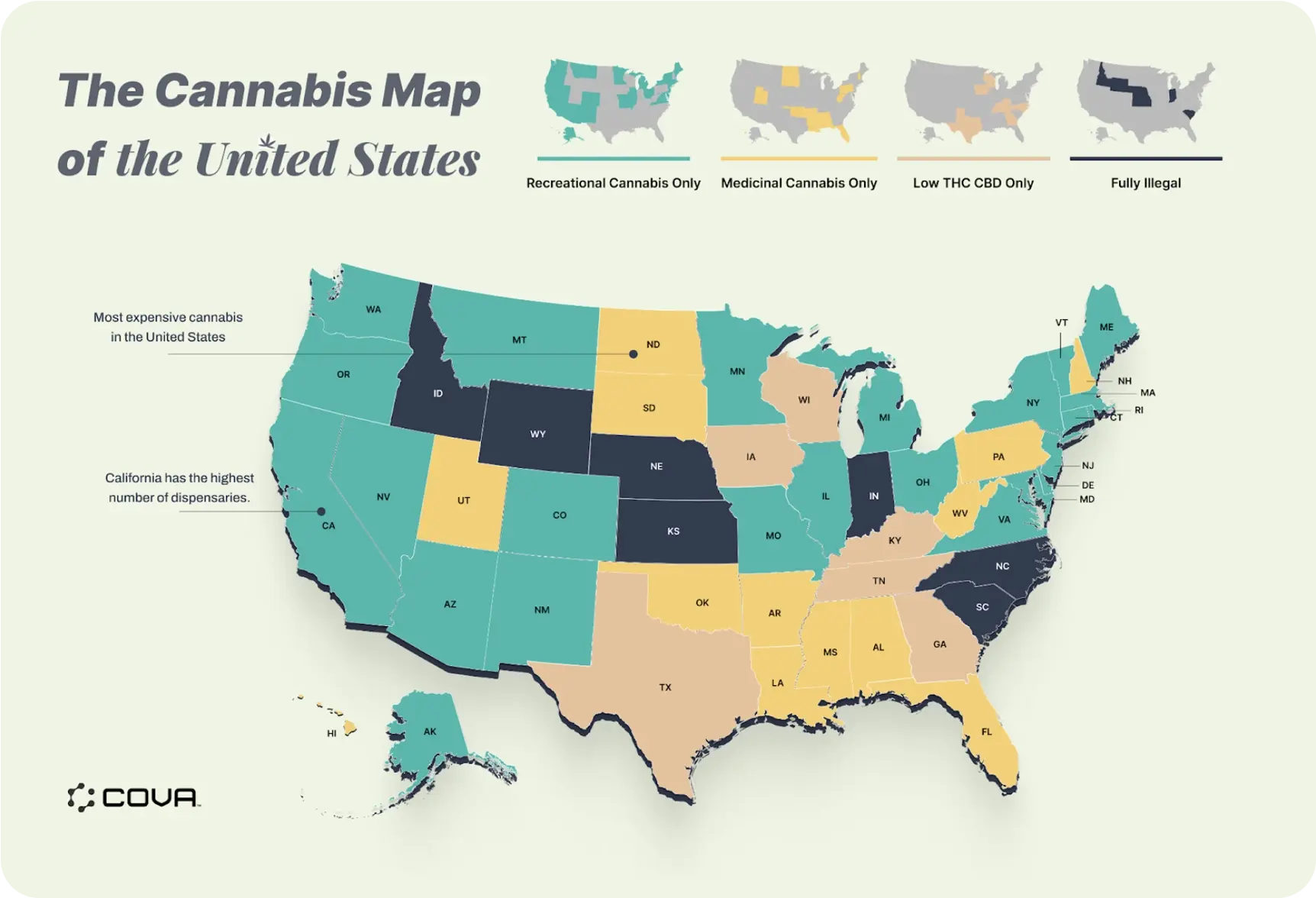
As of June 2024, 24 of 50 states have legalized cannabis for recreational use and an additional 14 allow cannabis for medical use. An additional 7 states have yet to pass any bills legalizing cannabis and therefore, weed remains completely illegal — the remaining 5 states have implemented some form of CBD-related program that allows certain cannabis products to, almost always with low THC content.
The table below breaks down the legal status of cannabis on a state-by-state basis:
Frequently Asked Questions about Legalization in the US
Where is marijuana legal in the United States?
As of June 2024, marijuana is legal for recreational use in 24 out of 50 states in the U.S., including:
- Alaska
- Arizona
- California
- Colorado
- Connecticut
- Delaware
- Illinois
- Maine
- Maryland
- Massachusetts
- Michigan
- Minnesota
- Missouri
- Montana
- Nevada
- New Jersey
- New Mexico
- New York
- Ohio
- Oregon
- Rhode Island
- Vermont
- Virginia
- Washington
Where is medical marijuana legal in the United States?
As of June 2024, the following US states have legalized the sale and consumption of medical cannabis only:
- Alabama
- Arkansas
- Florida
- Hawaii
- Louisiana
- Mississippi
- New Hampshire
- North Dakota
- Oklahoma
- Pennsylvania
- South Dakota
- Utah
- West Virginia
Which states have limited CBD laws?
The following US states have limited CBD laws and specific requirements set by the state government, which means they only allow the sale and consumption of certain CBD products like CBD oils and low THC content CBD. States with such laws include:
- Texas
- Iowa
- Wisconsin
- Tennessee
- Kentucky
- Georgia
Where is marijuana illegal in the United States?
As of June 2024, the sale and consumption of cannabis (both recreational and medical) is completely illegal in the following states:
- Idaho
- Indiana
- Kansas
- South Carolina
- North Carolina
- Nebraska
- Wyoming
Which states are considering making marijuana legal?
Several US states are currently in the process of or in talks for legalizing cannabis. Most notably, Kentucky started accepting applications for medical cannabis dispensaries and has already passed the legislation that would make recreational cannabis fully legal by 2025.
Wisconsin is another state that is likely to fully legalize recreational cannabis in the coming years. In 2022, the state saw advisory referendums pass in several counties and municipalities.
Federal vs. State Cannabis Laws
One of the more complex aspects of cannabis legalization in the United States is how it differs at the federal and state levels. Crucially, state governments have the power to pass laws on the legal status of cannabis — 38 states have already done so with comprehensive state cannabis programs.
At the federal level, cannabis is, for the time being, illegal which creates several hurdles (most notably, banking restrictions and tax complications) for cannabis users and businesses, even in states where cannabis is fully legal.
Also Read: What Marijuana Rescheduling Means for the Cannabis Industry
State of Cannabis Legalization in Canada
After more than a century of prohibition, Canada passed the Cannabis Act in 2018 and became one of two countries to have a federal framework legalizing cannabis, the other being Uruguay.
However, despite cannabis being legal in the entire country, not every Canadian has access to the same facilities due to differences in how provincial governments choose to implement sale of cannabis. As of 2024, there are three main models of cannabis sales: government-run stores, private retailers, and a hybrid of both.
The following comprehensive map was created with the latest data and illustrates the differences in cannabis sales models and other key information.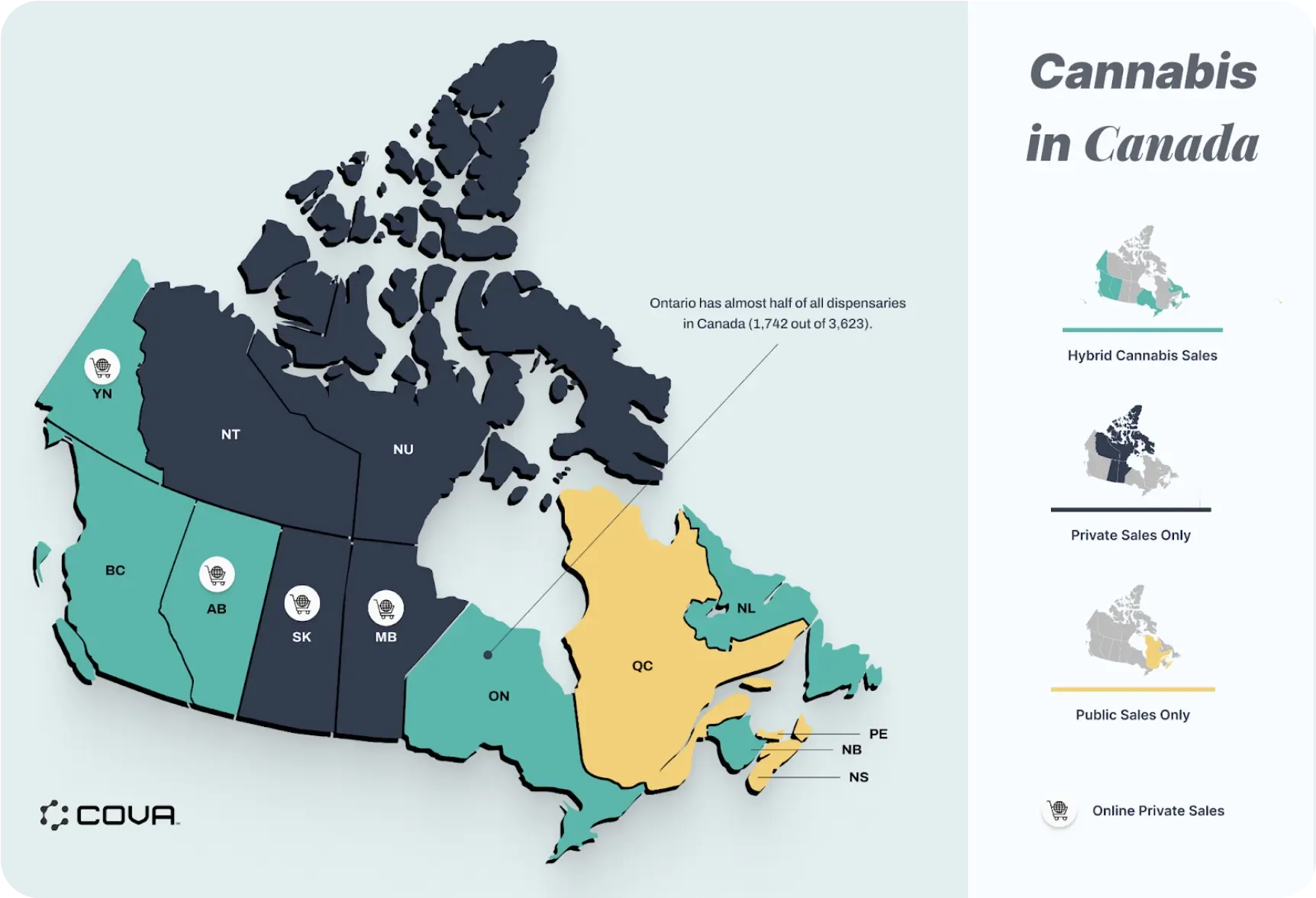
As of January 2024, there were more than 3,600 legal recreational cannabis storefronts in Canada with hundreds of applications currently in review.
The table below breaks down the legal status of cannabis on a province by province basis:
No
Yes
No
Yes
Yes
Frequently Asked Questions about Legalization in Canada
Where is cannabis legal in Canada?
Cannabis is legal across all of Canada for adults aged 19 and over (18 in Alberta and Quebec) following the Cannabis Act of 2018. This applies to all provinces and territories:
- British Columbia
- Alberta
- Saskatchewan
- Manitoba
- Ontario
- Quebec
- New Brunswick
- Nova Scotia
- Prince Edward Island
- Newfoundland and Labrador
- Yukon
- Northwest Territories
- Nunavut
That said, provinces and territories set their own rules around how cannabis can be sold, where it can be used, and growing restrictions.
Which provinces in Canada allow private retailers to sell cannabis?
As of 2024, the following provinces and territories allow cannabis to be sold by private retailers:
- Alberta
- British Columbia
- Manitoba
- Newfoundland and Labrador
- Northwest Territories
- Nunavut
- Ontario
- Saskatchewan
- Yukon
Which provinces only allow cannabis sales through government-run stores?
Currently, Quebec, Nova Scotia, and Prince Edward Island do not allow private cannabis retailers and cannabis can only be purchased from government-run stores.
Which provinces allow cannabis to be purchased online?
The following provinces and territories have government-operated online sales portals:
- British Columbia
- New Brunswick
- Newfoundland and Labrador
- Northwest Territories
- Nova Scotia
- Nunavut
- Ontario
- Prince Edward Island
- Quebec
Alberta, Manitoba, Saskatchewan, and Yukon allow private retailers to sell cannabis online.
Which provinces permit home cultivation of cannabis?
All provinces and territories allow home cultivation except for Quebec. Additionally, Manitoba only allows home cultivation with a medical license.