
Missouri Cannabis Laws
Find info on Missouri marijuana dispensary laws & seed-to-sale regulations, and how Cova Software's dispensary solutions can keep you compliant in MO.
Missouri's adult-use cannabis market launched on February 3, 2023, following voter approval of Amendment 3 in November 2022 – making cannabis legal in Missouri for adult use and medical patients. The state's licensed market is regulated by the Department of Health and Senior Services (DHSS) through its Division of Cannabis Regulation (DCR). This page covers the cannabis laws, licensing requirements, and compliance obligations Missouri dispensary operators need to know.
Disclaimer: This page is meant to educate readers and spread awareness only, it is not intended to be, nor should be considered legal advice. This page is current as of May 27, 2026. Given the evolving nature of cannabis regulations, legal advice of any nature should be sought from legal counsel.
Missouri Key Cannabis Laws and Regulations
|
Category |
Key Details |
|
Minimum Purchase Age |
21 for adult-use and 18 with a valid medical card |
|
Adult-Use Possession |
Up to 3 ounces total (in public and at home) |
|
Medical Purchase Limit |
4 oz per 30 days and above 6 oz with physician authorization |
|
Legal Status |
Adult-use and medical both legal under Amendment 3 (2022) |
|
Regulatory Body |
Missouri Department of Health and Senior Services (DHSS) and Division of Cannabis Regulation (DCR) |
|
Track-And-Trace System |
Metrc |
|
Adult-Use Excise Tax |
6% state tax + applicable local taxes |
|
Home Cultivation |
Up to 6 flowering plants with a valid cultivation card |
Missouri Medical vs. Recreational Comparison
|
Feature |
Medical Cannabis |
Adult-Use (Recreational) |
|
Minimum Age |
18 (or under 18 with caregiver consent) |
21 |
|
Purchase & Possession Limit |
4 oz per 30 days (standard); up to 6 oz or more if physician-certified |
3 oz per transaction / possession |
|
State Tax Rate |
4% state medical cannabis tax |
6% state adult-use excise tax |
|
Local Taxes |
Subject to municipal local sales taxes |
Subject to voter-approved local taxes (up to 3%) |
|
Registration Requirement |
DHSS medical registry card (renewed every 3 years) |
Government-issued photo ID (driver's license or passport) |
|
Home Cultivation Limit |
6 flowering, 6 non-flowering, 6 clone plants with a patient cultivation card |
6 flowering, 6 non-flowering, 6 clone plants with a consumer cultivation card |
Latest Missouri Cannabis Regulatory Updates
Antitrust Lawsuit Alleges One Company Controls Over 25% of Missouri's Dispensary Market
May 3, 2026 – A class-action lawsuit filed in Jackson County Circuit Court alleges that Good Day Farm and roughly 50 affiliated LLCs have unlawfully seized control of more than 60 of Missouri's 224 dispensary licenses (over 25% of the market) through coordinated pricing, supplier-allocation agreements, and management structures that the plaintiffs argue violate the state constitution's license cap. The plaintiffs, manufacturers and cultivators, allege Good Day Farm used its consolidated buying power to force wholesale discounts as high as 65%, with a "fill or kill" ultimatum. The DCR has declined to comment citing ongoing litigation.
Federal Rescheduling Updates Medical Tax Code, Allowing 280E Deductions
April 28, 2026 – The DEA's federal rescheduling order officially moved state-licensed medical cannabis to Schedule III of the Controlled Substances Act, finally exempting medical cannabis businesses from the Internal Revenue Code (IRC) Section 280E tax restrictions. However, because adult-use cannabis remains classified under Schedule I, recreational retailers do not qualify for this tax exemption and remain subject to 280E, creating a complex dual-tier tax accounting burden for co-located dispensaries in Missouri.
Governor Signs Hemp Ban, Closing the “Hemp Loophole” in Missouri
April 23, 2026 – Gov. Mike Kehoe signed HB 2641 (Intoxicating Cannabinoid Control Act), banning intoxicating hemp products containing more than 0.4 mg of THC per container from being sold outside licensed marijuana dispensaries. Products currently sold in gas stations, smoke shops, and convenience stores (including THC seltzers and hemp-derived edibles) must be removed by November 12.
Even if Congress reverses course, it wouldn't restore hemp sales outside dispensaries and those products would still be dispensary-only under state law..
Missouri Law Classifies Cannabis Workers as Covered Employees, Not Agricultural Labor
April 23, 2026 – Missouri lawmakers signed House Bill 2641 into law, classifying cannabis industry employment as covered employment under Missouri collective bargaining law, not agricultural labor. The labor provision takes effect August 28, 2026 and includes cultivation, processing, manufacturing, retail, and support operations.
Missouri Opens Unlimited Research Licenses for Cannabis Study
April 20, 2026 – The Division of Cannabis Regulation (DCR) filed proposed rules to create a new, uncapped research license category. This creates opportunities for universities, companies, and independent researchers to study cannabis cultivation, safety, and health effects. Public comment runs through May 31 with final rules expected to take roughly eight months to complete the legislative review process.
Missouri Regulators Propose Stiffer Penalties, Up to $100K in Fines
March 2026 – The DCR filed draft rule revisions (19 CSR 100-1.070 and 19 CSR 100-1.100) in strengthening enforcement authority. Proposed changes include fines up to $100,000 and license suspension or revocation for violations including unregulated THC distribution, fraudulent agent ID card use, tampering with surveillance recordings, and refusing to cooperate with investigations. The framework also establishes formal product recall protocols and streamlines ownership-change procedures.
Bill Requiring Automatic Expungement Passes Missouri Senate
March 10, 2026 - The Missouri legislature approved SB 1421 which mandates automatic expungement of felony and misdemeanor drug possession convictions after three years and one year respectively. The bill limits expungements to three misdemeanor and two felony expungements (combined with existing expungement laws). SB 1421 is currently awaiting approval by the governor.
Key Missouri Dispensary Laws and Regulations
|
Compliance Area |
Operator Requirement |
|
Licensing Authority |
DHSS issues all facility licenses while DCR conducts inspections and enforcement |
|
Reporting Requirements |
Mandatory real-time Metrc reporting for all inventory movements, sales, and transfers |
|
Staffing Requirements |
Employee credentialing, background check criteria, and onboarding training programs described under 19 CSR 100-1.070 and 19 CSR 100-1.080 (covered later in this article) |
|
Location Requirements |
Comprehensive facility location constraints, setback distances, and local municipal zoning buffer rules described under 19 CSR 100-1.100 and 19 CSR 100-1.180 (covered later in this article) |
|
Security Requirements |
Comprehensive facility security, video surveillance, and access control plans described under 19 CSR 100-1.100 and 19 CSR 100-1.180 (covered later in this article) |
|
Packaging & Labeling |
Comprehensive packaging and labeling requirements described under 19 CSR 100-1.120 (covered later in this article) |
Missouri Cannabis Dispensary FAQs
Missouri Medical and Recreational Purchase Rules
Who can purchase marijuana in Missouri?
Any adult 21 or older may purchase cannabis, including non-residents. Medical cannabis is available to patients 18 or older with a qualifying condition and a state-issued medical card. Patients under 18 must have a designated caregiver purchase and administer cannabis on their behalf.
Do I need a medical card to buy cannabis in Missouri?
No. Adults 21 or older can buy cannabis at any licensed dispensary without a medical card. A medical card provides a higher 30-day purchase limit and access for patients aged 18–20. Apply through the DHSS cannabis portal.
What are the qualifying conditions for Missouri’s medical cannabis program?
Patients may qualify for a Missouri medical card if they have been diagnosed with any of the following qualifying conditions:
- Cancer
- Epilepsy
- Glaucoma
- Intractable migraines
- Chronic pain
- PTSD
- HIV/AIDS
- ALS
- Parkinson's disease
- Tourette's syndrome
- and any other condition a licensed physician certifies would benefit from cannabis treatment.
Patients can apply for a medical card through the DHSS online portal.
What are Missouri's cannabis purchase limits?
Missouri sets purchase thresholds for adult-use customers and registered medical patients. All limits apply to the total amount purchased within a rolling period regardless of product form, and dispensaries are required to track and enforce them in real time through Metrc at the point of sale.
|
Product |
Adult-Use (per transaction) |
Medical - Standard (per 30 days) |
Medical - Physician-Authorized (per 30 days) |
|
Dried flower |
3 oz |
6 oz |
Above 6 oz, as certified |
|
Concentrates |
Equivalent to 3 oz flower |
Equivalent to 6 oz flower |
As certified |
|
Edibles / infused |
Equivalent to 3 oz flower |
Equivalent to 6 oz flower |
As certified |
|
Tinctures / topicals |
Equivalent to 3 oz flower |
Equivalent to 6 oz flower |
As certified |
A Metrc-integrated POS like Cova POS can automatically flag transactions that approach or exceed these thresholds, reducing the risk of an inadvertent compliance violation.
What are the rules on public consumption?
Public consumption of cannabis is prohibited in Missouri under Amendment 3. It is also prohibited in vehicles, workplaces (unless permitted by the employer), and all public spaces. Consumption is permitted only on private property with the owner's permission. A first offense is a civil infraction with a fine of up to $100.
How much weed can you buy in Missouri in a day?
Adult-use customers may purchase up to 3 ounces (or its equivalent in concentrates, edibles, or tinctures) in a single transaction from a licensed dispensary. There is no separate daily cap. Medical patients may purchase up to 6 oz per rolling 30-day period.
What are the laws for home cultivation in Missouri?
Adults 21+ may apply for a consumer personal cultivation card from DHSS and grow up to 6 flowering plants and 6 non-flowering plants per person at home for personal use. No more than 12 flowering plants may be kept at a single residence regardless of how many adults live there. Medical patients with a cultivation card have the same limits.
Plants must be kept in a locked, enclosed space not visible from a public place, and all plants must be labeled with the grower's name.
Missouri Dispensary Licensing and Application Process
What state agency is in charge of cannabis licensing in Missouri?
The Division of Cannabis Regulation (DCR), a division within the Department of Health and Senior Services (DHSS), issues all cannabis facility licenses and enforces compliance statewide.
What type of marijuana licenses are available in Missouri?
The DCR issues the following license categories to cannabis businesses:
|
License Type |
Scope |
|
Comprehensive Cultivation |
Grow cannabis for wholesale to other licensees |
|
Comprehensive Manufacturing |
Process cannabis into finished products |
|
Comprehensive Retail (Dispensary) |
Sell cannabis directly to patients and adult consumers |
|
Microbusiness |
Integrated vertically (license for small operators, with lower fees and ownership caps) |
|
Testing |
Laboratory testing of cannabis products for potency and contaminants |
|
Transportation |
Move cannabis between licensed facilities |
|
Research |
Cannabis health and safety research |
What is a Comprehensive Retail license?
A Comprehensive Retail license authorizes a facility to sell all approved cannabis product types – flower, concentrates, edibles, tinctures, topicals, pre-rolls, and (beginning November 12, 2026) intoxicating hemp products – to registered medical patients (18+) and adult consumers. Delivery is permitted where authorized by the DCR.
Comprehensive licenses are capped under Article XIV of the Missouri Constitution. Since new Comprehensive dispensary applications are currently closed, entry into the market typically requires acquiring an existing licensed facility.
What is a Microbusiness license?
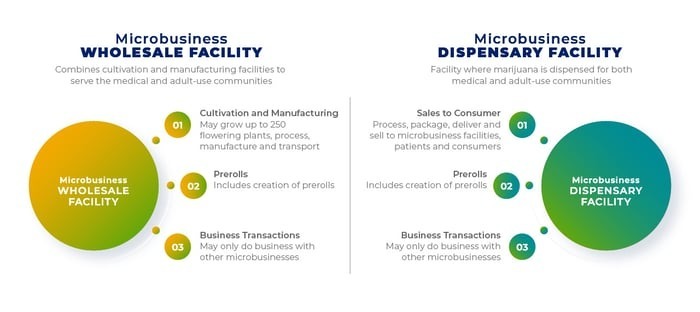
A Microbusiness license is a vertically integrated license designed for smaller operators, combining cultivation, manufacturing, and retail under one license at a smaller scale. Application fees and ownership caps are lower than Comprehensive licenses. Missouri is expected to open a third Microbusiness lottery round following DCR rule reforms filed in March 2026.
What is the process for obtaining a dispensary license in Missouri?
Applications are submitted through the DCR's online licensing portal during designated application windows. When applicants exceed available licenses, DCR scores applications competitively. Key scoring criteria include business plan quality, facility security plan, community benefit, and owner qualifications. For a step-by-step walkthrough of the full application process, see Cova's guide to opening a dispensary in Missouri.
You can also search current DCR-issued licenses through the DHSS license lookup tool. Application windows and license availability are announced on the DCR website.
What are the key criteria applicants will be scored on to earn the best chance at a dispensary license?
DCR evaluates applications competitively when demand exceeds available licenses, meaning highest-scoring applications receive priority. Scoring criteria include:
- quality of the business plan
- facility security plan detail
- community benefit contributions (e.g., social equity, local hiring commitments)
- qualifications and experience of owners and managers
- compliance history for applicants who hold existing licenses.
What are the basic requirements for applicants?
To be eligible for a Missouri cannabis license, applicants must meet the following baseline criteria:
- A minimum percentage of the applicant entity must be owned by Missouri residents, as defined by current DCR rules
- No disqualifying felony convictions, though drug-related offenses are not an automatic disqualifier and the DCR evaluates each application on a case-by-case basis
- All owners, officers, managers, and facility agents must submit to fingerprint-based criminal history background checks administered by the DCR
- Applicants must demonstrate the financial ability to cover facility buildout, ongoing operations, and the compliance systems required to maintain licensure
- A complete facility plan must be submitted with the application, including a detailed security plan, floor plan, and operations plan
- The proposed facility must satisfy all DCR setback requirements from schools, daycares, and other protected uses, as well as any applicable local zoning ordinances
What fees are associated with a dispensary license in Missouri?
Missouri cannabis license fees are subject to annual CPI adjustments under Article XIV of the Missouri Constitution. The table below reflects current DCR fees as of the FY2026 and FY2027 schedules. All fees are paid through the DCR online registry portal.
|
License Type |
New Application |
Renewal (every 3 yrs) |
Annual Fee |
|
Comprehensive Dispensary (FY2026) |
$3,000 |
$3,000 |
$11,255 |
|
Comprehensive Dispensary (FY2027) |
$3,083 |
$3,083 |
$11,568 |
|
Medical Dispensary (FY2026) |
Closed |
$3,747 |
$12,492 |
|
Medical Dispensary (FY2027) |
Closed |
$3,851 |
$12,839 |
|
Microbusiness Dispensary (FY2026) |
$1,592 |
$1,592 |
$1,592 |
|
Microbusiness Dispensary (FY2027) |
$1,637 |
$1,637 |
$1,637 |
|
Facility Agent ID Card |
$75.00 |
$75.00 |
– |
Is one entity allowed to own more than one license?
Yes, but ownership is capped per facility type. Under 19 CSR 100-1.110, no entity or individual may hold a 10% or greater ownership interest in more than 10% of total outstanding licenses within a given category. Based on DCR figures published in May 2025:
|
Facility Type |
Total Licenses |
Max Per Entity |
|
Comprehensive + Medical Dispensary |
224 |
22 |
|
Comprehensive + Medical Cultivation |
68 |
6 |
|
Comprehensive + Medical Manufacturing |
91 |
9 |
These caps fluctuate as licenses are issued, revoked, or transferred. Check the DCR common relationships page for current figures.
Missouri Recreational Dispensary Operating and Staffing Requirements
What do you need to work in a dispensary in Missouri?
Before beginning work at a licensed Missouri cannabis facility, all prospective employees, owners with facility access, contractors, and volunteers must obtain a Missouri Facility Agent Identification Card from the Department of Health and Senior Services (DHSS).
To qualify for an Agent ID card, applicants must be at least 21 years old and have no prior cannabis license revocations. A felony conviction history will be evaluated; however, past drug offenses do not trigger automatic disqualification, as the Division of Cannabis Regulation (DCR) reviews criminal backgrounds on a case-by-case basis.
The application process is completed through the online DHSS Cannabis Registry Portal:
- Submission: Register under the “New Agent” designation, providing a government-issued photo ID and Social Security number. A written employment offer is no longer required to apply, as the DCR has waived this mandate.
- Background Vetting: After submitting the initial application, candidates will receive instructions from the DCR to submit fingerprints for a mandatory criminal history background check.
Agent ID cards remain valid for three years from the date of issuance and must be actively renewed prior to expiration. While working on shift, personnel must adhere to the following operational rules:
- On-Person Credentials: The Agent ID card must be worn visibly at all times within the facility, and employees must also carry a valid government-issued photo ID.
- Status Updates: The DCR must be notified promptly of any changes to an agent's employment status.
- Public Verification: Credential validity can be verified at any time by the public or operators via mo-verify.mycomplia.com
Who can Missouri dispensaries sell to?
Dispensaries may sell to adults 21 or older (adult-use) and registered medical patients 18 or older. Patients under 18 must be accompanied by a designated caregiver. The dispensary must check a valid government-issued ID for every transaction. Selling to a minor is grounds for immediate license action under DCR enforcement rules.
What are the restrictions on dispensary locations in Missouri?
Under Missouri state regulations, cannabis dispensaries are subject to a default 1,000-foot setback distance from existing elementary or secondary schools, child daycare centers, and churches. This distance is calculated in a straight line from the closest external wall of the dispensary structure to the nearest property line of the protected use.
However, the state explicitly grants local municipalities the authority to reduce or completely alter these buffer zones. Because local governments can adjust these boundaries operators must verify local zoning maps and ordinances before securing a property.
What products can be sold in Missouri dispensaries?
Missouri dispensaries are authorized to sell the following product types, each subject to DCR testing, labeling, and packaging requirements:
|
Product Category |
Examples & Purchase Limits |
|
Cannabis flower |
Dried, unprocessed (weight-based purchase limits apply) |
|
Concentrates and extracts |
Oils, wax, shatter, rosin (sold in equivalent flower weight) |
|
Edibles and infused products |
Must meet DCR potency limits per serving and per package |
|
Topicals |
Lotions, balms (typically excluded from purchase limits) |
|
Tinctures |
Liquid extracts (equivalent flower weight limits apply) |
|
Pre-rolled products |
Pre-packaged joints (equivalent flower weight limits apply) |
|
Seeds and clones |
Where permitted by DCR rules |
|
Intoxicating hemp products* |
Products >0.4 mg THC per container may only be sold in licensed dispensaries under HB 2641 |
Editor’s Note: Intoxicating hemp-derived beverages, delta-8 edibles, and similar products – is an expansion of the permitted product set for licensed operators beginning November 12, 2026.
What oversight do Missouri dispensaries face?
Missouri dispensaries operate under strict, ongoing oversight from the DCR and are subject to multiple layers of regulations including:
- Unannounced inspections by DCR at any time
- Mandatory Metrc compliance and real-time reporting
- Advertising restrictions (no targeting of persons under 21, no unsubstantiated health claims, no cartoon characters or imagery with clear appeal to minors)
- Product recall obligations under DCR's March 2026 enforcement rule framework
- Fines up to $100,000 and potential license suspension or revocation for serious violations
What labeling and packaging rules apply to cannabis products sold in Missouri?
All Missouri cannabis products must comply with 19 CSR 100-1.120 and all designs must be submitted to and approved by the DCR before use. Violations carry fines of up to $5,000 per product/packaging category.
In summary, the packaging rules mandate that packaging must be:
- resealable, opaque, and child-resistant (excluding seeds and plants)
- constructed from FDA-approved food contact materials
- free of human, animal, or fruit shapes – including cartoons
- It may not visually mimic any non-cannabis product
- Single packages cannot exceed 3 oz of dried flower or its equivalent.
Similarly, DCR mandates that the following requirements in labels (required on the container closest to the product):
|
Required Element |
Detail |
|
"Marijuana" + THC diamond symbol |
Printed at least as large as any other text (red and white universal symbol) |
|
Full ingredient list |
No vague groupings (like “natural flavors") |
|
Servings or doses per package |
– |
|
"Best if used by" date |
– |
|
Originating license number + testing lab |
Must identify the lab where mandatory testing passed |
|
Metrc tag number |
Tied to mandatory testing results |
|
Exact weight |
Grams for flower/concentrates/prerolls and mg of Δ9-THC for infused products |
|
Cannabinoid panel per serving |
Δ9-THC, THCA, CBD, CBDA, CBN, THCV, CBDV, Δ8-THC in milligrams |
|
Terpene analysis |
If tested during mandatory testing |
|
Instructions for use + estimated duration |
– |
|
DCR packaging approval number |
Issued after pre-use review |
|
Required warning |
"Cognitive and physical impairment may result from the use of marijuana. Keep out of reach of children." |
Missouri Cannabis Compliance, Tracking, and Reporting
What seed-to-sale tracking system does Missouri use?
Missouri uses Metrc as its mandatory statewide seed-to-sale tracking system, as required by DHSS. All licensed cannabis businesses must track plant and product inventory in Metrc from cultivation through final sale. Every transaction, transfer, and disposal must be recorded in real time. Failure to maintain accurate Metrc records is one of the most common compliance violations cited by DCR during inspections.
What are the reporting requirements for Missouri dispensaries?
Missouri dispensaries carry a range of ongoing reporting obligations, each tied to specific triggers and submitted to the DCR or recorded through Metrc:
|
Obligation |
Triggered On |
|
Record inventory movements, sales, transfers |
Real time – every transaction |
|
Maintain employee Agent ID card logs |
Ongoing (updated on hire/termination) |
|
Report adverse events and product recalls |
Upon discovery |
|
Report security incidents |
Upon discovery |
|
Submit financial reports |
As specified by DCR |
|
Cooperate with unannounced inspections |
Any time DCR requests |
|
Enforcement penalties |
Fines up to $100,000, license suspension or revocation for serious violations |
Editor’s Note: Under DCR's March 2026 draft rules, tampering with surveillance recordings or refusing to cooperate with an investigation is a basis for license revocation.
What advertising restrictions apply to Missouri cannabis businesses?
Missouri cannabis advertising is governed by 19 CSR 100-1.100(5)(B) and under 19 CSR 100-1.010(3) “advertisement" includes websites, mobile apps, email, and social media. In March 2025, the DCR issued formal online advertising guidance after identifying widespread non-compliance in digital channels.
Prohibited across all channels:
- Targeting or directing ads at persons under 21
- Advertising in media where a substantial portion of the audience is under 21
- Using the shape of any human, animal, or fruit – including realistic, artistic, or cartoon renderings
- Making health claims not substantiated by evidence
Can dispensaries sell hemp-derived THC products after November 12, 2026?
Yes, and licensed dispensaries are the only retailers permitted to do so under HB 2641. Intoxicating hemp products (>0.4 mg THC per container) must exit unregulated retail and can only be sold inside licensed dispensaries. Operators planning to sell these products should review DCR guidance on inventory onboarding, labeling compliance, and Metrc tracking.
Missouri Cannabis Market Outlook
Missouri's licensed cannabis market is among the strongest in the country for operators who entered early. Since adult-use sales launched in February 2023, the market has generated hundreds of millions in annual tax revenue and supported thousands of jobs.
Based on this growth, here are some key developments to watch in 2026:
- Hemp channel consolidation: The removal of intoxicating hemp products from unregulated retail expands the addressable product set for licensed dispensaries. Operators who move quickly to stock and merchandise compliant hemp-derived products will capture customers who previously bought from smoke shops and gas stations.
- Microbusiness Round 3: Following DCR's March 2026 rule reforms, Missouri is expected to open a third microbusiness lottery round, adding new licensed operators to the market.
- Thampy ballot initiative: If the November 2026 ballot initiative is certified and passes, it would be the most significant structural change to Missouri cannabis law since Amendment 3 – removing license caps, possession limits, and mandatory seed-to-sale tracking. Licensed operators should monitor the certification outcome and model scenarios accordingly. The initiative faces substantial opposition from the established cannabis industry.
- Research licenses: New research license rules signal growing institutional interest in cannabis science, with potential long-term benefits for product legitimacy and development.
Additional Resources
Dive deeper into everything related to cannabis retail in and around Missouri with these curated resources.
- Where Is Cannabis Legal in North America in 2026?
- How to Open a Dispensary: Step by Step Guide to Getting Started
- Certified Dispensary POS & Inventory Management System for Missouri
- How to Open a Dispensary in Missouri
- How Much Does it Cost to Open a Cannabis Dispensary in Missouri?
- Seed-to-Sale Guide for Missouri Dispensary Applications
- 7 Things to Look For in a Seed-To-Sale Compliant POS in Missouri
- 5 Cannabis Consultants in Missouri You Should Know
- How to Prepare your Missouri Dispensary for Recreational Cannabis Sales
- Licensing, Rules, and Compliance Resources | Missouri Division of Cannabis Regulation
- Apply for a Facility Agent ID Card | Cannabis Registry Portal
- Search Active Missouri Cannabis Licenses | Licensed Facilities Dashboard
- Missouri Cannabis Rules – 19 CSR 100 | Administrative Ruleset
- Missouri Proposed Cannabis Rules – Secretary of State
- Approved Seed-to-sale Software Providers | Metrc Missouri Validated Integrators
- DEA Federal Register Notice – June 29 Rescheduling Hearing
Conclusion
Despite being just over a year old, the legal adult-use market in Missouri is incredibly impressive. To put this into perspective, Missouri has licensed over 200 dispensaries to operate in the state, in just a year. New York only has 78. Similarly, Missouri generated over $1.4 billion in recreational sales, nearly beating Illinois’ $1.6 billion sales with a significantly smaller population.
All of these accomplishments have been possible for a continuously evolving legal and compliance framework that enables dispensaries to work harder, better, and faster. To stay on top of this changing landscape, subscribe to the Cova newsletter and get the latest updates & insights on cannabis retail regulations, trends, and technology.