
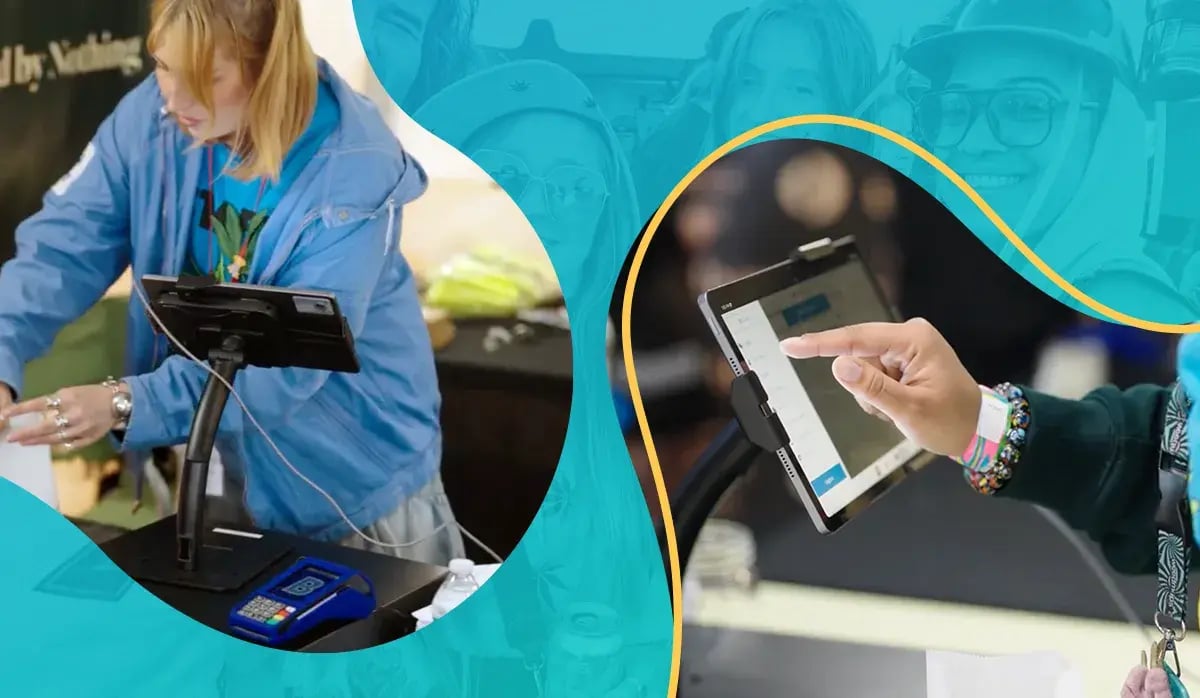
At Legacy Cup Minnesota, you can learn about a new pre-roll from the grower who produced it, hear about a vape from the brand behind it, and order both from a kiosk at the booth. When you’re ready to leave, you pay and pick up everything in a single order.
It’s a clean and streamlined process – but to support that one checkout, two things have to happen: A licensed retailer has to make every sale, and each sale has to be reported to the state's traceability system on time. The same is true of any pop-up dispensary or cannabis pop-up: the location is temporary, but the compliance rules are the same ones that apply in your store.
This guide covers which states allow cannabis event sales, who can make the sale, what your POS has to do away from the store, and a setup checklist for your first marijuana retail pop-up shop. State rules are current as of October 2026; however, you should confirm requirements with your state regulator and local government before committing to an event.
Key Takeaways
- A pop-up dispensary extends a retail license; it is not a new license type. A licensed retailer runs a temporary point of sale at an approved event, market, or venue.
- Only businesses with retail authorization can sell. In Minnesota, New York, and California, growers and brands without it reach event buyers through a licensed retailer that completes the sale.
- Event sales carry store-level compliance duties. Minnesota requires inventory moved to an event to be recorded in Metrc and every event sale to be entered within 24 hours.
- Your event POS has four core jobs: ID and purchase-limit checks, on-time traceability reporting, offline selling where your state permits it, and reconciliation back to the store.
What Is a Pop-Up Dispensary?
A pop-up dispensary is a temporary point of sale that a licensed cannabis retailer operates outside its permanent store, at an approved event, market, or venue, for a set number of days. The retailer's existing authorization covers the sale, while the event itself typically needs separate state and local approval.
Cannabis pop-ups are easy to confuse with other event formats. The difference is who can sell:
In California, a purely informational or educational event with no sales or consumption does not need a Department of Cannabis Control (DCC) license.
Skipping licensing carries real consequences. In April 2026, Black Enterprise reported that Atlanta police arrested 40 people at an illegal marijuana pop-up event. Licensing comes before venue, vendors, or marketing, and once it’s in place, every sale runs through the retailer's POS and traceability account.
Can You Sell Cannabis at Events? State Rules for 2026
You can sell cannabis at events in states that license the events, but only a business authorized for retail sales can make the sale. In Minnesota and California, the organizer’s license lets the event happen but does not, on its own, authorize anyone to sell. In New York, the business selling at the event holds the showcase permit itself.
Can You Use Your Existing Dispensary License for a Pop-Up?
You can use your existing cannabis retail license to sell at a pop-up in all three states, though the mechanics differ:
- Minnesota: Your retail license covers event sales once the licensed event organizer names you on its vendor list to the Office of Cannabis Management (OCM). Vendor list changes are due at least 72 hours before the event.
- New York: Your dispensary applies for its own CSE permit. Several dispensaries can each hold a permit at the same event.
- California: Your retail license covers sales at a licensed temporary event, inside the area assigned to you on the event's premises diagram. Daily purchase limits still apply.
Minnesota Rules in Practice
Legacy Cup operates under Minnesota cannabis laws. Many Minnesota growers and manufacturers who take part in cannabis events hold no retail license or retail operations endorsement, so they cannot sell to attendees directly. Other rules every Minnesota vendor should plan around:
- Medical cannabis sales are prohibited at events.
- Deli-style flower sales require a cannabis flower packaging endorsement.
- Every attendee must be 21 or older.
- A licensed cannabis transporter (or a Tribal transporter operating under a compact) must move all product to and from the event.
Recent and Upcoming Changes
On August 6, 2026, New York Governor Kathy Hochul signed S.10113/A.11217, opening CSE permits to microbusinesses with retail authorization, including at farmers' markets. Minnesota's 2026 legislative session converted the event organizer license from a temporary, per-event license to an annual, renewable one, effective January 1, 2027.
All three states require city or county approval, so check your local rules before signing a venue contract.
How Do Growers Sell at an Event Without a Retail License? The Legacy Cup Model
Growers and brands without retail authorization take part in event sales by partnering with a licensed retailer that completes every transaction. The grower educates at the booth; the retailer takes payment, keeps the sale compliant, and fulfills the order.
Legacy Cup Minnesota, the Midwest's largest cannabis event, draws more than 10,000 attendees. Its host, Minnesota retailer and Cova customer Legacy Cannabis, built its marketplace on this model.
How the Legacy Cup Minnesota Marketplace Works
- Discover at the booth. Attendees meet growers and brands, ask questions, and see products in person.
- Order at the kiosk. Kiosks at participating booths take orders as attendees explore. The first activation uses seven kiosks.
- Combine vendors in one order. Attendees choose products from several vendors instead of completing separate purchases.
- Route every order to one licensed retailer. Orders flow into Legacy Cannabis' Cova POS, which connects to VFI Technology's digital retail platform, VFI Edge.
- Pay and pick up once. Attendees pay for and collect their complete order through Legacy Cannabis.
Brands with products available through the kiosks include Slaps, ERBA, and Green Thumb Industries. Because one licensed retailer makes every sale, those brands can reach buyers without retail authorization of their own. The kiosks act as ordering points, much like a self-service kiosk in a store, while Legacy Cannabis handles payment and handoff. Growers spend their time on education and relationships, attendees get one checkout, and every transaction stays inside a licensed retail operation.
Josh Wilken-Simon, founder and owner of Legacy Cannabis and Legacy Cup, credited Cova with “adapting its system to Minnesota-specific needs” and doing the work required to make the experience possible within state rules.
The right to host an event and the right to sell at it are different things, and Legacy Cup keeps those roles separate by design.
What Does a Cannabis Event POS Need to Do?
A cannabis event POS has to do everything your store POS does, verifying age, enforcing purchase limits, and reporting every sale on time, while running on temporary hardware, often on an unreliable connection, and reconciling back to store inventory afterward. In practice, that means:
- Record inventory moved to the event. Minnesota requires any product transferred to an event to be recorded in Metrc.
- Report every sale on the state's clock. Minnesota vendors must enter event sales in Metrc within 24 hours. Each vendor records its own sales; the event organizer does not.
- Verify age and enforce purchase limits. Minnesota vendors must confirm every customer is 21 or older before a sale and cannot sell beyond lawful possession limits. California requires the selling retailer to check valid ID and applies standard daily limits.
- Keep selling when the connection drops. POS offline mode keeps sales moving during an outage and syncs the data once the connection returns. It applies only where your state does not require a live connection to the traceability system or customer database, so confirm your state's rule first.
- Accept orders from more than one channel. At Legacy Cup, kiosk orders from every booth fed into one POS. Your system should take orders from kiosks or online ordering and ring them up as one transaction.
- Take payment within your license and processor rules. Test your cannabis payments payment setup on the actual event hardware before doors open.
- Reconcile when the event closes. Cash, returned inventory, and the sales record must match before product goes back to the store. California requires unsold goods to return by licensed distributor, and New York prohibits storing cash or cannabis overnight at a CSE location.
Event traffic will also test your system’s reliability. Cova's cannabis POS has delivered 100% uptime on 4/20 for nine consecutive years.
How Do You Set Up a Cannabis Pop-Up Shop, Step by Step?
Setting up a cannabis pop-up show follows a specific sequence, and each step depends on the one before it:
- Confirm the rules. Check your state's event requirements and your local approval process.
- Choose your role. Event organizer, licensed retail vendor, or a grower or brand partnering with a retailer, as at Legacy Cup.
- Apply on time. California requires the temporary event license application at least 60 days ahead and New York requires CSE applications 45 days ahead. Minnesota recommends applying at least 45 days out.
- Book licensed transport. Minnesota requires a licensed cannabis transporter; California requires a licensed distributor.
- Set up the POS. Record the inventory transfer, configure devices, connect kiosks or online ordering, and test offline behavior.
- Train event staff. Cover ID checks, purchase limits, and the event checkout flow.
- Run and reconcile. Close out sales, cash, and returned inventory within your state's reporting window.
How Do You Make a Cannabis Pop-Up Worth Running?
A cannabis pop-up earns its cost when it reaches customers your store doesn't already see, and when it brings them back afterward.
- Pick events for audience fit, not attendance alone.
- Carry a focused product list rather than your full menu.
- Use limited-time pricing and bundles that fit your broader pricing strategy.
- Enroll buyers in loyalty at checkout so event customers return to your store.
A single event put Legacy Cannabis in front of more than 10,000 attendees. For ways to build that audience before and after, see our guide to cannabis event marketing.
FAQ
Do You Need a License to Run a Pop-Up Shop That Sells Cannabis?
Yes, and usually more than one. The seller needs retail authorization, while the event needs its own permit or organizer license plus local approval. California requires two event licenses on top of the retailer's. Events with no sales or consumption may not need a state license at all.
Can You Use Your Store's POS at a Cannabis Event?
Yes. Legacy Cannabis runs the Legacy Cup marketplace on its store's Cova POS. Any POS you bring must record the inventory transfer, report sales on deadline, and enforce limits away from the store's network. Run a full test transaction, including a simulated outage, before event day.
Can Customers Order From a Kiosk at a Cannabis Event?
Yes, when a licensed retailer takes the order and handles payment and pickup, as at Legacy Cup Minnesota. Minnesota prohibits vending machines or other unattended devices from dispensing cannabis at events, so a kiosk can collect orders but staff must complete the handoff.
Next Steps for Your First Pop-Up
Confirm the rules, secure your permit or retail partner, set up the POS, then run and reconcile. Start with your state agency's event guidance, and test your POS's offline and reporting behavior well before event day.
Legacy Cup Minnesota offers a model other high-traffic events and emerging markets can adapt: growers meet buyers face to face, and every sale stays inside a licensed retail operation.
Planning an event of your own? Book a demo today to see how Cova supports event sales.