
Text messaging has become one of the primary ways for cannabis dispensaries to reach customers. Emails can get buried, and social media posts can get suppressed – but an SMS lands on a screen that almost everyone checks within minutes. As convenient as it is, though, dispensary SMS marketing is not as simple as uploading a contact list and hitting send.
Cannabis businesses operate within a complex compliance environment that combines federal telecommunications law, carrier-level messaging standards, and state cannabis advertising rules. Getting any of these layers wrong can result in fines, carrier blocking, or worst of all, jeopardizing your license.
The good news is that compliance doesn’t have to be a barrier. With the right platform partner, dispensaries can send SMS and MMS campaigns within the rules and without having to build the compliance infrastructure themselves. Cannabis-specific platforms like Carrot can handhold operators through the entire registration, approval, and execution process, so you can focus on running great campaigns instead of navigating carrier requirements.
To help you get the most out of SMS for your cannabis retail operation, we’re diving deep into the legal requirements around dispensary SMS marketing, how to build a compliant subscriber list, which platforms are best suited for cannabis operators, and how to run campaigns that drive results without putting your business at risk.
“SMS and MMS marketing gives dispensaries a direct line to their customers – higher open rates, real-time alerts, and no algorithm standing in the way. The operators who do it well treat compliance as part of the product, not an obstacle. When the opt-in list is clean, the 10DLC registration is done right, and the age-verification flow is frictionless, SMS becomes one of the most reliable revenue channels in the store.”
– James Hammer, CEO, Carrot
Key Takeaways
- SMS marketing is legal for cannabis dispensaries when done in full compliance with federal rules, carrier registration requirements, and your state’s cannabis advertising laws.
- Dispensaries must register their brand and campaigns under 10DLC, include age-verification steps in message flows, and only text customers who have explicitly opted in.
- Cannabis-specific SMS platforms handle industry compliance requirements that general tools like Klaviyo and Mailchimp are not built to address.
- SMS typically delivers open rates above 90%, making it one of the highest-performing outreach channels available to dispensaries.
- Costs range from $0.01- $0.03 per SMS and $0.03- $0.06 per MMS, plus carrier fees, and vary by platform and volume.
What is Dispensary SMS Marketing?
SMS stands for Short Message Service, the built-in text messaging system on mobile phones that lets businesses send short, permission-based promotional and transactional messages directly to opted-in customers. For cannabis dispensaries, SMS marketing offers strong engagement: industry benchmarks show that about 98% of SMS messages are opened and 90% are read within three minutes of delivery, giving dispensaries a high-impact way to drive visits and sales when traditional ad channels are limited.
Is SMS Marketing Legal for Cannabis Dispensaries?
Yes, SMS marketing is legal for cannabis dispensaries, but only when conducted in full compliance with federal telecommunications law, carrier messaging requirements, and applicable state cannabis advertising regulations. There is no blanket federal prohibition on cannabis SMS marketing, but the compliance bar is significantly higher than it is for most other industries.
Ultimately, legally marketing your dispensary through SMS comes down to three things:
- Whether your customers have explicitly consented to receive text messages
- Whether your brand and campaigns are registered under the 10DLC framework
- Whether your message content meets your state’s cannabis advertising standards
Missing any one of these elements puts you at compliance risk and exposes you legally.
Understanding Cannabis SMS Marketing Laws and Regulations
Cannabis SMS marketing is regulated under multiple compliance frameworks. The following sections break down the specific federal texting rules, carrier requirements, and state advertising restrictions that apply to dispensaries.
Federal SMS Rules That Apply to Dispensaries
The Telephone Consumer Protection Act (TCPA) is the primary federal law governing commercial text messaging in the United States. It requires businesses to obtain prior express written consent before sending marketing messages to consumers via SMS. Consent must be clear, unambiguous, and documented; it can’t be buried in fine print or assumed from a prior business relationship.
TCPA violations carry statutory damages of $500 to $1,500 per message, which can become catastrophic in class-action scenarios. Cannabis dispensaries are not exempt from TCPA and must meet the same standards as any other business.
10DLC Registration
10DLC (10-Digit Long Code) is the carrier-level framework that governs commercial SMS messaging in the U.S. Under 10DLC, businesses must register their brand and messaging campaigns with The Campaign Registry before sending bulk text messages. Carriers like AT&T, T-Mobile, and Verizon use this information to vet senders and filter spam.
For cannabis businesses, the 10DLC registration process includes additional requirements. Because cannabis is federally controlled, carriers treat cannabis messaging as a restricted content category. That means your registered campaign must document an age-verification flow that prevents minors from accessing cannabis promotional content.
Typically, the registration process for a cannabis dispensary involves three stages:
-
Brand registration: Submit your business name, EIN, address, and contact information to The Campaign Registry via your SMS platform.
-
Campaign registration: Submit each campaign type (promotions, loyalty updates, delivery notifications, etc.) with sample messages and a description of your opt-in and age-verification process.
-
Carrier approval: Campaigns are reviewed by carriers before messages can be sent.
Once approved, dispensaries can only send the types of messages and content that were registered. Deviating from approved templates or sending unapproved content can get you blocked by the carrier.
Age Verification Requirements for Cannabis SMS Marketing
One critical compliance requirement specific to cannabis is age verification. When a recipient clicks a link in a cannabis SMS message, they must pass through an age gate or PIN-based verification before accessing the content. This applies to any link that leads to cannabis product pages, menus, promotions, or other dispensary content.
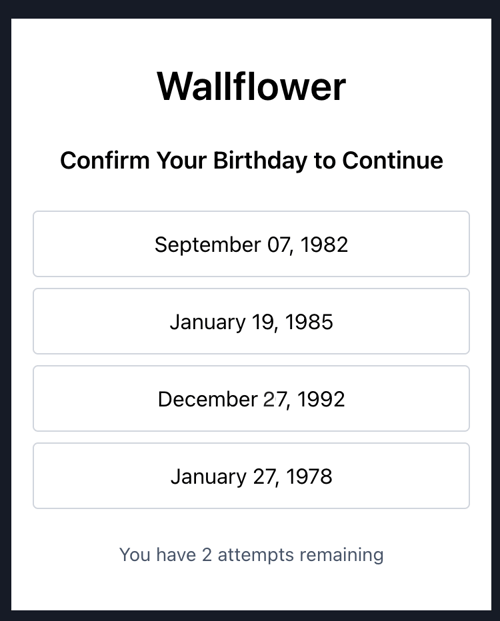
Age gate example
The verification step must be meaningfully functional, not just a checkbox. Recipients must verify their age and identity before accessing the content; this can be accomplished through a PIN code or a customer-specific age gate. Keep in mind that too many clicks between the message and the content can significantly reduce conversion rates, so evaluating platforms on the smoothness of their age-verification flow is just as important as evaluating the messaging features themselves.
“The age verification step is where a lot of generic platforms fall short. Carriers require it for cannabis campaigns, but the implementation has to be smooth. A clunky age gate means customers drop off before they ever see your offer. We built our flow specifically for cannabis operators to meet the carrier requirement with the fewest clicks possible, so compliance doesn’t come at the cost of conversions.”
– James Hammer, CEO, Carrot
How State Cannabis Regulations Affect Dispensary SMS Marketing
In addition to federal requirements, dispensaries must comply with their state’s cannabis advertising regulations, which vary significantly by market. Most states with legal cannabis have specific rules about what can be said in marketing materials, who can be targeted, and what disclosures must be included.
Common state-level cannabis marketing restrictions include:
- Rules against making health or medical claims about cannabis products
- Requirements to include specific disclaimers such as “For Adults 21+ Only” or equivalent language for medical markets
- Restrictions on targeting audiences that may include minors, including requirements to suppress contacts below a certain age threshold
- Prohibitions on certain types of promotional language or imagery
- Required inclusion of licensed dispensary information in marketing materials
Some states have additional requirements specific to SMS, including restrictions on how opt-in consent can be collected or requirements to maintain specific records of consumer content. Dispensary owners should review their state cannabis authority’s advertising guidelines directly and consult legal counsel for clarifications. Because cannabis advertising laws continue to evolve at the state level, partnering with a cannabis-specific SMS platform that monitors regulatory changes is a major advantage over a general-purpose marketing tool.
Dispensary SMS Marketing Strategy and Best Practices
How do dispensaries send bulk text messages legally?
Sending bulk SMS legally requires a compliant platform with an approved 10DLC registration, a documented opt-in list, and message content that has been registered with carriers. From a practical standpoint, the process of SMS marketing for cannabis dispensaries works like this:
- A customer opts in through an in-store sign-up, website form, loyalty program enrollment, or checkout flow.
- Their consent is recorded with a timestamp and source, creating a documentation trail.
- The dispensary’s SMS platform uses the registered 10DLC phone number and approved campaign type to send the message.
- Any links in the message pass through an age-verification step before leading to cannabis content.
- Opt-out requests via STOP are processed automatically and permanently.
“Becoming compliant to send SMS/MMS isn’t a one-step process; it’s a sequence. Your brand has to be registered and approved as 10DLC compliant first. You then submit a customer journey that includes age-identification checkpoints, and then each campaign type gets submitted as a template before you can send. Once you’re approved, strict adherence to those registered templates is non-negotiable. Carrot can handhold operators through every one of those steps and provide the platform to send compliantly.”
– James Hammer, CEO, Carrot
Deviating from this process – say, by importing a contact list purchased from a third party or sending from an unregistered number – exposes you legally, and messages will typically be blocked by carriers before they’re even delivered.
Building and Managing a Compliant Dispensary SMS Subscriber List
A quality subscriber list is the foundation of your cannabis dispensary’s SMS program. Effective opt-in collection points include:
- Point-of-sale enrollment: Staff ask customers to opt in at checkout, either verbally with a written confirmation step, or through a digital signup on a POS-integrated tablet.
- Online ordering platforms: Opt-in checkboxes on your eCommerce site or menu platform during account creation or order checkout.
- Loyalty program signup: Customers enrolling in your loyalty program can be prompted to opt into SMS communications as part of the enrollment process.
- In-store signage with keyword opt-in: Customers text a keyword to a short code or long code number to op in, which automatically triggers a confirmation message.
- Post-purchase follow-up: A follow-up message after a first purchase offering loyalty enrollment or promotions, with a clear opt-in action.
Regardless of how you collect contacts, each record should include the date, time, source, and method of consent. This protects you in the event of a TCPA complaint or regulatory audit.
Contacts who opt out via STOP must be removed from all future campaigns immediately. Most compliant platforms handle this automatically, but it should be verified as part of your platform evaluation.
“Dispensary SMS only works at scale when compliance and safety are designed in from the start. Federal carrier rules, state cannabis regulations, and customer consent have to be treated as core infrastructure, not afterthoughts.
When that foundation is in place, SMS becomes more than a broadcast tool. It becomes a flexible, data-driven channel that gives dispensaries optionality in how they engage customers, adapt to regulation, and grow without risking their license or their brand.
The dispensaries that pull ahead fastest are the ones compounding opt-ins across multiple channels and in-store, online, and post-purchase touch points, turning every interaction into a long-term, compliant customer relationship.”
– Nicholas Paschal, CEO, Alpine IQ
SMS Messaging Types, Frequency, and Timing for Dispensaries
Effective SMS programs balance promotional messaging with content that customers genuinely find valuable. Over-messaging is one of the most common reasons customers opt out.
Message types that work well for dispensaries include:
- Flash sales and limited-time deals
- New product arrivals
- Loyalty rewards updates
- Event and education announcements
- Order and delivery status updates
Frequency and timing guidelines:
- Most dispensary SMS programs send between two and six messages per month. Exceeding this without strong value in each message increases opt-out rates.
- Send messages during business hours, generally between 10am and 8pm in the customer’s local time zone.
- Avoid sending messages late at night or early in the morning, as these times generate complaints and opt-outs.
- Test timing and frequency with different segments of your list to identify what drives the best results for your customer base.
SMS Marketing for Cannabis Delivery Services
If your dispensary offers delivery services, SMS can serve a particularly practical function. Delivery status updates, driver tracking notifications, and estimated arrival messages are transactional communications that customers actively want. These messages have very high open and satisfaction rates and reinforce the reliability of your delivery service.
You can also use SMS to specifically drive delivery orders – think promoting free delivery windows, minimum order discounts, or exclusive delivery-only deals. Segmenting your subscriber list by customers who have used delivery before lets you target these offers efficiently.
Compliance rules still apply to delivery SMS marketing. Messages linking to your delivery menu or ordering platform must still funnel through age verification, and all promotional delivery messages must use registered campaign types.
Cannabis-Compliant SMS Marketing Platforms vs General SMS Marketing Software
General SMS platforms like Klaviyo, Mailchimp, Attentive, and Postscript are built for mainstream eCommerce and retail. They handle TCPA compliance and 10DLC registration for standard industries, but they are not designed for the cannabis-specific requirements dispensaries must follow and are not suitable for cannabis-compliant SMS marketing.
The biggest shortcomings of general SMS platforms when it comes to cannabis marketing include:
- No built-in age-verification flow for cannabis links, which is required by carriers for cannabis campaigns
- No cannabis-specific campaign registration support, meaning your campaigns may not be approved or may be blocked by carriers
- Terms of service that prohibit cannabis industry use, which can result in account termination without warning
- No integration with cannabis POS and loyalty systems, limiting your ability to personalize and segment campaigns
- No monitoring of state cannabis advertising law changes, leaving compliance responsibility entirely on the operator
Cannabis-specific SMS marketing platforms are built to handle all of these requirements. Leading cannabis-compliant SMS marketing providers include:
Alpine IQ (AIQ)
Alpine IQ is a comprehensive cannabis marketing and analytics platform with robust SMS capabilities. It handles 10DLC registration, age-verified link flows, loyalty integration, segmentation, and multi-state compliance. AIQ is built for operators that want to run sophisticated, data-driven SMS programs with strong compliance infrastructure.
Springbig
Springbig is a loyalty and marketing platform purpose-built for cannabis retailers. It includes SMS marketing with compliance workflows, deep POS integrations, customer engagement automation, and detailed analytics. Springbig is widely used across multi-location operators and single-store dispensaries alike.
Carrot
Carrot is an SMS and MMS marketing platform specifically designed for the cannabis industry. Carrot manages the full 10DLC registration process including brand submission, age-verification flow setup, and campaign template approval. It provides a compliant end-to-end pipeline for operators who want expert guidance through the registration and approval process, with a focus on minimizing friction between the message and the content while staying fully within carrier and regulatory requirements.
Cost of Dispensary SMS Marketing
Dispensary SMS marketing costs vary based on the platform you use, the volume of messages you send, and the message type (SMS or MMS). According to Carrot, general cost ranges per message (before platform fees) are:
- SMS: $0.01–$0.03 per message plus carrier fees, decreasing at higher volumes
- MMS: $0.03–$0.06 per message plus carrier fees, reflecting the higher cost of multimedia delivery
In addition to per-message costs, most cannabis SMS platforms charge a monthly subscription or platform fee that covers access to the software, compliance support, and analytics. These fees range from a few hundred dollars per month for smaller operators to several thousand per month for enterprise-level accounts with large subscriber lists and high send volumes.
When budgeting for your dispensary’s SMS marketing, factor in:
- Monthly platform fee
- Per-message send costs based on your expected monthly volume
- One-time or annual 10DLC registration fees
- Potential setup or onboarding fees, particularly for platforms that provide white-glove compliance support
For most dispensaries, SMS marketing at reasonable volume delivers a strong return on investment relative to cost, particularly for promotional campaigns where a single high-performing send can drive meaningful same-day revenue.
Dispensary SMS Marketing FAQs
Do I need MMS or SMS for dispensary promotions?
SMS is a standard text message limited to 160 characters. MMS supports images, GIFs, short videos, and up to 1,600 characters of text. For dispensaries, MMS is particularly effective for product launches, showcasing visual packaging, and seasonal promotions where imagery adds impact. SMS works well for urgent, text-based alerts like flash sales, deal reminders, and loyalty updates.
MMS typically costs two to three times more per message than SMS, so many dispensaries use SMS as the default and reserve MMS for campaigns where visual content can meaningfully improve results.
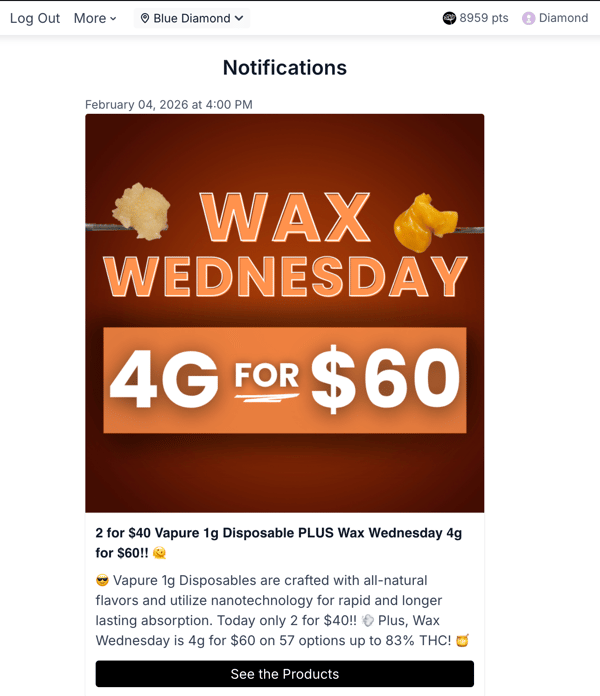
MMS example
What’s the difference in SMS marketing vs. email marketing for dispensaries?
SMS and email serve complementary roles in a dispensary’s marketing program. SMS delivers significantly higher open rates – 98% vs 20% for email – and drives faster action because messages are seen within minutes. Email is better suited for longer content, educational newsletters, product guides, menu announcements, and communications where detail matters more than immediacy.
Both channels require opt-in consent and are subject to cannabis advertising restrictions, but email platforms generally have more permissive terms of service for cannabis operators than mainstream SMS tools. Running both channels through a cannabis-specific platform that integrates them is the most efficient approach.
Can I use a shared short code for cannabis dispensary SMS?
Shared short codes, where multiple businesses use the same 5- or 6-digit number, have largely been discontinued by major carriers. Most compliant cannabis SMS campaigns now use 10-digit long codes (10DLC) registered to a specific business. This is the current standard and is required for cannabis campaign registration.
What happens if a customer texts STOP?
Any customer who replies STOP must be immediately and permanently removed from all future SMS campaigns. This is both a legal requirement under TCPA and a carrier rule. Compliant platforms handle opt-outs automatically. Continuing to send messages to a customer who has opted out is a significant TCPA violation and can put you at serious compliance risk.
Can I buy a cannabis contact list for dispensary SMS marketing?
No. Purchasing or renting contact lists for SMS marketing is not compliant and creates serious legal liability. Every contact in your SMS subscriber list must have explicitly opted in to receive messages from your specific dispensary. Sending to purchased lists violates TCPA, will likely be blocked by carriers, and exposes you to regulatory and legal action.
Do dispensaries need a lawyer to set up SMS marketing?
You do not necessarily need a lawyer to launch an SMS program, but you should work with a cannabis-compliant platform that includes compliance support as part of its service. Platforms like Alpine IQ and Carrot are designed to guide operators through the 10DLC registration and approval process and help ensure your opt-in workflows and message content meet the relevant standards. For dispensaries operating in multiple states or navigating complex state advertising regulations, a review by cannabis-experienced legal counsel is highly recommended.
How long does 10DLC registration take?
10DLC brand registration typically takes a few days to a week. Campaign registration and carrier approval can take one to three weeks depending on the carrier and the complexity of the campaign, and cannabis campaigns may take longer due to restricted-category review. Plan for at least two to four weeks from starting registration to being cleared to send, and work through a platform that can actively manage and expedite the process.
Dispensary SMS and Email Marketing Compliance Checklist
Here’s a checklist you can use when launching or auditing your dispensary SMS marketing program:
Opt-In and Consent
- Every contact on your SMS list has explicitly opted in with documented consent
- Consent records include date, time, and source of opt-in for each subscriber
- Opt-in language clearly discloses what types of messages the customer will receive
- Opt-in is not bundled with other agreements in a way that obscures consent
10DLC Registration
- Brand registration submitted and approved with The Campaign Registry
- All campaign types (promotional, transactional, loyalty, etc.) registered and carrier-approved
- Age-verification flow documented and included in campaign registration
- Messages are sent only from registered 10DLC numbers
Message Content
- All messages include your dispensary name or brand
- Every promotional message includes clear opt-out instructions (e.g., Reply STOP)
- No health claims or medical claims are made about cannabis products
- Age-appropriate disclaimer language included where required by your state
- Links in messages route through age verification before reaching cannabis content
- Message content matches the registered campaign type and sample messages
Platform and Operations
- Using a cannabis-compliant SMS platform with appropriate industry terms of service
- STOP opt-outs are processed automatically and suppressed from future sends
- Messages are sent only during appropriate hours (typically 10am–8pm local time)
- Send frequency is appropriate to your customer base and not exceeding platform or state limits
- State cannabis advertising regulations have been reviewed and reflected in your content guidelines
- Compliance documentation is retained and accessible in case of regulatory inquiry
Ready to Launch Your Dispensary SMS Marketing Program?
If you’re evaluating SMS marketing for your dispensary, start by choosing a cannabis-compliant platform, getting your 10DLC registration in order, and building your subscriber list through the in-store and digital touchpoints where your customers already engage with you. Done right, SMS can be one of the most reliable and cost-effective parts of your marketing stack.
Cova POS integrates with leading cannabis marketing platforms to help dispensaries build compliant customer relationships and drive repeat visits. If you’re ready to learn more, contact us today and let’s talk!