
For multi-state cannabis operators, the question of whether to add a Cannabis ERP comes at a critical juncture: your point of sale handles retail cleanly, but as the business takes on cultivation, manufacturing, or wholesale licenses, it’s not clear whether that same stack can carry the load.
In this article, we’ll break down what a cannabis ERP handles that a POS doesn’t, the triggers that signal a need for an ERP, and how the two systems connect when an MSO business needs both.
Key Takeaways
- The Cannabis POS-versus-ERP question is really a question about vertical integration, not software features.
- Retail-only multi-state operators often run a point of sale plus an accounting connection, not a full ERP.
- Vertically integrated operators typically need both systems, connected by API rather than one replacing the other.
- Cannabis-specific ERPs and general enterprise ERPs solve different halves of the same problem.
What Does a Cannabis ERP Do That a Cannabis POS Doesn't?
A cannabis ERP platform coordinates cultivation, manufacturing, distribution, and consolidated finance across licensed entities. A cannabis POS runs the retail floor: transactions, inventory, compliance, and reporting at the point of sale. (For a full breakdown of the differences, see POS, ERP and seed-to-sale explained.) The short version: these systems cover different layers of the business, not overlapping ground.
The table below compares three stack configurations, since that's the actual choice most multi-state operators are weighing.
At What Point Does a Multi-State Cannabis Operator Outgrow a POS-Only Setup?
A POS-only stack stops being enough once an operation adds licensed cannabis activity beyond retail. Cultivation, manufacturing, and wholesale distribution each introduce planning and costing requirements that retail software was never built to handle. Five triggers signal it’s time to add an ERP:
- Vertical integration. The operation adds cultivation or manufacturing licenses on top of retail.
- Wholesale distribution. Selling to third-party retailers, not just its own stores.
- Multi-entity financial consolidation. Separate license-holding entities per state that need a consolidated view.
- Cross-state procurement and demand planning. Buying and allocating inventory across markets that can't legally share product.
- Investor or audit reporting. Public operators, or private ones facing 280E-driven cost accounting scrutiny.
An operator running retail only – even across a dozen states and a hundred locations – often doesn't need a full ERP. A POS with multi-location hierarchy, centralized multi-location reporting, and an automated accounting connection covers that ground. Multi-state operators are more likely to need an ERP than single-state operators, mainly because scaling a cannabis business across state lines tends to bring vertical integration with it. But scale alone doesn't force the decision; licensed activity does.
Sage x3 and Canix, the cannabis ERP bundled into Cova's own partner ecosystem, is designed for cultivators, manufacturers, and distributors. Cova is built for cannabis retail. That boundary isn't a marketing distinction; it's where the vendors draw their own lines.
How Do POS and ERP Connect in a Multi-State Cannabis Operator's Tech Stack?
The point of sale feeds retail transaction, inventory, and general ledger data to the ERP through a POS API ERP integration. Sync frequency and data quality at that connection point determine whether consolidated reporting holds up.
Most operators never write a line of code to make this work. Cova’s ERP and accounting partners are ready-to-run integrations, built and maintained against Cova’s open REST API. You connect them. The open API is there for the cases those partners don’t cover, which is when your team or your ERP vendor builds against the same 24 documented API areas our own development teams use.
GeneralLedger answers the question a finance team actually asks. It returns every GL account in the company, the detail behind any one of them, and general ledger transactions filtered by date range. SalesInvoice returns finalized invoices and filtered invoice summaries. CompanyTree returns your company hierarchy including locations, which is what a multi-state operator POS needs when each state sits under a separate licensed entity. Authentication runs on OAuth2, and we publish a Postman collection so integrators can test before they build.
On the ERP side, pick based on where your complexity sits. Canix brings cannabis-native supply chain modeling for cultivation, manufacturing, and distribution. Microsoft Dynamics and Sage X3 bring general enterprise depth across finance and multi-entity operations. QuickBooks, through TendTech Connect, covers the accounting-only path that suits retail-first operators. Each solves a different half of the problem, so the right choice follows from how vertically integrated you already are.
Case in point: Vireo Growth, a fast-growing MSO, runs Cova as its point of sale and inventory system across its New Mexico and Colorado retail locations and connects to Sage X3’s ERP.
How Should a Multi-State Cannabis Operator Decide?
Map the scope of the business first, then match software to those needs. A quick checklist:
- Does the business grow or manufacture product, not just sell it at retail?
- Does it distribute to other retailers, not only to its own stores?
- Does it operate as multiple legal entities across states that need one consolidated financial view?
- Does inventory need to be planned and allocated across separate state markets?
- Does the business report to investors or face audit-level financial scrutiny?
Two or more "yes" answers point toward ERP connected to the POS, not a POS-only stack. This is also where the question of the best cannabis ERP for MSOs comes up, and the honest answer depends on how much of the business sits outside retail, not how large the operation has grown.
Cost follows a similar split. The POS-to-accounting path is sold at published per-location monthly pricing: TendTech Connect, for example, lists per-location pricing with a higher tier that includes QuickBooks Online, plus a custom enterprise tier built around multi-company support and consolidated billing. Full ERP implementation looks different: it's quoted, multi-quarter, and involves real process redesign, not licensing alone.
FAQ
How does Metrc integration work between a cannabis POS and an ERP?
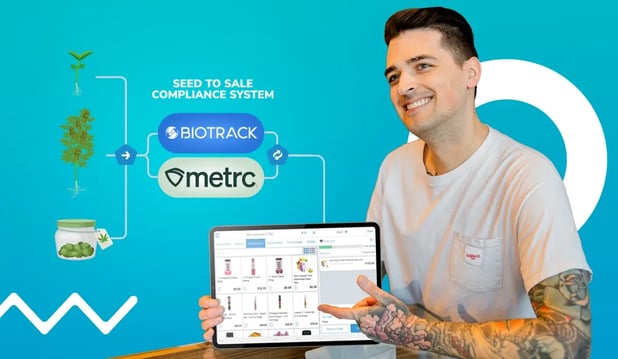
Cova integrates directly with Metrc and BioTrack and typically acts as the system of record for retail traceability events. Canix publishes Metrc-compatible functionality on the supply side. Running both systems against Metrc without a clear division of responsibility risks duplicate reporting. See state-by-state compliance requirements for how this plays out by jurisdiction.
Does a multi-state cannabis operator need a separate ERP for each state?
No. Compliance is enforced per state and per license, but ERP deployment is normally per-entity or corporate-wide rather than per-state. Cannabis can't legally cross state lines, so supply chains stay physically separate even when the software managing them doesn't.
Should an MSO buy a cannabis-specific ERP or a general ERP?
Cannabis-specific systems model plant tracking and state compliance natively. General enterprise suites like Microsoft Dynamics or Sage X3 bring broader finance and multi-entity capability. Both routes exist in Cova's partner ecosystem, and the right choice depends on whether cannabis-specific supply chain modeling or general enterprise depth matters more to the operation.
Next Steps
Map every license your operation holds, then flag which ones fall outside retail. From there, check whether your current POS actually exposes general ledger data to whatever finance system is already running.
Cova runs the retail layer: transactions, inventory, compliance, and reporting, connected to ERP and accounting systems through a documented API. For operators weighing what an enterprise cannabis POS should handle before adding ERP on top, book a demo to see the connection points firsthand.