
Five years after the initial "legalization", Virginia lawmakers finally negotiated the retail framework directly into the 2026–2028 state budget bill (HB 30), which became law on June 29, 2026. This means cannabis businesses can now have clarity into the Virginia cannabis license rules including the application process, lottery system, and fees.
In 2021, Virginia legalized simple possession of cannabis without any framework for commercial retail. Retail bills repeatedly stalled or were vetoed all between 2022 and 2025. In May 2026, Virginia's Governor vetoed the standalone adult-use retail bills over concerns that the proposed rollout timetable (which targeted sales by January 2027) was too rushed.
On June 29, 2026, after five years, Virginia enacted the retail framework for cannabis retail as part of its next state budget. This guide covers which license fits each business, who qualifies, how the lottery works, the application process, and what each cannabis license costs.
Disclaimer: This guide is general information current as of September 30, 2026 and is not legal advice. The fees and several rules come from draft regulations which the CCA Board has not yet adopted. Confirm current requirements with the Virginia Cannabis Control Authority and a Virginia cannabis attorney before applying.
Key Takeaways
- The Virginia Cannabis Control Authority (CCA) can accept license applications from February 1, 2027, and adult-use sales begin July 1, 2027.
- Virginia caps retail store licenses at 350 statewide, and the first round includes up to 100 microbusiness licenses for Impact applicants, farmers and eligible hemp businesses. Licenses can be issued from May 1, 2027.
- Impact applicants enter their own lottery first, and those who are not drawn also go into the general lottery.
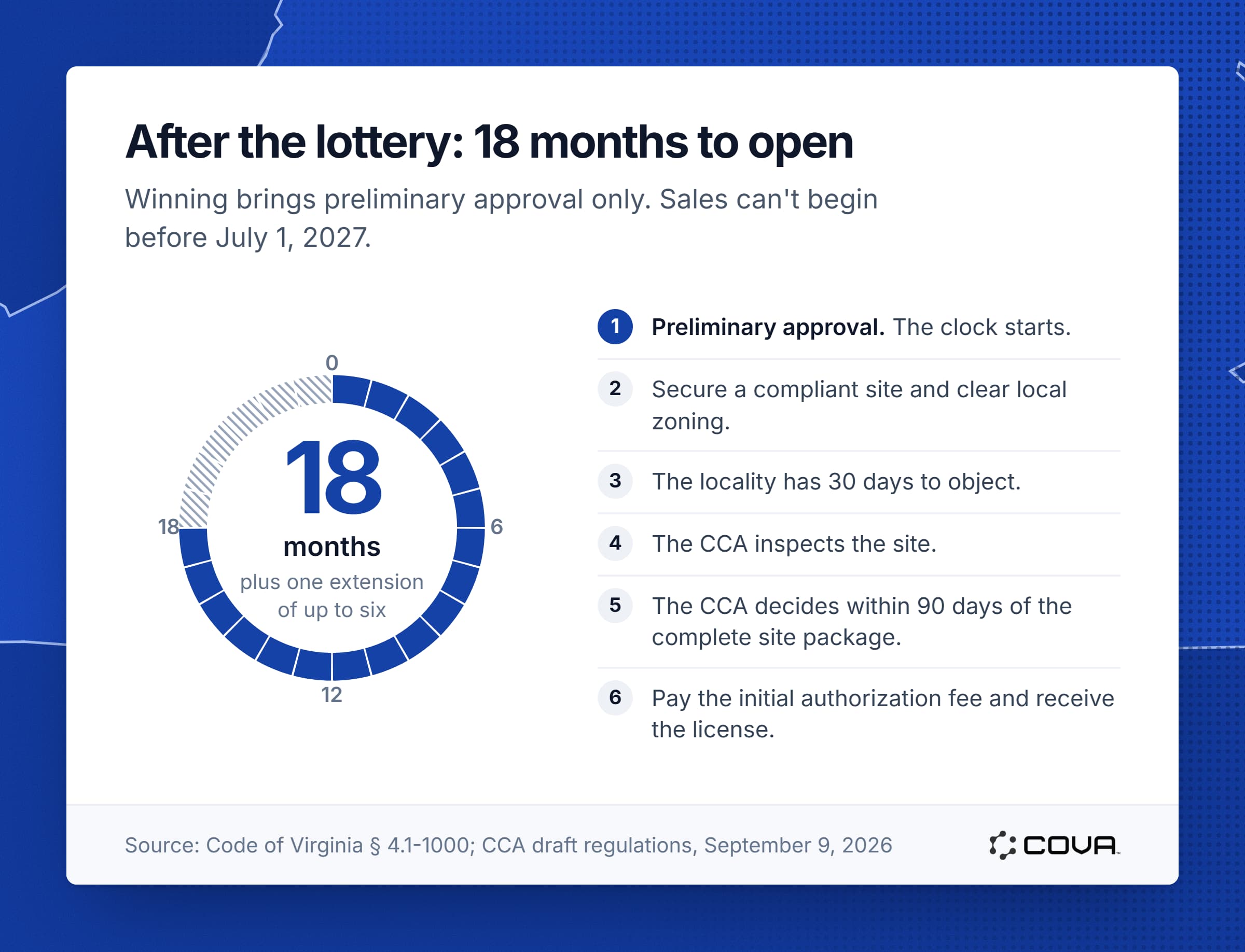
- Winning the lottery gives preliminary approval only. Selected applicants then have 18 months, plus one extension of up to six months, to secure a site, pass local zoning and a CCA inspection, and pay the license fee.
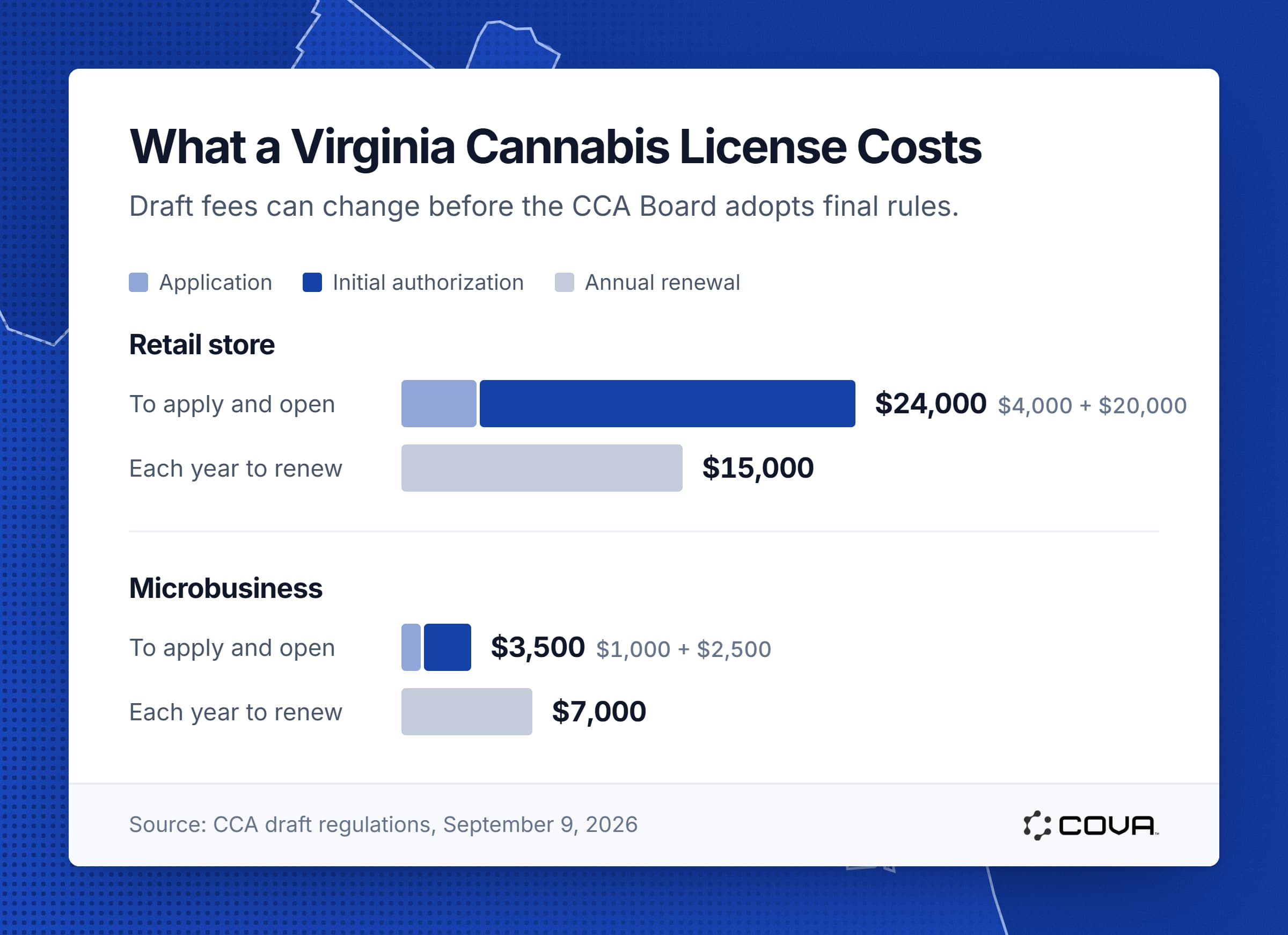
- Total fees (as per draft rules) for a retail store are $24,000 to apply and open ($4,000 application fee + $20,000 initial authorization), with a $15,000 annual renewal.
When Can You Apply for a Virginia Cannabis License?
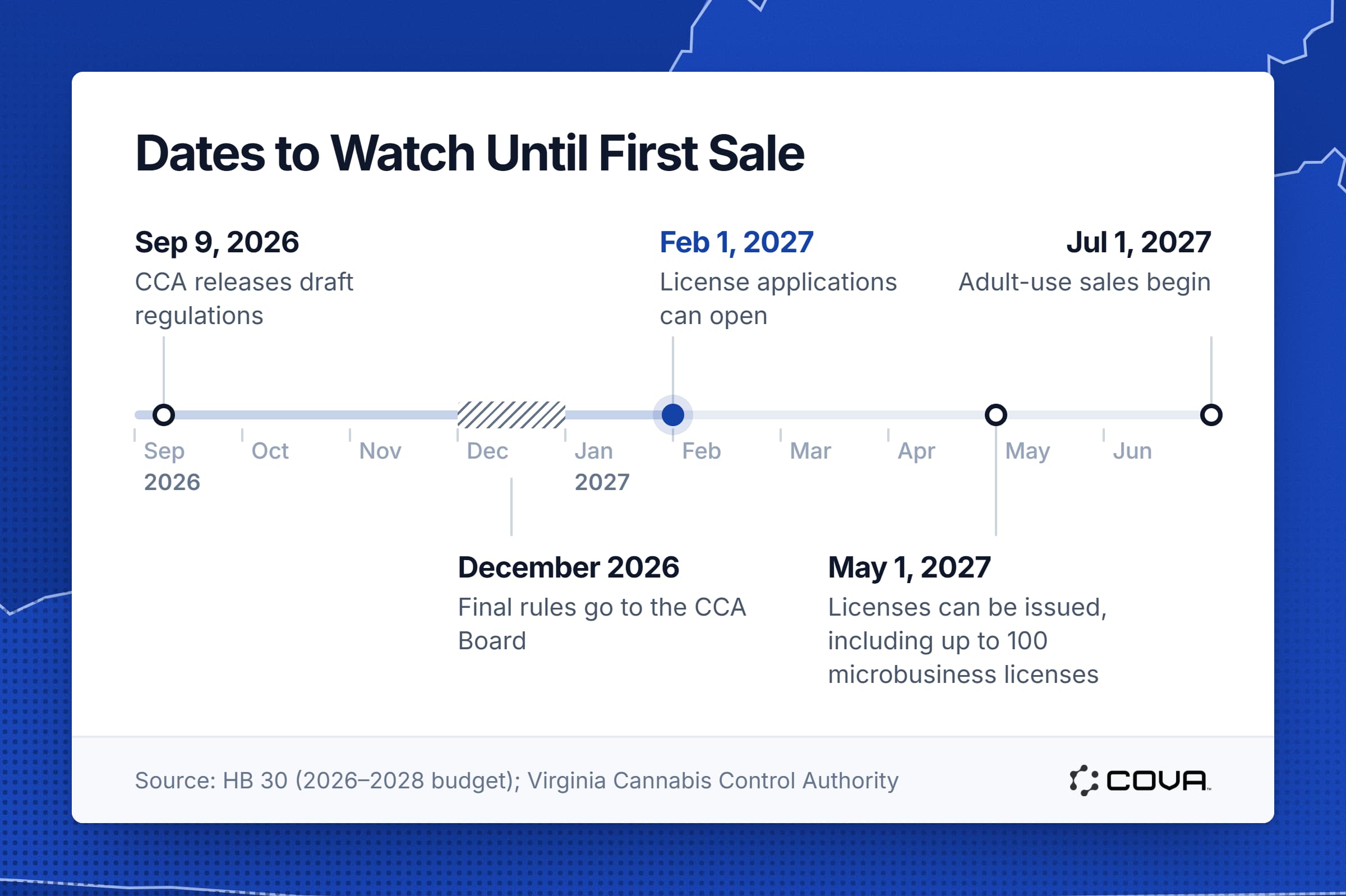
The Virginia Cannabis Control Authority (CCA) can begin accepting Virginia cannabis license applications on February 1, 2027 and can issue licenses from May 1, 2027, with no adult-use sales before July 1, 2027. HB 30 (the 2026–2028 state budget) set those dates when it was enacted on June 29, 2026, after the Governor vetoed HB 642 and SB 542 on May 19.
Only three application windows must open by February 1:
- Microbusinesses
- Pre-2021 hemp growers and processors
- Dual-use permits
The CCA decides when the other license types open, retail stores included. Though in one of its presentations on July 22, 2026, CCA outlined potentially opening applications on February 1 and issuing conditional awards on May 1 to align with statutory targets.
The rules applicants will file under are not final. The CCA released its draft regulations on September 9, 2026, the final version goes to the Board in December, and the CCA expects the rules to be "published and effective" in January 2027, ahead of a statutory deadline of February 1.
HB 30 exempts the Board's first adult-use regulations from the Administrative Process Act, so the standard 60-day public comment period does not apply. Applicants can still submit a written comment or sign up to speak at Board meetings, including October 21, 2026. The Cannabis Public Health Advisory Council reviews the draft in October and November, before the Board considers final rules in December."
The table sets out the licensing dates, and a separate article tracks when Virginia recreational dispensaries open.
|
Date |
Milestone |
|
September 9, 2026 |
CCA releases draft regulations |
|
December 2026 |
Final regulations go to the CCA Board |
|
February 1, 2027 |
License applications can open |
|
May 1, 2027 |
Licenses can be issued; up to 100 microbusiness licenses by this date |
|
July 1, 2027 |
Adult-use retail sales begin; at least 55 additional licenses issued by this date |
Which Virginia Cannabis License Should You Apply For?
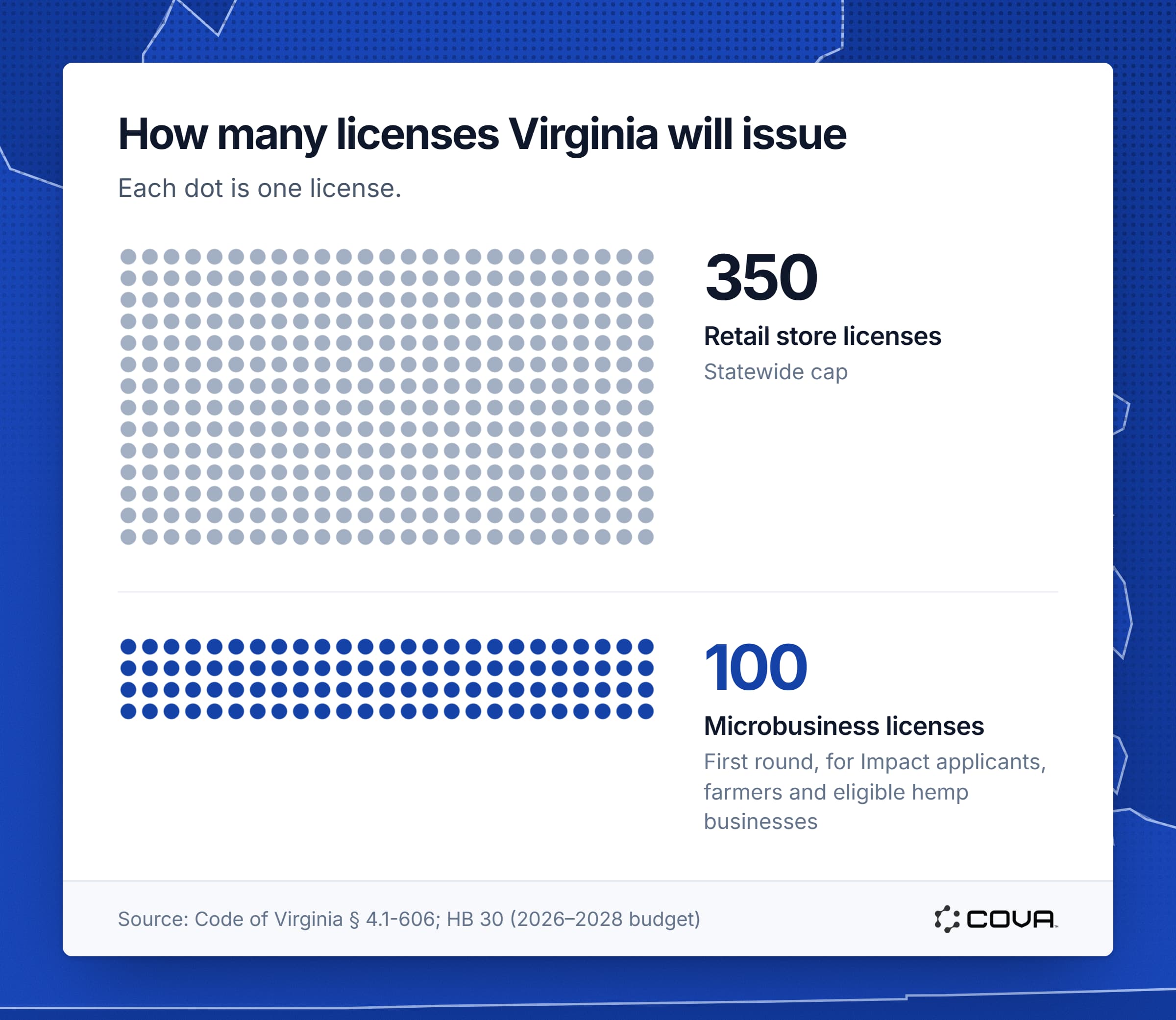
For most new retailers, a Virginia dispensary license means a retail store license, capped at 350 statewide, or a Virginia cannabis microbusiness license for those who qualify. The microbusiness license combines cultivation, processing and retail in one smaller operation, and up to 100 are available in the first round.
A Virginia dispensary license application commits the applicant to one route, because a microbusiness holder may hold no other license, whereas other licensees can hold an interest in up to five. Retail stores cannot use drive-thru windows or vending machines under the statute, and the draft rules add a ban on curbside pickup. Testing facilities are licensed separately and cannot be combined with any other license type.
The table sets both licenses against Virginia's other license types.
|
License |
What It Allows |
Limit |
Best For |
|
Retail marijuana store |
Sell cannabis, immature plants and seeds to adults 21+ |
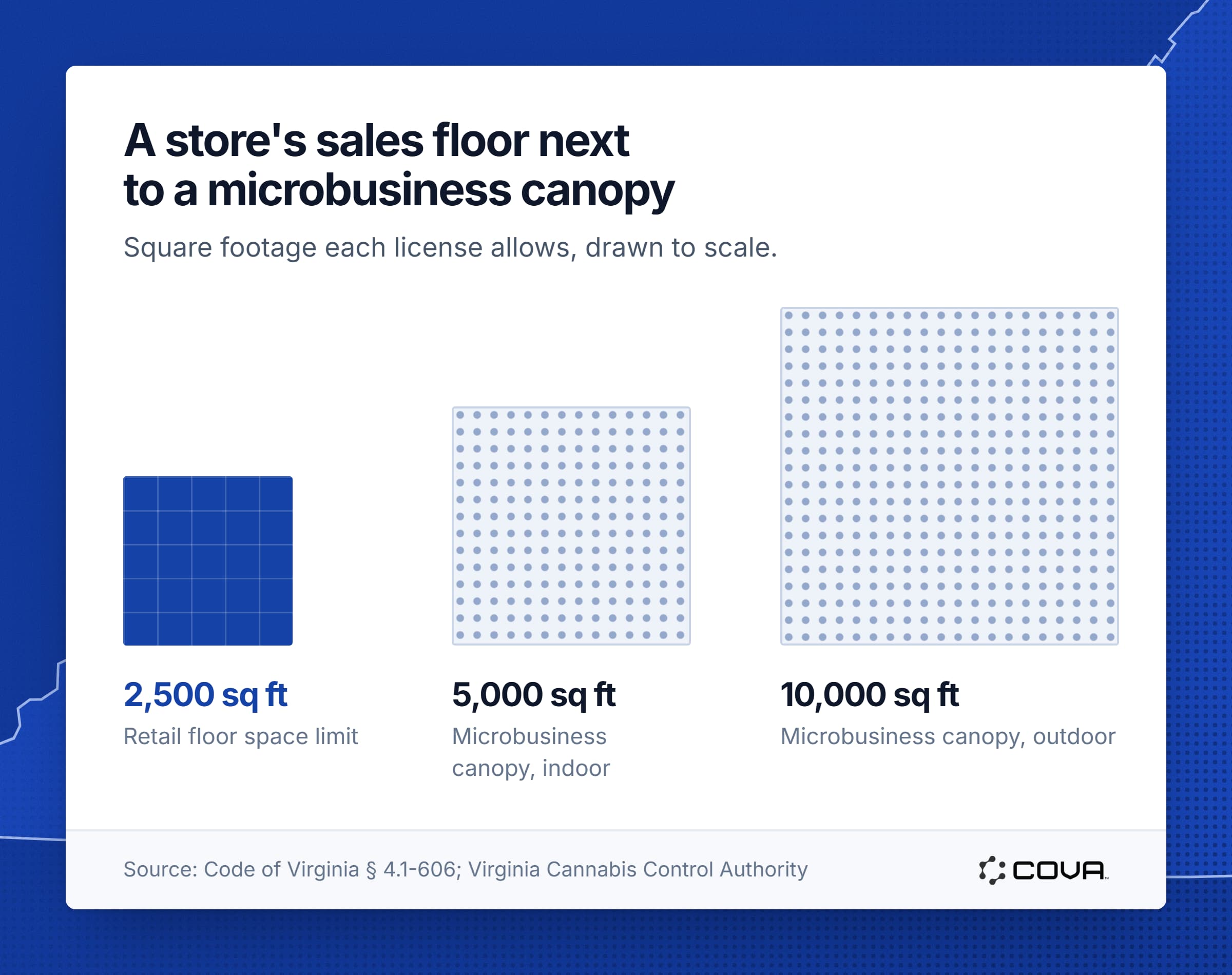
350 statewide; 2,500 sq ft retail floor space |
Retail-only operators |
|
Microbusiness |
Cultivate (up to 5,000 sq ft indoor or 10,000 sq ft outdoor canopy), process and sell, at up to two locations within 20 miles |
Up to 100 in the first round |
Impact applicants, farmers and pre-2021 hemp businesses |
|
Delivery operator |
In-person delivery from retail stores and microbusinesses |
Board discretion |
Delivery-only businesses |
|
Transporter |
Business-to-business transport and storage |
Board discretion |
Logistics operators |
|
Cultivation (Tiers I to V) |
Grow and sell to licensees |
Tier V capped at five in the initial round |
Growers |
|
Processing |
Manufacture and package products |
Board discretion |
Manufacturers |
|
Dual-use permit |
Existing medical operators add adult-use sales |
Existing pharmaceutical processors only |
Not open to new applicants |
What Are the Virginia Cannabis License Requirements?
A Virginia cannabis license requires applicants to be 21 or older, pass a state and FBI background check, show enough money to run the business and submit a signed labor peace agreement attestation, which remains a condition of the license.
Anyone researching how to get a dispensary license in Virginia should start with the statute's grounds for refusal, which list why the Board can deny an application:
- an applicant under 21
- a felony or crime of moral turpitude within the last seven years, other than marijuana offenses
- failure to show "financial responsibility sufficient to meet the requirements of the business"
- a site within 1,000 feet of a hospital, school, college or child day program
- a site that would harm nearby residential property values or quiet
- too many licenses already in the locality
Ownership limits apply across the market. No person may hold an interest in more than five licenses, transporter licenses excluded, and an interest means 10% or more of the equity or economic stake, which can bring passive investors under the cap. Acquiring 25% or more of a licensee requires Board approval.
Fingerprinting and a criminal history check cover the applicant and its officers, directors and principals, although the Board cannot disqualify anyone over a past marijuana-related conviction.
Standard applicants face no Virginia residency requirement, and no applicant needs a site at the application stage.
State law sets no minimum distance between dispensaries. Localities cannot ban cannabis businesses, although Virginia cannabis laws let them reduce the 1,000-foot requirement, set zoning and hours of sale, and object to a license within 30 days of CCA notice.
Who Qualifies as a Virginia Impact Licensee?
A Virginia Impact Licensee must be at least 51% owned, have a qualifying conviction (own’s, or a parent's, child's, sibling's or spouse's), and controlled by people who meet a residency test and at least one of six criteria. In return, Impact applicants get their own lottery, can request fee waivers and can access equity loans.
The residency test is met in either of two ways:
- having lived between 1999 and 2025 in a jurisdiction disproportionately policed for marijuana crimes
- having lived for at least three of the past five years in a historically economically disadvantaged community
The CCA has not yet published the jurisdictions that count. Qualifying owners must also meet at least one of these criteria:
- a conviction for a listed marijuana offense
- a parent, child, sibling or spouse with such a conviction
- five years at a public K-12 school in a historically economically disadvantaged community
- a Pell Grant, or two years at a college where at least 30% of students are Pell-eligible
- military veteran status
- USDA distressed-farmer relief in the last five years
Under the draft rules, Impact applicants can request a fee reduction or waiver and may have proof-of-funds requirements waived. The loans come from the Cannabis Equity Business Loan Fund, which receives 75% of the license fees collected from May 1, 2027 to May 1, 2028.
The status carries a five-year transfer lock meaning no more than 49% of an Impact license can be sold or transferred in that period. The CCA revokes licenses obtained through fraudulent or predatory arrangements. Both provisions target deals in which a qualifying person fronts for an outside investor, so Impact partnerships are best structured with counsel from the start.
How Does the Virginia Cannabis License Lottery Work?
The CCA holds a Virginia cannabis license lottery only when qualified applicants outnumber the licenses available in a category. Impact applicants are drawn first in a separate lottery, and anyone not selected there moves into the general lottery for the same license type, in this sequence:
- The CCA screens each application and marks it qualified or not qualified.
- Where qualified applicants exceed the licenses available in a category, the CCA holds a lottery that is "impartial, random, and in a format determined by the Authority."
- Impact applicants are drawn first, in their own lottery.
- Impact applicants who are not selected join the general pool for a second draw.
- Unselected applications stay on file for one year and can be considered in later rounds.
The CCA has not yet set the lottery's format, or how many licenses it will make available in each category beyond the retail and Tier V caps.
What Happens After You Win the Virginia Cannabis License Lottery?
Selection in the lottery brings preliminary approval and starts an 18-month period in which the applicant must secure a compliant site, clear local zoning, pass a CCA inspection and pay the license fee. The process then moves through six steps:
- The CCA issues preliminary approval.
- The applicant secures a compliant location and meets local zoning and land-use rules within 18 months, or within the extension the CCA may grant "if an applicant has made good faith efforts."
- The CCA notifies the local governing body, which has 30 days to object.
- The site passes a CCA inspection. Under the draft rules, a second inspection costs a retail store $2,500.
- The CCA grants final authorization or rejects the application within 90 days of receiving the complete site package.
- The applicant pays the initial authorization fee, $20,000 for a retail store under the draft rules, and receives the license. Sales cannot begin before July 1, 2027.
Editor’s Note: This 18-month period is extendable once by up to six months. Licenses are not allowed to sell at any point during this period.
Applicants are expected to finalize the real estate for their store during this period. It’s best to already have considered all zoning requirements including the 1,000-foot buffers, and for retail store licensees, the 2,500-square-foot floor space cap.
Many localities are also writing and updating their rules, so it’s best to check with your local authorities. For instance, Chesapeake's city council adopted a zoning initiating resolution for retail cannabis on September 22, 2026. Applicants who shortlist sites and talk to local planning staff before February 2027 can move straight into buildout, while everyone else starts the 18-month clock without a site.
|
Fee (Draft) |
Retail Store |
Microbusiness |
|
Application |
$4,000 |
$1,000 |
|
Initial authorization |
$20,000 |
$2,500 |
|
Annual renewal |
$15,000 |
$6,000 |
|
Reinspection |
$2,500 |
$1,000 |
Virginia's six licensed pharmaceutical processors pay a statutory one-time $10 million conversion fee for dual-use status. For new entrants, license fees are a small share of the full cost of opening a dispensary, which is driven by real estate, buildout, security and inventory.
How Much Does Virginia Cannabis License Cost?: Application & License Fees
Under the CCA's September 9, 2026 draft regulations, a Virginia retail store license costs $4,000 to apply, $20,000 for initial authorization, and $15,000 a year to renew.
A microbusiness license costs $1,000 to apply, $2,500 for initial authorization, and $6,000 a year to renew. Impact applicants can request fee waivers.
How Should You Prepare Before Virginia License Applications Open?
For anyone planning how to open a dispensary in Virginia, the months before February 2027 are critical for laying the foundation for your retail cannabis business, including preparing the ownership structure, documents, sites, capital and systems.
The CCA has not yet published its application documents but this checklist is based on the statute, the draft rules, and over a decade of experience working with cannabis retailers across North America:
- Structure Ownership: Audit your cap table with legal counsel to guarantee no individual or entity holds a 10% or greater stake across more than five licenses statewide. Impact eligibility requires at least 51% ownership and direct control by qualifying people. Separately, for five years after the license is issued, no more than 49% can be sold or transferred. Structure the operating agreement to meet both rules..
- Gather Impact Documents: Impact applicants can start collecting evidence now, although the CCA has not yet said which documents it will accept. For residency, keep records such as tax filings, utility bills or leases showing where you lived between 1999 and 2025, or for three of the past five years.
For the qualifying criterion, gather the matching record: court disposition records for a conviction (plus proof of relationship if it is a family member's), a DD-214 for veterans, school or college transcripts, Pell Grant records or USDA relief records.
- Business Plan and SOPs: Build a comprehensive cannabis business plan paired with operational dispensary SOP templates covering inventory intake, cash handling, and product recall protocols. Under the CCA's draft rules, your written policies and procedures must cover how you identify, record and report diversion, theft or loss.
The CCA checks your controls against diversion through your application, your security plan and a satisfactory inspection before it issues a license.
- Draft a Security Plan: Customize a compliant security plan template detailing commercial-grade intrusion alarms, limited-access vault storage, and continuous 24/7 video surveillance. Align camera coverage, retention and access control with the CCA's draft security rules, which require cameras at every entry and exit point and anywhere marijuana is held, with recordings kept for at least 30 days.
- Shortlist Sites and Check Local Zoning: Map potential commercial sites outside the mandatory 1,000-foot buffer zones surrounding schools, daycares, colleges, and hospitals (and under the statutory 2,500sq-ft retail sales floor cap). Cross-reference each property against municipal zoning codes and establish early contact with local planning departments to anticipate local conditional-use permit timelines or municipal objections.
- Proof of Capital: Raise liquid capital or get binding equity commitments to satisfy Virginia’s statutory financial responsibility requirements. Sufficient liquid reserves ensure operators can fund commercial lease deposits, architectural drawings, and facility buildouts immediately once the 18-month clock starts.
- Plan the Technology: The CCA must launch its adult-use seed-to-sale system by February 1, 2027. Virginia's medical program has run on Metrc since 2025, and Metrc states it will serve as the adult-use system of record, though the CCA has not announced an adult-use vendor contract or named a vendor in the draft regulations.
A Virginia dispensary POS needs to report to that system, verify age, enforce the draft per-transaction limit (2 ounces of cannabis, 8 grams of concentrate or 800 mg of THC in edibles) and track inventory from opening day.
- Watch the CCA: Monitor the CCA website and meeting agendas through December 2026 to track amendments between the preliminary draft rules and final regulations. Attend scheduled public proceedings to verify final application window release dates, adjusted fee schedules, and localized lottery guidelines before submitting your file in February 2027.
Virginia Cannabis License FAQ
Can out-of-state residents apply for a Virginia cannabis license?
Yes, under the statute as written. HB 30 sets no Virginia residency requirement for standard applicants, although Impact status depends on where the owners have lived, and residency-based programs elsewhere have drawn Dormant Commerce Clause challenges. Out-of-state applicants should confirm the position against the CCA's final application rules.
Do you need a location before applying?
No, Virginia requires a compliant premises only after lottery selection, within the 18-month preliminary approval period. Shortlisting sites early still pays off, because the 1,000-foot buffers, local zoning and (for retail store applicants) the 2,500-square-foot floor space cap limit the options.
Does a past marijuana conviction disqualify you?
No, the Board cannot disqualify an applicant because of a past marijuana-related conviction, and a qualifying conviction of the applicant or a close family member can support Impact status. Other felonies and crimes of moral turpitude within the last seven years remain grounds for refusal.
Can your county or city ban dispensaries?
No, Virginia localities cannot ban or opt out of cannabis businesses. They can set zoning, hours of sale and business license rules, reduce the state's 1,000-foot requirement, and object to a specific license within 30 days of CCA notice.
Next Steps for Virginia Cannabis License Applicants
Virginia’s commercial cannabis rollout finally gives entrepreneurs an opening to establish an enduring market presence in the Mid-Atlantic. While the license lottery introduces an element of chance, long-term market dominance will belong entirely to operators who treat the pre-application window as active preparation rather than passive waiting.
The path to a license runs in order:
- check eligibility and ownership
- apply from February 2027
- get through the lottery
- complete site, zoning and inspection within 18 months
Even though the CCA’s December vote on final rules is still months away, Virginia businesses should start their site and technology planning right away.
Over 2,200 cannabis dispensaries run on the Cova platform – voted Best Cannabis POS and Software of the Year twice in a row. Cova is helping Virginia retailers prepare their POS and Metrc reporting before the first sale. Get in touch with a Cova expert to learn how the right tech platform can streamline payments, inventory management, reporting, and compliance.
To top it all off, Cova’s vast ecosystem of integrations includes leading tech partners in the cannabis industry, like Leafly, Weedmaps, Headset, KayaPush, SpringBig, and many more.