
Cannabis Payments Guide 2026

U.S. regulated cannabis sales reached an estimated $28.6 billion to $29.6 billion in 2025, down from $30.1 billion in 2024. The same analysis forecasts a modest recovery to $30.5 billion in 2026. Payment access, however, remains fragmented by product type, state program, financial institution, sponsor bank, and payment network.
Cannabis retailers therefore need more than a payment method. They need a documented payment structure, integrated reporting, clear settlement terms, and a fallback when a provider or network changes its rules.
But with most banks still refusing cannabis payment services to cannabis businesses, how are these payments being made? It can’t all be cash.
This guide covers the payment methods available to U.S. cannabis retailers, the current status of cannabis banking legislation, and everything you need to know before choosing a payment provider.
Disclaimer: This page is meant to educate readers and spread awareness only, it is not intended to be, nor should be considered legal advice. This page is current as of July 2026. Given the evolving nature of cannabis regulations, legal advice of any nature should be sought from legal counsel.
- Key Takeaways
- Federal Cannabis Rescheduling 2026
- What’s the Deal with Cash?
- Cashless Cannabis Payments 2026
- Can U.S. Dispensaries Accept Credit Cards?
- CBD & Hemp Retailer Payments
- What About Cryptocurrencies?
- No Regular Banking for Cannabis?
- Cannabis Payment Compliance
- Choosing the Right Solution
- The Future of Cannabis Payments
- Ready to Accept Cannabis Payments?
Key Takeaways
- Federal rescheduling is making progress. The Justice Department placed FDA-approved marijuana products and products regulated under a qualifying state medical marijuana license in Schedule III on April 23, 2026. Adult-use marijuana and other uncovered products remain in Schedule I.
- Broader rescheduling is still pending. A new DEA hearing began June 29, 2026, and is scheduled to conclude July 15. No broader final order had been issued by this page's July 14 cutoff.
- ACH is the most reliable cashless option available today and is projected to handle roughly 42% of cannabis transactions in 2026.Customers spend measurably more per visit when using ACH.
- Cashless ATM and PIN debit both depend on traditional payment infrastructure that face regulatory crackdowns – resulting in potential disruptions or worse. Multiple payment solutions are thus non-negotiable.
- A combined. integrated payments solution (like Cova Pay) adds payments support for major debit and credit cards, Apple Pay, Google Pay, and Samsung Pay in a single POS platform.
- The new SAFE Banking Act of 2026 has been introduced in both chambers. It has not passed either chamber or become law.
Federal Cannabis Rescheduling: What Changed in 2026

The Trump administration signed Executive Order 14370 on December 18, 2025, directing the Attorney General to complete the Schedule III rulemaking process as quickly as federal law allowed.
On April 23, 2026, the Justice Department and DEA placed two categories in Schedule III:
- FDA-approved products containing marijuana
- marijuana products regulated under a qualifying state-issued medical marijuana license
The order did not move all marijuana to Schedule III. Adult-use marijuana, unlicensed crops, bulk marijuana, and products outside the order's scope remain in Schedule I.
Treasury and the IRS have said the order should provide Section 280E relief for covered medical-marijuana activities. Forthcoming guidance is expected to address businesses with both covered and Schedule I activities, including expense allocation and transition rules. Adult-use operators should not assume that medical rescheduling changes their federal tax treatment.
Schedule III reduces a federal barrier for qualifying medical activity, but the order does not require any bank, card network, acquirer, or payment processor to accept marijuana transactions. Retailers still need written confirmation that their specific products, licenses, merchant category, transaction flow, and service area are approved.
That said, the DEA opened an expedited hearing on June 29 to consider moving the remaining marijuana covered by the 2024 proposed rule to Schedule III. As of writing, a broader final rule has yet to be issued.
What’s the Deal with Cash Payments

Cash has always been the most common form of payment in the cannabis industry. It is undoubtedly convenient in a lot of ways, offers quick turnaround time for customers, and is the most “fire and forget” option out there.
Yet, it’s not the ideal solution:
- Over 83% of Americans aged 30 to 50 use debit or credit cards for their daily transactions and don’t necessarily carry cash regularly.
- Cards accounted for 79% of U.S. noncash payments by number in 2024.
- A cash-only dispensary asks many customers to change a routine they use almost everywhere else.
- Cash limits your ability to upsell to customers and cart size is also limited by how much cash someone has in their pocket.
Additionally, keeping track of cash payments is neither easy nor always possible. And with regulations around cannabis payments becoming stricter, this is a major problem for cannabis dispensaries.
One way to get around this is to use a comprehensive POS system that makes life easier for your budtenders. For instance, Cova POS brings active cash management features that help with a variety of cash drawer functions including managing cash in-cash out, drawer audit, bank transfers, and more. These features also help reduce the cost of overhead expenses, inefficiencies, and errors that come with counting cash manually.
Another problem with cash payments is the lack of compliance oversight when it comes to tracking and tracing. And untraceable cash handling practices can lead to cannabis inventory issues as well. But these issues too can be overcome with the right POS system. For instance, Cova has cutting-edge security integrations that combine transaction data with security camera footage to have 360-degree visibility into cash payments.
But even with the best point-of-sale system possible, there is still one risk cannabis dispensaries face with cash payments – the risk of robberies and theft. In fact, we’re currently seeing an alarming trend of robbers specifically targeting cannabis dispensaries because of their large cash reserves.
Also Read: Cannabis Fraud 101: Tips to Safeguard your Dispensary & Prevent Thefts
The Cashless Cannabis Payments To Use in 2026
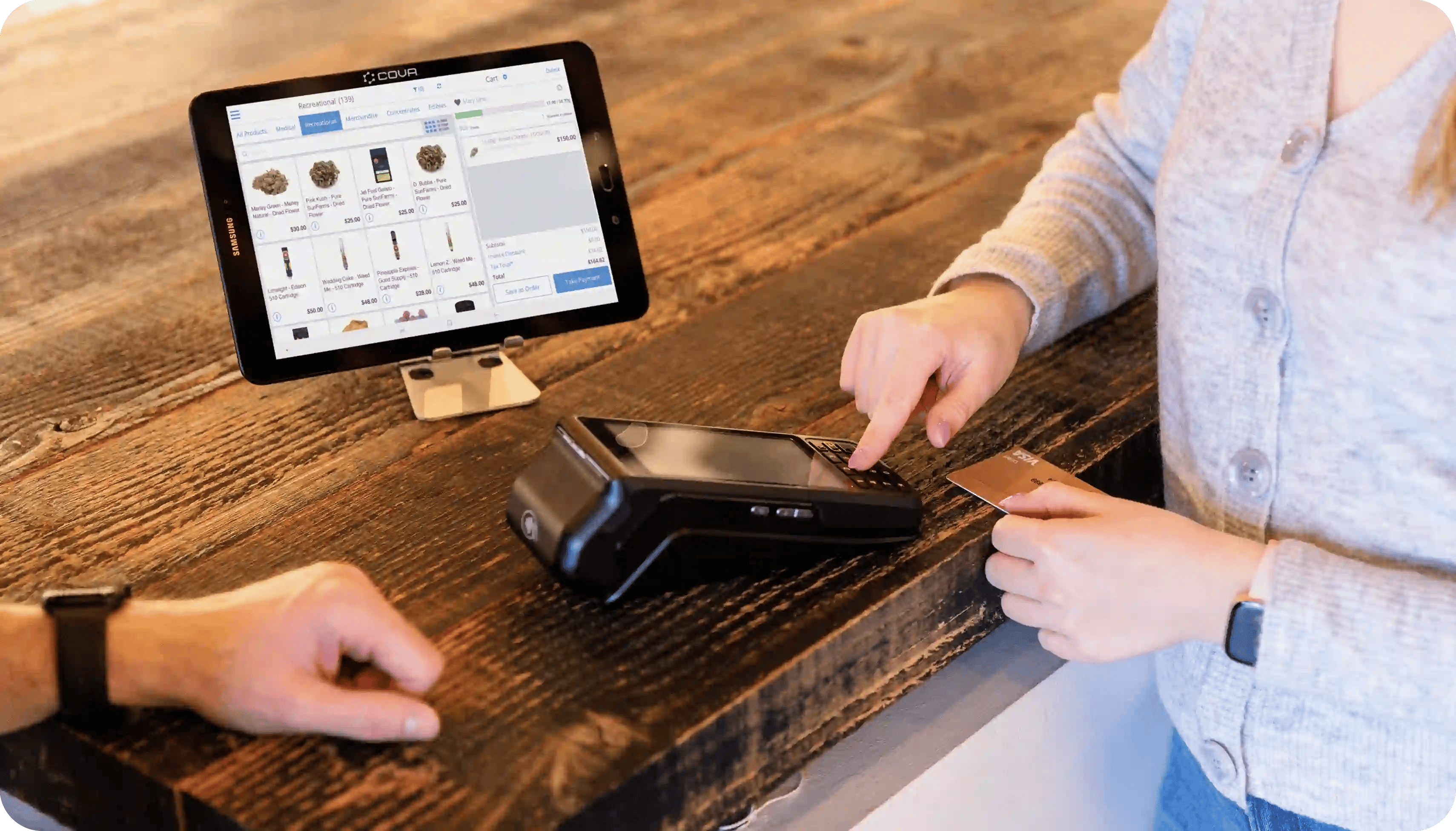
Cannabis, being currently classified as a controlled substance at the federal level, has consequences for cannabis businesses all over the country. Arguably, the biggest challenge is the inability to use traditional payment networks like Visa and Mastercard to process payments.
Cash is indeed a popular choice, but it’s not without issues (some of which are too big to ignore). Cova works with hundreds of cannabis dispensaries across North America and we’re seeing a clear trend – a growing number of cannabis businesses are making the switch to cashless payment methods, like:
1. ACH Electronic Transfer
ACH or Automated Clearing House is a form of transferring money directly between banks without the use of checks, wire transfers, or cards. With ACH, businesses can instantly verify that a payment has come through and instantly see the difference reflected in their bank accounts.
It’s robust too. The U.S. ACH Network processed 35.2 billion payments worth $93 trillion in 2025, up 4.9% and 7.9%, respectively, from 2024. ACH's share of cannabis transactions is projected to grow significantly, potentially reaching 42% of all cannabis payments by the end of 2026.
But even if you use a method as reliable as ACH, your Point of Sale system can still be the weak link.
Except if you’re using Cova Pay. Cova has achieved nine consecutive years of 100% uptime on 4/20, the busiest day in the cannabis retail calendar – processing hundreds of thousands of orders in a single day, year after year.
Cova comes with a fully integrated ACH solution that supports in-store and cannabis eCommerce websites out of the box. Cova Pay ACH doesn't require any terminals – on a customer's first purchase, the budtender provides a secure link for bank-account connection and payment. Repeat purchases use the saved setup, with the transaction recorded in POS reporting. No separate app or payment card is required.
2. Cashless ATM Products
A cashless ATM or point-of-banking product uses a debit card but records the transaction as an ATM withdrawal rather than a retail purchase. Cashless ATM reduces transaction times and improves customer experience which very often leads to increased basket size and greater revenue.
There are some small trade-offs, though. Notably, cashless ATM transactions can only be processed in $5 increments (some vendors may let you round up to the nearest dollar) and customers may incur additional transaction fees.
Editor’s Note: In the past, Visa and Mastercard have raised concerns about cashless ATMs as transactions disguised as cash withdrawal, with widespread processor disruptions following in late 2022.
When evaluating payment solutions, cannabis retailers should always:
- Have a backup payment solution in place
- Ask processors about their contingency plans
- Verify the processor's track record and stability
At Cova, we carefully vet our payment partners and maintain relationships with multiple processors. This approach ensures that if one system experiences disruption, we can quickly transition our clients to alternative solutions, minimizing any impact on their business operations.
Also Read: Cannabis Payment Alternatives to Cashless ATMs for Dispensaries
3. Debit Cards
PIN debit processes a retail purchase through an enabled debit network after the customer enters a personal identification number. The transaction should be authorized and coded as a retail debit purchase rather than an ATM withdrawal. Debit cards provide convenience for both customers and dispensaries, but there are caveats.
Federal Regulation II requires debit cards to support at least two unaffiliated payment networks. It does not guarantee that every enabled network will accept marijuana transactions. Availability still depends on the issuer, network, sponsor bank, provider, merchant agreement, and transaction structure.
The restriction results in only about 50% of PIN debit payments being successfully processed through these networks. That said, providers like Fiserv are now openly supporting cannabis debit payments on their rails.
Before adopting PIN debit, ask the provider to identify the network and sponsor bank in writing, confirm that the agreement expressly covers the products sold, and document settlement, reserve, chargeback, and service-interruption terms.
Can Cannabis Dispensaries Accept Credit Card Payments in the United States (2026)?

The answer depends on what the retailer sells. Standard credit-card payments remain unavailable for adult-use marijuana sales in the United States. Visa, Mastercard, Discover, and American Express have not broadly authorized marijuana transactions through their conventional credit-card networks.
CBD-only stores can legally accept credit cards through integrated solutions like Cova CBD payment processing.
Credit cards remain attractive to retailers and consumers because they are familiar and can reduce cash handling. But while things may change in the future, in the United States, processing marijuana transactions through credit card comes with some inherent risks, such as:
- frozen or terminated merchant and bank accounts
- held funds or additional reserves
- chargebacks, fines, and contract claims
- regulatory scrutiny and potential licensing consequences where misrepresentation violates state rules
This is true even if recreational cannabis is legal in your state because the payment networks (like Visa, Mastercard, Discover, and American Express) all operate at the federal level.
Fortunately, there are alternative digital payment solutions like Cova Pay that allow cannabis businesses to accept electronic payments without any “high-risk” fees or restrictions. Cova offers cashless payments through vetted payment partners, ensuring reliable, compliant transactions while providing redundant processing options to maintain business continuity.
What About Payments for CBD & Hemp Retailers?
CBD and hemp businesses generally have more options but neither “CBD” nor “hemp” provides blanket approval. Product formulation, cannabinoid source, testing, labeling, therapeutic claims, sales channel, destination state, and processor policy all affect eligibility.
The 2026 Federal Hemp “Ban” or Section 781 of the 2026 federal appropriations law brings major changes for hemp retailers. It replaces the current delta-9-only framework with a total-THC standard, excludes cannabinoids synthesized or manufactured outside the plant, and limits final hemp-derived cannabinoid products to 0.4 milligrams of total THC per retail container.
Once a product falls outside the federal hemp definition, a processor may no longer treat sales of that product as lawful hemp or CBD transactions. A retailer selling both compliant CBD and newly excluded hemp products could place its entire merchant account at risk.
The change could also affect some full-spectrum CBD products containing trace THC. Many banks and payment processors already classify CBD and hemp retail as high risk. Retailers should audit their product catalog and certificates of analysis before November 12, then obtain written confirmation that each product category remains eligible under their merchant agreement.
Section 781 is scheduled to take effect November 12, 2026 and states may impose lower limits, prohibit intoxicating hemp products, restrict particular cannabinoids, or require licensed channels.
In May 2025, Cova expanded its integrated payment processing for CBD and hemp retailers. Cova Pay for CBD and hemp supports major debit and credit cards, Apple Pay, Google Pay, and Samsung Pay through Cova POS. Availability remains subject to product review, underwriting, state law, and the processor's current terms.
Before signing with a CBD or hemp processor, confirm:
- which cannabinoids and product formats are permitted
- whether eCommerce, subscriptions, delivery, and card-not-present sales are covered
- reserve, chargeback, termination, and prohibited-product terms
- required age verification and product documentation
- support for every state in which the retailer sells or ships
- how the November 12, 2026 federal definition will affect product eligibility and accounts
- the process and notice period for removing newly prohibited products from the catalog
We’ve compiled a detailed breakdown of what to look for – and what to avoid – based on real-world experience with CBD retailers. Read the full guide here: Payment Processing for CBD and Hemp Retailers
What About Cryptocurrencies?

Cryptocurrencies largely operate outside traditional banking systems and regulations, which can be attractive as a cannabis dispensary owner. However, crypto payments come with significant risks and challenges that outweigh potential benefits.
While cryptocurrency payments are legal for cannabis transactions, their notorious price volatility makes them unreliable for daily business operations. Stablecoins reduce some of the price volatility but does not address the other problem of cryptocurrencies – it can be a technical nightmare.
Some payment solutions promise to simplify the process by managing wallets and converting crypto to cash deposits, these services typically rely on federally regulated sponsoring banks. This creates a critical vulnerability: if transactions violate bank risk policies, accounts can be frozen, and retailers may permanently lose access to their funds since there's no regulatory protection or recourse for recovery.
Overall, the practical implementation of cryptocurrency payments demands significant technical expertise, dedicated IT support, and substantial resource investment. These operational demands are particularly difficult to justify given that only a small percentage of consumers regularly use cryptocurrency for purchases.
Moreover, the unregulated nature of cryptocurrencies means new restrictions can be implemented without notice, potentially leaving retailers without access to their funds and no government backing or FDIC insurance to protect their assets.
Why Can’t I Use Regular Banking for Cannabis Payments?
Banks operate under federal law and are thus not allowed to facilitate the sale of cannabis, even if cannabis is legal in your state.
Editor’s Note: Banks are not categorically barred from serving every cannabis business. FinCEN's marijuana-banking guidance gives financial institutions a framework for customer due diligence and suspicious activity reporting. The work is costly with federal-state conflict and thus banks simply choose to decline the industry.
Current State of SAFE Banking Act of 2026
In the past five years, the SAFE Banking Act has been introduced in the Senate several times but has yet to be passed.
As of July 14, 2026, the active proposal is the SAFE Banking Act of 2026. Congress has two companion versions of the same proposal: S. 4942, introduced in the Senate on June 24, and H.R. 9471, introduced in the House on June 25. Only one bill is pending in the Senate.
Neither version has received committee approval or a floor vote, and no vote is currently scheduled.
The 2026 SAFE proposal would protect banks that choose to serve state-sanctioned marijuana businesses from specified federal penalties, deposit-insurance consequences, criminal liability, and asset forfeiture. It also covers service providers and hemp and CBD businesses while preserving FinCEN obligations and each bank’s right to decline an account. It would not legalize marijuana, guarantee banking access, lower fees, or authorize credit-card networks. Both bills remain at the introductory stage.
How to Maintain Compliance in Cannabis Payments and Avoid Payment Risks
US states have made significant strides in clarifying the rules and regulations surrounding cannabis payment processing. The onus is now on cannabis businesses to ensure compliance and mitigate risks.
This starts with ensuring your inventory management and POS systems are fully integrated with your state’s seed-to-sale track and trace system. For instance, delaying, failing to send, or sending incomplete/incorrect compliance reports to your state’s regulatory body can result in financial penalties and in some cases, loss of licensure.
There are different steps cannabis businesses are encouraged to take to ensure compliance but perhaps the single most important thing is to use a secure payment solution with a vendor that specializes in cannabis transactions. Industry-specific vendors offer:
- a more complete feature set for compliance with cannabis regulations
- have a support ecosystem that better understands your needs
- built-in integrations with additional services crucial to running your dispensary smoothly
For instance, Cova's Cannabis Dispensary POS Software and inventory management system is built specifically for the marijuana retail industry. With lightning-fast transactions, 100% uptime, and a reliable offline mode, Cova is the best-reviewed and most recommended dispensary management software system.
Cova adheres to all reporting requirements, has automatic 2-way integration with Metrc, BioTrack, and other regulatory systems, and includes all the features needed to keep cannabis retailers compliant, including:
- ID scanner for age and card verification
- Integrated inventory and sales tracking and reporting
- Built-in product equivalency conversions and purchase limit enforcement.
The Cova Dispensary POS also synchronizes directly with Quickbooks® (or export into other file formats) and meets several industry compliance regulations including Type 1 HIPAA and SOC 2 Type II.
In addition to a comprehensive cannabis payment processing solution, cannabis dispensaries are also encouraged to:
- Implement Secure Payment Solutions: Use payment processors that specialize in cannabis transactions and are knowledgeable about the unique challenges and compliance requirements of the industry.
- Stay Updated on Regulations: Regularly review state and federal guidelines related to cannabis payment processing to ensure that your practices align with the latest legal requirements.
- Conduct Regular Audits: Periodically audit your payment processing systems and financial records to identify and address any potential compliance issues.
- Train Employees: Ensure that your staff is well-trained in the legalities and best practices of handling cannabis payments to prevent inadvertent violations.
- Maintain Transparent Records: Keep detailed and accurate records of all transactions to provide clear documentation in case of regulatory scrutiny.
By proactively addressing these areas, businesses minimize payment risks and ensure compliance with federal and state regulations.
Choosing the Right Cannabis Payments Solution (and the Benefits of Doing So)

Picking a cannabis payment processing solution is a major investment for any dispensary. There are several cannabis payment solutions available in the United States but not all are built to the same standard.
And it can be a time-consuming process to tell apart the superficial features from the features that have a real impact on your bottom line.
Also Read: Your 2026 Guide to Essential Cannabis Dispensary Technology
To help you make that call with confidence, here is a list of the five most essential features that you should look for in your next cannabis payment solution:
1. Seamless Integrations with POS and eCommerce
Your cannabis payments software should be connected with your cannabis POS, eCommerce platform, inventory management, and other tools for a seamless experience, both for your employees and your customers.
A fully integrated system eliminates the need for manual reconciliation and data entry, streamlining the payment process to a few clicks. Cova Pay offers seamless integrations across Cova POS and partner solutions for a unified digital payment experience.
Real World Benefit: Improved Customer Experience
Going cashless reduces customer wait times and enhances the shopping experience, increasing transaction rates by over 20% per hour and allowing customers to spend more without cash limitations. Also, most people don’t carry cash nowadays.
2. Multichannel and Mobile Dispensary Payments
Don’t leave any of your customers without an option. Offer multiple payment options to increase sales and streamline collections. Ensure your payment provider supports transactions from deliveries to curbside pickup and integrates additional payment methods like gift cards. For instance, Cova’s mobile tablet POS is flexible enough to integrate additional cannabis payment methods like gift cards in the future and supports the default payment methods.
Real World Benefit: Increase in Sales and Revenue
Cashless payments can increase average basket size by up to 25%. When customers are not limited by the amount of cash they carry, they tend to buy more. Upselling techniques are also easier to implement in a cashless dispensary environment.
3. Transparency in Transaction Fees and Deposit Timeline
Choose a payment partner with clear pricing and quick deposit timelines. Your dispensary may be charged extra fees by some payment processors, such as monthly subscription costs, annual compliance fees, refuse fees, support fees, termination fees, consumer convenience fees, etc.
Transparency in processing fees also helps you set accurate product prices and forecast profits.
Real World Benefit: Easy Banking and Account Tracking
Cashless payments reduce trips to the bank and simplify tracking. Automated transaction reporting also helps save time on cash handling and counting, making accounting, error reporting, and compliance much simpler.
4. Valuable Insights via Data Analytics
Integrated payment data analytics provide crucial insights into your dispensary’s performance and customer preferences. Gain crucial insights into the success of your dispensary and the opinions of your customers by utilizing integrated dispensary data analytics to derive valuable insights from your payments.
Visualize data points with clear, real-time graphs and charts to make better business decisions and evaluate the success of offers like rewards or gift card programs. Additionally, these insights enable you to assess the success of offers, such as your rewards or gift card programs. For instance, with Cova Pay, customers tend to spend an average of 25% more as compared to cash purchases.
Real World Benefit: Data Collection and Analytics
Every digital payment transaction provides individualized customer data, offering valuable market research. Payment data analytics help evaluate sales performance and the success of special offers.
5. Compliance and Security Measures
The right payment processor will ensure you can protect your clients by adhering to all regulations. This compliance guarantees that your payments are processed over unique, secure routes, ensuring the ongoing security of your client's financial information.
Real World Benefit: Increased Safety and Less Overhead
A cannabis payments solution with error-reporting features improves cash management and reduces administrative overhead and employee time spent on counting cash manually and reconciling errors, which can be invested elsewhere to streamline dispensary operations.
In addition to these essential features, cannabis dispensaries should look for automated features in dispensary payment processing software such as:
- accepting and managing tips
- support for cannabis delivery services
- offline functionality
- cannabis inventory management
- integration for loyalty programs and clienteling
- seamless syncing with your accounting software
These features and integrations can pay for themselves, many times over.
The Future of Cannabis Payments (2025 and Beyond)
With most of us focused completely on the SAFER Banking Act and federal rescheduling, it’s easy to forget about all of the other developments happening in the cannabis industry. And with cashless solutions becoming increasingly necessary, it’s even more important for dispensary owners to stay informed about the latest trends and developments in cannabis payments.
Here is a sneak peek at some of the biggest cannabis payment trends:
- The U.S. cannabis industry is projected to reach nearly $47 billion in 2026, as it cements its place as one of the country's fastest-growing sectors. Pressures to relieve as well, through market consolidation with the number of active cannabis business licenses declining as oversaturation is trimmed
- Medical and adult-use businesses now face different federal classifications. Retailers serving both markets need clean records and professional guidance before allocating revenue, expenses, or payment methods between them.
- Nearly 42% of cannabis transactions are projected to run over ACH rails in 2026, up from 28% in 2025, reflecting a continued an d accelerating shift away from cash. While cash still accounts for roughly 60% of payments, that share dropped 5.4% year-over-year, and data shows customers who pay digitally spend more per visit.
- An increasing number of states are providing tax relief by decoupling section 280E from their state tax codes. This would allow cannabis businesses to claim business expenses and reduce their taxable income. New York and Illinois are some of the most recent states to make this change.
Ready to Accept Cannabis Payment at Your Dispensary?

Choosing safe and convenient cannabis payment methods requires a thorough understanding of the evolving landscape. While cash payments are still very common, switching to cashless methods such as ACH transfers can significantly improve operational efficiency and customer experience.
With over two decades of experience working with countless cannabis dispensary owners across North America, Cova dispensary POS systems offer secure and compliant payment processing options that mitigate the risks associated with cash-based transactions.
Stay ahead of the competition by choosing the best cannabis payment solution for your dispensary. Schedule your COVA Software Dispensary POS Demo. Our team of experts will help you understand the capabilities of our award-winning POS system and how it can meet (and exceed) your business’s unique needs.