
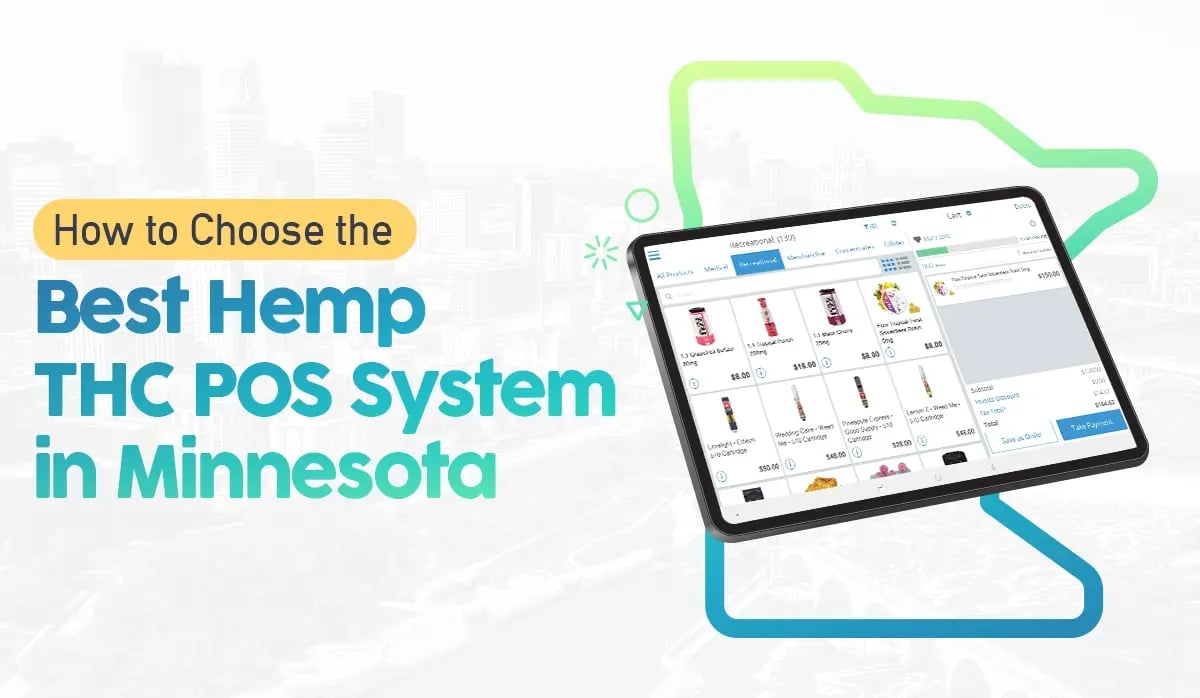
Minnesota’s hemp-derived THC market is evolving quickly, and retailers now have the option to convert their existing registrations into a permanent lower-potency hemp edible retailer (LPHE-R) license. With that shift comes a growing need for technology that can support compliant, reliable day-to-day operations. For many stores, that starts with choosing the right hemp THC POS system built for Minnesota and understanding what separates the best systems from the rest.
Not every POS can handle high-risk payments, accurate THC tracking, or Minnesota’s regulatory requirements. The wrong system creates risk, slows down checkout, and adds work for your staff. The right hemp THC POS keeps your store compliant, simplifies daily workflows, and prepares you for future changes in the state’s cannabis program.
This guide explains what to look for in a Minnesota-ready hemp THC POS, how to compare vendors, and which features matter most as the market continues to mature.
Why Popular POS Systems Don’t Work for Minnesota Hemp THC Retailers
As a Minnesota hemp THC retailer, using a generic POS puts your business on borrowed time. Popular "out-of-the-box" payment processes like Square, Clover, or Stripe flag all THC transactions as “high-risk”, while some outright ban the sale of THC or CBD products.
If the prospect of frozen funds and account shutdowns wasn't enough to make you avoid non-approved processors, there is also the matter of customer service and ease of use. Dedicated hemp POS systems have the specific tools and functions your budtenders will use every day, like age verification and weight limit alerts, as well as a wide variety of integrations, useful for any hemp business.
Best Payment Methods For Minnesota Hemp THC POS Retail
Being labelled “high-risk” doesn’t mean you have no options, in fact, far from it. Unlike cannabis dispensaries that are restricted by federal banking laws, CBD and hemp retailers in Minnesota have access to stable, integrated card processing – provided they use the right partner.
To ensure smooth checkout with payment options for your customers, your THC POS system should the following payment methods:
Also Read: Best CBD Payment Processors for CBD & Hemp Stores 2025
-
Integrated Credit & Debit Cards
One critical advantage hemp THC retailers have over dispensaries is their ability to accept major credit and debit cards directly. Having a specialized processor (like Cova Pay) that offers fully compliant, integrated card processing creates a familiar checkout experience for customers while ensuring stability and safety for operators.
-
ACH Payments
ACH Electronic Transfer (ACH) has some of the lowest transaction fees and is consistently reliable for THC retailers. Because ACH bypasses credit card networks entirely, it is immune to many of the sudden policy shifts that affect card processing. Your POS should have out-of-box integration with ACH for both the in-store terminal and eCommerce checkout. -
Gift Cards & Store Credit
Fully supporting digital gift cards through your POS not only aids faster checkout but also results in a marked improvement in sales, up to 40% increase in revenue and an influx of new customers.
Editor’s Note: Cashless ATM is another popular option but it’s not recommended for CBD or Hemp THC retailers since it operates on traditional payment networks and additional scrutiny due to federal cannabis regulations.
8 Features to Look For in a Minnesota Hemp THC POS System
For the best hemp THC POS system in Minnesota, focus on these 8 core features. They reflect Minnesota’s regulatory requirements and outline the POS capabilities that support compliance, high-risk payment processing, accurate inventory, and smooth daily operations.
-
Payment Processing Integrations
The ideal Minnesota hemp THC POS supports approved high-risk payment processors suitable for hemp THC retail. You can compare THC payment processors on settlement reliability, approval consistency, and processor transparency, but should always have multiple options for redundancy.
Why You Need It: THC retailers need a dedicated POS because of “high-risk” transactions and limited to no support from popular payment processors such as Stripe or PayPal.
What To Look For: A POS system with high reliability (no outages in recent history), real-time reconciliation so you can flag errors and manage chargebacks quickly. Fraud prevention tools like address verification are also a must for cannabis and hemp retailers.
-
Inventory Management, Tracking & Compliance Reporting
Inventory management and POS go hand-in-hand – a THC retailer requires both and ideally within the same platform to prevent compatibility issues, extra training, and tech bloat.
Why You Need It: Only a dedicated POS & inventory management system will meet all compliance requirements. For instance, retailers must track each item’s sale by its batch number, as per Minn. Stat. §151.72. This allows immediate flagging at the point-of-sale if a batch is recalled or found to be noncompliant.
Similarly, clear transaction logs are needed to maintain payment-processor approval for any THC shop.
What To Look For: A combined platform with both an inventory management suite and a fully compatible THC POS. The platform should have support for custom product information fields, workflows, integrations with other business tools, and the flexibility to update settings as Minnesota’s OCM refines its guidelines.
-
Fast Checkout, Product Lookup, and Return Workflows
A seamless checkout isn’t guaranteed with every POS system – some are built for it, others lack key functionality.
Why You Need It: Over 61% of U.S. consumers have left stores due to long lines. Searching inventory, handling returns, and transaction processing all need to be quick and easy for a seamless checkout.
What To Look For: An easy-to-use POS specifically for hemp THC shops in Minnesota with searchable inventory, barcode scanning, and loyalty/CRM with intuitive staff workflows for common scenarios (such as gift cards and returns).
-
Built-in ID Scanner
Typically, you would have to purchase a separate ID scanner, but a full-featured POS system like Cova POS has a built-in secure ID scanner with real-time integration with your inventory, customer data, and local compliance rules.
Why You Need It: Retailers are legally required to verify that the customer is at least 21 years of age, as per Subdivision 5c of the Minn. Stat. §151.72.
What To Look For: ID scanners built into POS systems are faster, more reliable, and easier to use. For instance, Cova POS supports instant age filtering, identifies existing customers for faster check-in, supports advanced audit logs, and stops looping with its built-in ID scanner.Also Read: ID Scanning & Age Verification: Secure, Compliant Sales
-
Analytics & Sales Data
The point-of-sale is a goldmine of customer information that standard retail analytics fail to capture, but are required to keep the customers coming back through effective in-store strategy, loyalty programs, and marketing campaigns.
Why You Need It: To identify sales trends, dead stock, and peak hours to optimize staffing.You can also build customer profiles while staying compliant with privacy regulations for more effective marketing.
What To Look For: A POS that captures the nuances of age-restricted sales through reporting dashboards, built-in data visualization, and easy data export. The POS must also offer built-in loyalty and CRM tools to keep your tech stack lean and efficient.
Also Read: Cannabis Analytics and BI Reporting to Expect From Your POS Provider
-
Multi-Location Support
A single POS system should work across your physical retail stores to minimize compliance overhead, errors, and ensure real-time inventory sync between locations.
Why You Need It: Without real-time synchronization, inventory and stock discrepancies will creep in between different sales locations. Syncing data manually adds admin overhead, creates data silos, and is a poor use of staff time.
What To Look For: A POS with real-time inventory syncing for hemp THC retail. For multi-location operators, the POS should support centralized inventory management that allows stock transfer between stores and view aggregate sales data.
-
eCommerce & Website Support
A POS with an eCommerce integration for hemp THC retailers in Minnesota ensures the online shopping experience is not an afterthought with poor (or no) syncing with the POS.
Why You Need It: Online menus and websites will make your hemp products more accessible and online orders have basket sizes up to 25% larger.
What To Look For: A POS with seamless eCommerce as part of its retail suite which syncs directly and in real-time with inventory, pricing, promotions, and CRM. Some providers like Cova also offer an in-store Self Serve tablet, allowing customers to browse menus, build orders, and send express checkout orders, and more from their phone.
Editor’s Note: Minnesota’s THC market is growing, and even if you don’t have a website or multiple stores right now, you may expand in the future, so plan accordingly.
-
A Growing Ecosystem
The best hemp POS systems act as a hub, connecting seamlessly with the specialized tools you use for accounting, marketing, workforce management, etc – while also future-proofing your investment against unexpected needs or regulatory requirements.
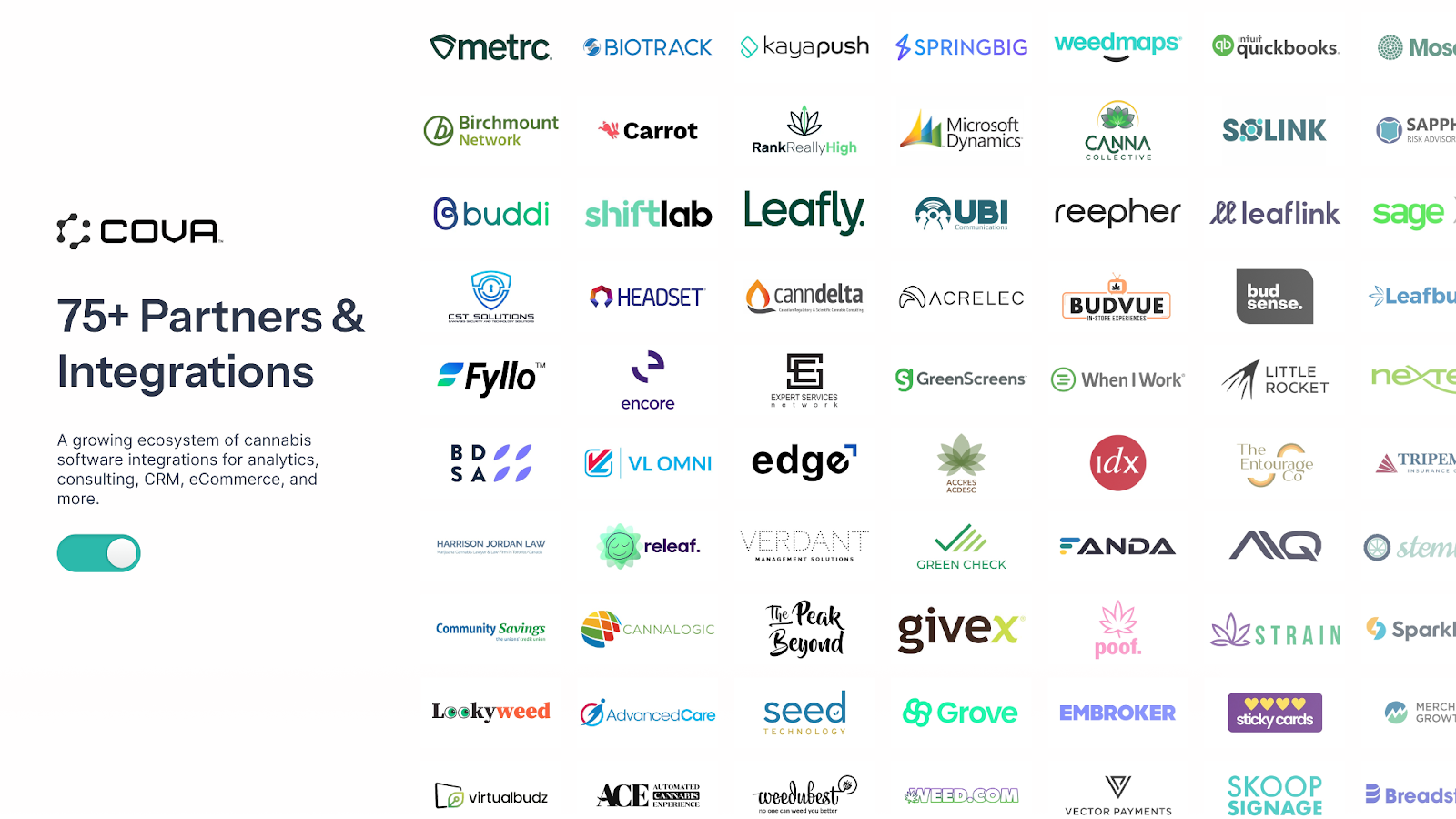
Why You Need It: Manual data entry is a productivity killer and liability, especially in accounting and compliance. A POS with few integrations significantly limits what you can do with it as your hemp store grows – and especially if you plan to transition to a licensed cannabis dispensary to anticipate strict hemp regulations in the future.
What To Look For: A POS with pre-built integrations with popular platforms (like Springbig & QuickBooks). For instance, Cova POS can over 75 software integrations and partners. Cova also has an open API that allows operators to build their own tech stack while accessing all POS data and features.
-
Transition-Ready (Hemp to Cannabis Licensing)
Switching POS systems is expensive and disruptive – you need a POS that supports hemp THC retail growth in Minnesota. Minnesota’s latest licensing and regulation changes are a good example of how regulations can change quickly and why your POS must be adaptable too.
Why You Need It: Minnesota is currently transitioning from the existing hemp regulations (§151.72) to the new adult-use cannabis laws (Chapter 342). If you are a "grandfathered" business (registered before April 14, 2025), you will be allowed to convert your registration to a license – but only if you remain compliant.
What To Look For: A POS that is already engineered for Chapter 342 compliance as well as fully compliant with Metrc. You need a system that supports your current hemp workflows today and also has the infrastructure to handle full OCM compliance the moment your new license is approved.
How Much Does A Minnesota Hemp THC POS Cost?
A Minnesota Hemp THC POS system will typically cost $1,000 upfront per station and between $350 to $600 per month for most small-medium sized THC stores. Here is a cost breakdown of a POS system for hemp THC stores in Minnesota, considering the three main costs: hardware, software, and high-risk payment fees.
- The typical monthly pricing for a POS for small hemp THC shops in Minnesota is around $350 and up to $600-1000 for medium-large operators.
- Hemp THC retailers also require a dedicated terminal, scanner, receipt printer, and tablets. For an affordable POS for hemp THC retailers in Minnesota, this will be around $1,000 per station.
- And finally, hemp products attract a high-risk transaction fee, roughly 3.5% to 4.0%.
That said, there is a fourth hidden cost – the implicit cost. A poorly engineered POS will become expensive if it is not easy to use, has downtime, or cannot be easily updated to meet future cannabis requirements.
Editor’s Note: The high cost of changing POS (hardware, training, service disruption) acts as a natural “vendor lock” so look out, especially for unclear fees or vague availability clauses that unstable vendors & processors use to lure businesses in.
How to Evaluate and Compare POS Vendors for Hemp THC Retail
The best way to compare POS vendors is to test them in person. Don’t be shy, book demos with all of the vendors you’re considering to make the right call.
At Cova, we recommend that all operators test the POS using real-world THC product workflows. From underage tests and custom quantity checks to the “bad batch” scenario and anything else that may be relevant to their own special use case.
Additionally, ask questions about payments, reconciliation, settlement timelines, and support:
- What is the settlement timeline?
- What does the chargeback management workflow look like?
- How much of the reconciliation workflow is automated?
- When was your last outage and what’s your Service Level Agreement (SLA)?
- Do you have a support hotline or relationship managers?
Editor’s Note: Another great way to evaluate vendors is to see what POS are used by other THC stores in Minnesota. And if possible, get your budtenders on the station to get their opinion on the ease of use.
Finally, evaluate if the system can evolve. If the vendor suggests using "workarounds" or custom built solutions to handle basic compliance tasks or operational needs, walk away. You need an adaptable system because things change fast in hemp – Minnesota's evolving environment being the perfect example.
Why Many Minnesota Hemp THC Retailers Choose Cova
If you’re thinking Cova sounds like the best option for you, you’re not alone. Cova works incredibly well for startups, small single-location THC retailers, and expanding multi-location operators. There are reasons why Cova has been voted Retail Software of the Year at the 2024 Emjay Awards and is loved by hemp retailers across Minnesota, including but not limited to:
- Extraordinary reliability with zero outages on 4/20 for the past 8 years straight.
- Integrated high-risk payment solutions that support stable debit and ACH transactions.
- Clear, transparent, and affordable POS pricing for hemp THC retailers in Minnesota.
- Easy onboarding, attentive support, and reliable uptime for high-volume THC retail.
- Robust inventory and reporting tools aligned with Minnesota THC workflows.
- Consistent workflows, shared reporting, and scalable tools for stores that want to eventually move into licensed cannabis retail without switching systems
Minnesota Hemp POS FAQs
Can my current retail POS be updated to handle hemp-derived THC, or do I need a new system?
Yes, general retail POS systems are typically a compliance nightmare because they are not made for THC payment workflows, reporting needs, or future cannabis requirements. A THC-ready POS reduces operational issues and avoids costly system changes later.
Why is payment processing for hemp-derived THC considered high-risk in Minnesota?
Banks treat a variety of age-restricted transactions (including cannabinoid-related) as high-risk, so retailers need a POS that integrates with approved payment providers experienced in THC retail.
Can Minnesota retailers use mainstream payment processors to process hemp THC sales?
Generally no. Most mainstream processors restrict cannabinoid transactions and using non-approved payment providers for THC transactions can result in frozen funds and account shutdowns. Retailers need POS systems with high-risk payment integrations.
How do I switch to a hemp THC POS system?
Switching to a THC-ready POS usually involves migrating your product data, configuring high-risk payment workflows, setting up age verification prompts, and training staff on the new interface. The right provider should guide retailers through each step so the transition happens with minimal disruption.
How do I future-proof my POS for Minnesota’s upcoming cannabis market?
A POS that is built for regulated environments should support structured product data, high-risk payment workflows, age-restricted sales, and inventory controls that align with evolving THC retail requirements. Choosing a platform designed for hemp-derived THC today makes it easier to scale into licensed cannabis operations later, without switching systems, retraining staff, or rebuilding your product catalog.