
Most dispensaries track which products sell best, but too many don’t track when those products sell best. That’s a problem, because missing seasonal peaks can tie up capital and leave revenue on the table.
Cova's 2025 cannabis sales data, drawn from dispensaries across more than a dozen U.S. markets, make one thing clear: cannabis category demand is not static across the year. Flower holds a steady share through most months. But pre-rolls, vapes, edibles, beverages, and other categories move with the calendar in ways that create real planning opportunities if you know where to look.
Key Takeaways
- Flower consistently represents roughly 50% of total cannabis sales across states and months, making it the stable baseline around which seasonal planning should be built.
- Pre-rolls, vapes, edibles, and beverages are the categories with the most meaningful demand movement over the year.
- Spring sales activity builds across April in most tracked markets, driven by 4/20 and the surrounding promotional period.
- Summer months show clear strength in portable and social formats, including pre-rolls and beverages in several states.
- Edibles maintain relatively stable demand year-round, with Q4 showing notable strength in several large markets.
Why Seasonal Cannabis Product Trends Matter to Dispensaries
Annual category rankings tell you what's popular among cannabis consumers. They don't tell you when to stock deeper, when to run promotions, or when to rotate your endcaps. For high-velocity categories like pre-rolls and vapes, being a few weeks behind the demand curve means stockouts during peaks. Being a few weeks too early means holding inventory through a soft period.
Looking only at annual category performance can also obscure meaningful shifts. A category that performs well on average may actually spike sharply in one quarter and underperform in another – and if your buying cycle doesn't account for that, you're planning against the wrong signal.
Seasonal data gives cannabis businesses a more actionable lens: not just what customers buy, but when they shift their behavior and why. Cova's cannabis inventory management platform is built to help operators track and respond to exactly these kinds of category-level trends in real time.
What Drives Seasonal Trends in Cannabis Sales
Several factors consistently shape how cannabis product category mix shifts throughout the year:
Cannabis-specific promotional periods. 4/20 is the clearest example; it functions as a multi-week event in most markets, not a single-day spike, and it concentrates demand on inhalable and ingestible formats. Cannabis holiday planning is an increasingly formal part of retail strategy for high-performing dispensaries.
Summer social occasions. Warmer months see a shift toward portable, on-the-go formats. Pre-rolls, disposable vapes, and low-dose beverages align with outdoor events, travel, and group settings in ways that heavier or less portable formats don't.
End-of-year gifting and indoor cannabis consumption. The November-December window mirrors broader retail holiday patterns. Discreet, giftable cannabis formats and products suited to indoor gatherings tend to perform well.
Market maturity and state context. Newer or medical-dominant cannabis markets tend to skew more heavily toward flower and therapeutic categories. Mature recreational states show more pronounced category cycling across the year.
What This Analysis Is Based On
This guide draws on 2025 state-level cannabis sales data compiled by Cova from more than 15 U.S. markets. The data cover monthly sales figures by product category – flower, pre-rolls, vapes, edibles, concentrates, beverages, and topicals – from February 2025 through early 2026. The analysis compares how each category's performance shifts across seasons and how those patterns differ by state, providing a ground-level view of where seasonal demand is consistent, where it spikes, and where it varies most by market.
Seasonal Cannabis Product Trends by Time of Year
Seasonal sales patterns give dispensaries a clearer view of when category demand actually changes across the year. They do more than highlight trending cannabis products; they show when category demand starts building, where it peaks, and which shifts matter most for inventory, promotions, and merchandising.
Spring
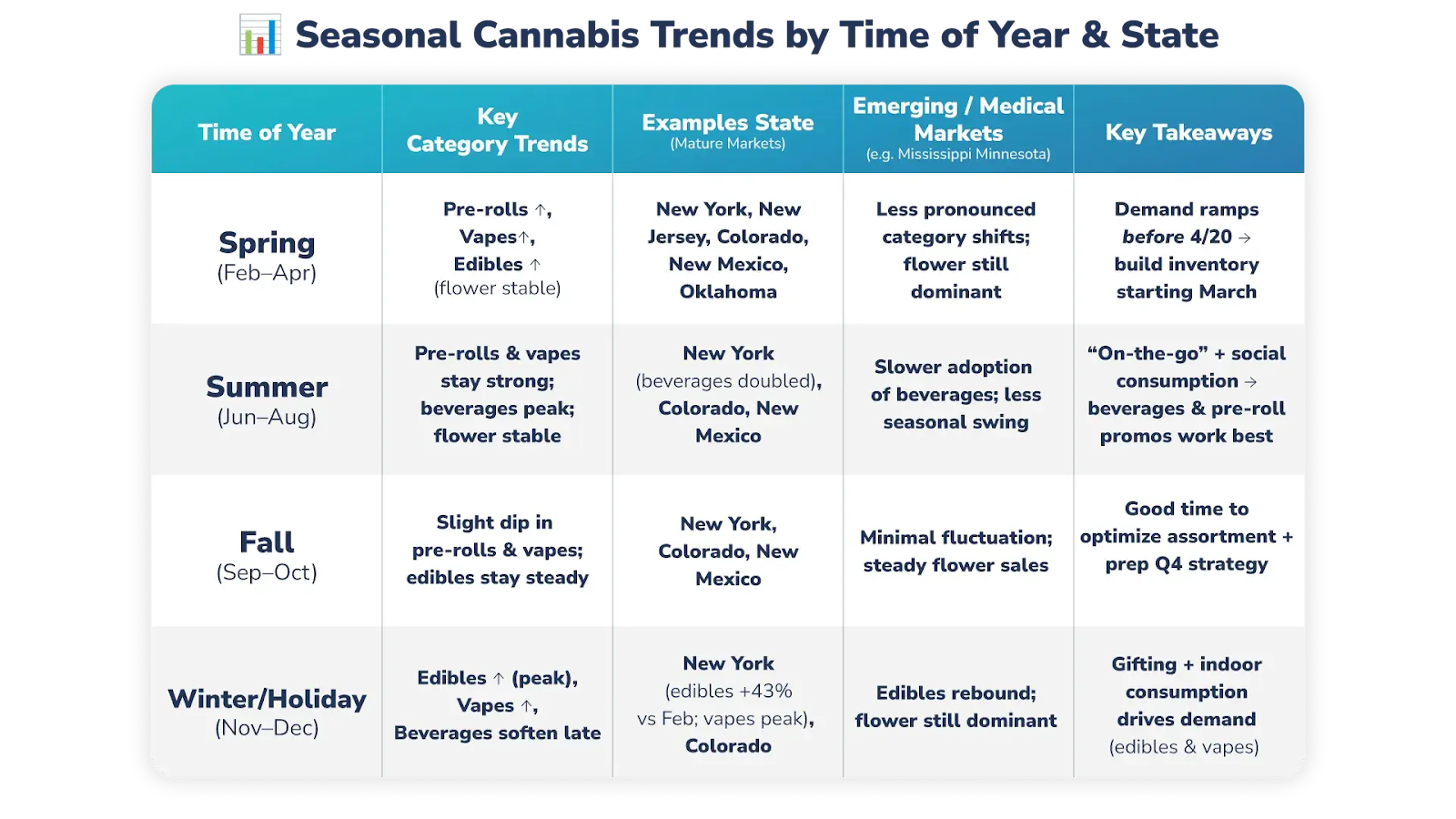
The 2025 data show a clear pre-spring ramp in most tracked cannabis markets. In states including New York, New Jersey, New Mexico, Colorado, and Oklahoma, pre-roll, vape, and edible sales climb from February into April, even when flower volume stays relatively flat.
New York illustrates the pattern clearly. Pre-roll sales grew 34% from roughly $7.1 million in February to $9.5 million in April. Edibles followed a similar arc, rising 7% from $6.8 million to $7.3 million over the same time period. Vapes grew from $5.6 million to $6.3 million, a 13% increase.
This pattern illustrates why 4/20 should be treated as a multi-week promotional window rather than a single promotional day. The implication for 2026: cannabis inventory depth in pre-rolls, vapes, and edibles should be built starting in March, not the week before April 20.
Summer
June through August 2025 showed consistent strength in categories associated with on-the-go and social consumption. Pre-rolls and vapes held elevated volumes across most markets through the summer months. Cannabis beverages, while a small overall share, saw some of their highest monthly dollar volumes of the year in summer in states like New York, Colorado, New Mexico, and Oklahoma.
New York's beverage category climbed from $341K in February to a peak of $708K in July – more than double – before gradually softening through the fall. Colorado showed a similar, if smaller, beverage lift through summer. While these numbers are modest in absolute terms, the relative seasonal swing makes beverages a category worth building promotional stories around during summer months. Think framing around outdoor occasions and lower-dose options.
Flower, by contrast, remained relatively stable through summer in most markets.
Fall
September and October show a natural demand softening in several markets as summer social occasions wind down. Cannabis pre-roll and vape volumes eased from their summer peaks in states like New Mexico, Colorado, and New York, though they held above their February starting points in most cases.
Edibles showed more resilience through fall than pre-rolls or beverages. In several markets, edible sales remained near their summer-peak levels into October. This supports positioning edibles as a staple rather than a seasonal spike category – they don't require aggressive promotional investment, but they do reward consistent shelf depth and staff familiarity.
This is also a useful window for assortment review. Dispensaries can use fall's relatively quieter pace to analyze what moved during spring and summer and refine their Q4 plan accordingly.
Winter and Holiday Season
The November-December window shows a second demand wave in several cannabis product categories. Edibles in particular rebounded into Q4 across multiple markets. Across retailers we track in New York, the edible category rose to $9.1 million in August, softened 7% to $8.5 million in September, then climbed back to $9.1 million in October and $9.8 million in December, its highest month of the year and 43% above its February starting point. Mississippi's edible sales followed a similar Q4 recovery, reaching $3.3 million in December, up 14% from a July peak.
Vapes also held strong or grew into December in several markets. New York's vape category hit $9.1 million in December, up 63% from $5.6 million in February and its highest monthly figure of the year. This Q4 vape strength, combined with edibles, points toward gifting, indoor consumption, and discreet use patterns driving the year-end lift.
Cannabis beverages held up through November in states like Colorado and New York before softening into December, suggesting a holiday hosting occasion that retailers can build specific promotional messaging around earlier in Q4 rather than waiting for the final weeks.
Which Cannabis Product Categories Were Most Seasonal in 2025?
Based on the 2025 data, here is how the major cannabis product categories rank by seasonal variability in the U.S.:
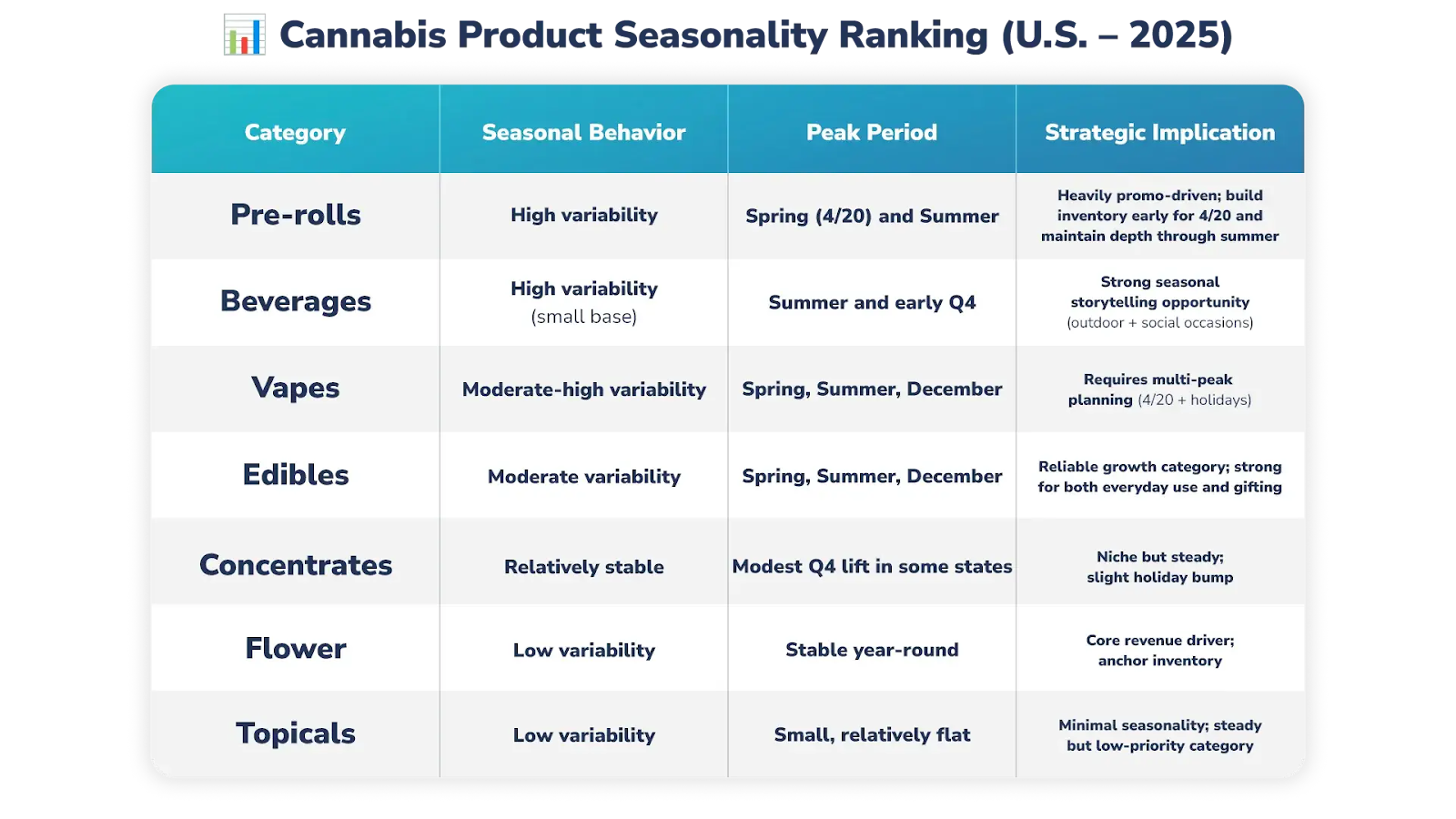
Flower's stability is the clearest pattern in the data. Across markets and months, flower consistently represents the largest revenue share with the smallest intra-year swings. It is the inventory anchor. The categories that require more active seasonal forecasting – and where mis-buys hurt most – are pre-rolls, vapes, edibles, and beverages.
State-by-State Differences in Seasonal Cannabis Sales
The same seasonal themes play out differently depending on market maturity. Two contrasts stand out clearly in the 2025 data.
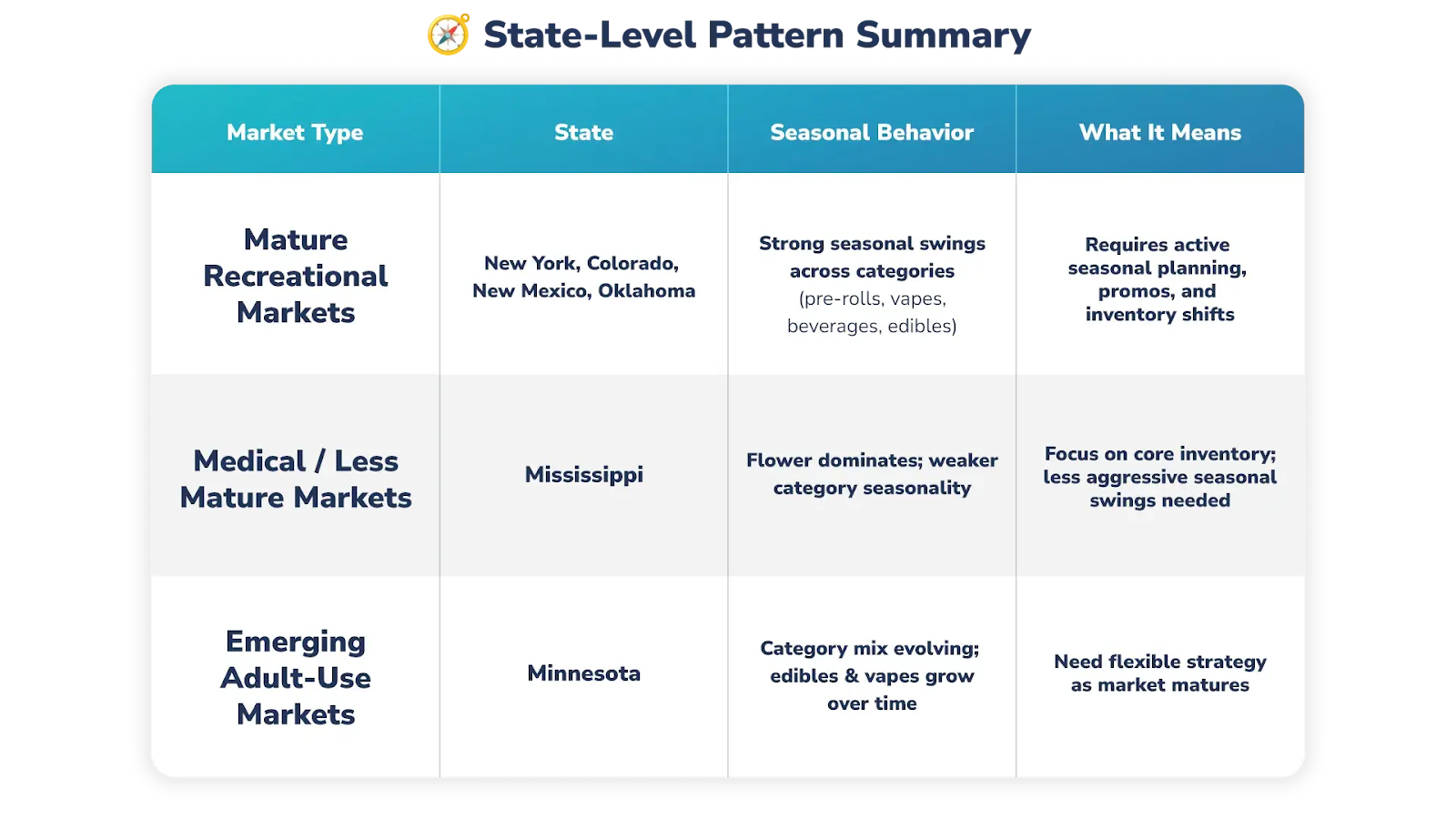
Mature recreational cannabis markets like Colorado, New Mexico, New York, and Oklahoma show the most pronounced category cycling. Vapes and pre-rolls move meaningfully with the calendar. Beverages spike visibly in summer. Edibles recover into Q4. These markets reward active seasonal planning.
Newer and medical-dominant markets like Mississippi show a different profile. Flower dominates at a much higher share of total dispensary sales, and the category cycling seen in mature rec states is less pronounced. Mississippi's flower sales ranged from approximately $23 million in February to $29 million in December, a 27% increase across the year. Vapes and pre-rolls exist and grow, but they don't cycle as dramatically as in states like New York or Colorado.
Minnesota presents an interesting emerging-market case. The state's cannabis category mix shifted noticeably through 2025 as its market developed, with edibles and vapes gaining traction later in the year as legal infrastructure expanded.
For multi-location operators, this means a single seasonal plan across all stores may underserve some markets and overcommit others. Our cannabis dispensary marketing guide outlines how to build location-specific promotional strategies that account for market-level differences.
What These Cannabis Product Trends Mean for Dispensaries in 2026
The 2025 data point toward a few clear cannabis retail planning principles:
Anchor forecasts on flower, build seasonal curves for everything else. Flower inventory should be planned for consistent depth year-round. Pre-rolls, vapes, edibles, and beverages need seasonal overlays – building depth before known peaks and managing down between them.
Treat the 4/20 window as a multi-week event. The spring ramp in pre-rolls, vapes, and edibles starts in March across most tracked markets. Cannabis inventory commitments and promotional planning should match that lead time.
Use summer to lead with portable cannabis formats. Pre-roll multi-packs, disposable vapes, and beverages are the categories with the clearest summer seasonal lift. Merchandise them prominently from June through August and build promotional storytelling around outdoor and social occasions.
Build Q4 depth in edibles and vapes. The December recovery in edibles and vapes is visible across enough markets to treat it as a planning signal, not an anomaly. Start building Q4 depth in October and develop holiday-occasion messaging for these categories specifically.
Adjust by market, not just by calendar. If you operate in both mature rec markets and newer or medical-dominant ones, your seasonal plans should differ. A Beverly Hills and a rural Mississippi dispensary should not be stocking the same seasonal assortment on the same timeline.
Dispensaries that use their cannabis POS data to track these patterns at the SKU level and build purchasing and promotional cycles around them are better positioned than those planning from annual averages alone.
FAQ
What are the peak sales seasons for the cannabis industry?
Peak periods vary by market and cannabis product category. Based on 2025 state-level data, spring and summer produce meaningful demand lifts for inhalable and portable categories. November and December generate a second wave for edibles and vapes, driven by holiday gifting and indoor consumption occasions. Flower, the largest single category, is relatively stable year-round rather than peaking sharply in any single season.
Which cannabis product categories are most seasonal?
Pre-rolls and beverages show the largest intra-year swings relative to their base. Vapes and edibles are moderately seasonal, with meaningful peaks in spring and Q4. Flower is the least seasonal category – it's the stable revenue baseline in virtually every cannabis market analyzed in the 2025 data.
Do edibles and flower follow the same seasonal sales trends?
No. Flower remains relatively flat across the year in most cannabis markets, with modest variation. Edibles show more movement; they build through spring and summer, soften slightly in early fall, and recover into Q4 across several large markets. The two categories behave quite differently, which matters for inventory planning.
Are cannabis beverage sales higher in summer?
In several key markets, yes. The 2025 data show cannabis beverage sales reaching some of their highest monthly levels in June through August in states including New York, Colorado, and New Mexico. The category is small in absolute terms but shows one of the largest relative seasonal swings of any cannabis product category tracked.
How should dispensaries prepare for seasonal demand changes?
Start with your historical sales data to identify when each category peaks, then build inventory depth three to four weeks ahead of those windows. Align promotions and merchandising rotations to category peaks rather than reacting after the fact. Multi-location operators should plan by market, not by a single national calendar. Cova's inventory management tools give dispensaries the category-level visibility to make these calls with data, not guesswork.
Plan for Seasonality, Not Just Popularity
Annual cannabis category rankings are a useful starting point, but they're a blunt instrument for retail planning. Knowing that pre-rolls are popular tells you to stock them; knowing that pre-roll demand builds through March and April, peaks around 4/20, holds through summer, and then eases into fall tells you how to stock them – and when to invest in promotions, rotate your merchandising, and bring staff up to speed on what's moving.
The 2025 data show consistent seasonal patterns across enough markets to treat them as reliable planning intel. Flower is stable. Pre-rolls, vapes, edibles, and beverages move with the calendar. State context shapes how pronounced those movements are. And the dispensaries that build their 2026 planning around those patterns – rather than against annual averages – will be better positioned to capture peaks and manage through the quieter stretches between them.
Cova's POS platform gives cannabis dispensaries the sales visibility, inventory reporting, and operational tools to respond faster to category-level demand shifts. Book a demo today to see how your dispensary can use real-time data to make smarter seasonal decisions.